On this page
How to identify it
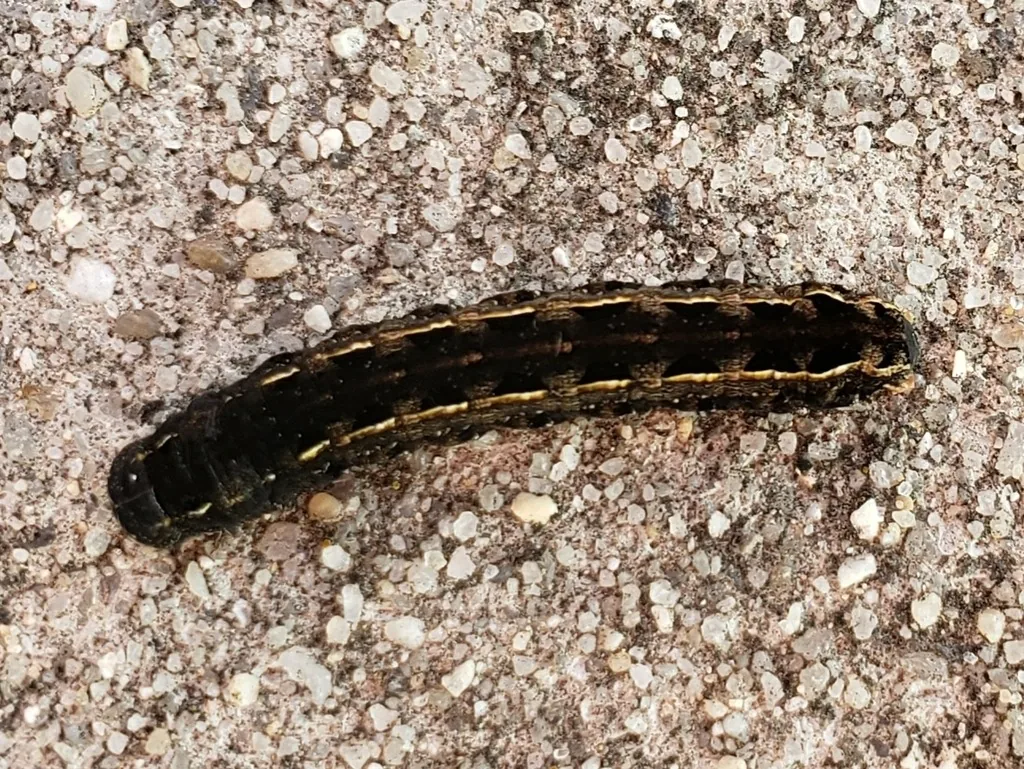
- Caterpillars are smooth, pale gray to jet black, with a yellowish-orange stripe along each side and a pair of black triangular spots on top of most segments. NC State gives up to 1 3/4 inches for the last stage; Kansas State says older caterpillars reach 1.5 to 2 inches.[1][3][5]
- The head is brown with black markings and a pale inverted V.[3][2][4]
- Moths have dark, mottled gray-brown forewings with light markings and a tan to brown diagonal band near the center; the hind wings are white or pale with a narrow dark edge. Wingspans reach about 1 1/2 inches.[1][3][2]
- The pupa is reddish-brown, cylindrical and about 5/8 inch long, found in the soil.[1]
Look-alikes
| Look-alike | How to tell them apart |
|---|---|
| Fall armyworm | Chews tomato leaves and fruit the same way, but a mature fall armyworm has white stripes along the body, four dark spots on each abdominal segment and a white inverted Y on the head, instead of paired black triangles and a faint V.[4] |
Where it lives
Found from New York south into Mexico and west to the Rocky Mountains, plus parts of California and the West Indies. It is more prevalent in the East and most common and injurious in the southern states. A 2019 study found the South American Spodoptera marima to be the same species, a new synonym.[2][4][7]
Biology and life cycle
It overwinters as pupae in the soil. Moths emerge in April and May, and in northern and midwestern states the caterpillars may not appear before July.[1][3][5][2]
Females lay egg masses on foliage, trees or even buildings and cover them with scales from the body. NC State says a female can lay up to 3,000 eggs, as many as 500 in one mass; Kansas State says more than 2,000, in clusters of 200 to 500.[1][3]
Eggs hatch in about six days. The young caterpillars feed in groups, then split up as they grow, feeding by day for about three weeks before burrowing into the soil to pupate.[1][6]
A generation takes about 40 days, with three to four a year in North Carolina and Missouri. Kansas State gives 30 to 90 days from egg to adult, depending on temperature.[1][5][3]
Damage and signs
- Hosts include alfalfa, asparagus, bean, beet, cabbage, carrot, corn, cotton, cucumber, lettuce, onion, pea, peanut, potato, sweet potato, tobacco, tomato, turnip, watermelon, wheat and weeds such as wild onion and morning glory.[1][2][4]
- Caterpillars eat tomato leaves and tunnel into tomato and pepper fruit, leaving droppings on the upper leaf surfaces. Kansas State reports it in hoop houses and greenhouses.[3][4]
- In cotton it is mainly an early-season pest that can destroy young plants, and later it can damage squares and bolls.[5]
Health risk
It feeds on plants; none of the sources describes any harm to people or pets.[1][3]
Control
Prevention
Caterpillars can move into vegetables from freshly mowed alfalfa, so site gardens away from alfalfa fields; a trench around the planting can also help where they are common.[4]
Traps and physical control
Scout the leaves regularly and handpick larger caterpillars into soapy water: big larvae are harder to kill with sprays and may already be inside the fruit.[3][2]
Biological control
Parasitic wasps and flies, diseases and predators help keep it in check. NC State adds that it is probably not resistant to pesticides, because it feeds on so many plants that are never sprayed.[1][4][5]
Pesticides
Bacillus thuringiensis (Bt) works best on very young caterpillars, and Kansas State also lists spinosad. Both have to be eaten, so cover upper and lower leaf surfaces and treat before the larvae tunnel into fruit. Follow the label.[1][3]
Where sources disagree
Winter survival: NC State, Kansas State and the University of Missouri say it overwinters as pupae in the soil; Penn State says none of its stages can survive a Pennsylvania winter, which is why it is only an occasional pest in the Northeast.[1][3][5][4]
Common questions
- What's the striped caterpillar eating my tomatoes?
- Possibly the yellowstriped armyworm: look for paired black triangles on the back and a yellow-orange stripe along each side. It eats the leaves and tunnels into the fruit.[3][1][4]
- Does Bt work on armyworms?
- Yes, while the caterpillars are small. Large larvae are much harder to kill and may need to be handpicked.[1][3]
Sources
- NC State Extension, “Yellowstriped Armyworm in the Landscape.” content.ces.ncsu.edu/yellowstriped-armyworm (accessed 2026-11-11)
- NC State Extension, “Insect and Related Pests of Vegetables: Pests of Sweetpotato.” content.ces.ncsu.edu/pests-of-sweetpotato (accessed 2026-11-11)
- Kansas State University Research and Extension, “Yellowstriped Armyworm on Tomatoes and Peppers (MF3250).” bookstore.ksre.ksu.edu/pubs/yellowstriped-armyworm-on-tomatoes-and-peppers_MF3250.pdf (accessed 2026-11-11)
- Penn State Extension, “Yellowstriped Armyworm on Tomatoes.” extension.psu.edu/yellowstriped-armyworm-on-tomatoes (accessed 2026-11-11)
- University of Missouri Extension, “Managing the Armyworm Complex in Missouri Field Crops (G7115).” extension.missouri.edu/publications/g7115 (accessed 2026-11-11)
- University of California Statewide IPM Program, “Armyworms (Home and Landscape).” ipm.ucanr.edu/home-and-landscape/armyworms/ (accessed 2026-11-11)
- Neotropical Entomology, via PubMed, “Spodoptera marima: a New Synonym of Spodoptera ornithogalli (Brito et al. 2019).” pubmed.ncbi.nlm.nih.gov/30515720/ (accessed 2026-11-11)
- iNaturalist, “Spodoptera ornithogalli taxon page (order and family).” www.inaturalist.org/taxa/118930 (accessed 2026-11-11)