On this page
How to identify it
- Larvae are light green to nearly black, with many fine, wavy pale lines down the back and a broader stripe along each side. Most have a dark spot on each side just above the second pair of true legs, but UC IPM notes the spot is missing in part of some populations. UF/IFAS says first- and second-stage larvae are pale green or yellow, pale stripes appear in the third stage, and full-grown larvae vary a lot, tending to be green above with pink or yellow below and a white side stripe; some are very dark, even black. The spiracles (breathing pores) are white with a narrow black border.[1][2][4]
- The body looks smooth and hairless, and full-grown larvae are about 1-1/4 inches long. UF/IFAS says the body is practically free of hairs and spines and there are normally five larval stages.[3][1][4]
- Eggs are laid in clusters covered with hair-like, cottony white scales from the female moth. UF/IFAS says masses hold 50 to 150 greenish to white eggs, usually on the underside of leaves and often near blossoms and branch tips.[1][2][3][4]
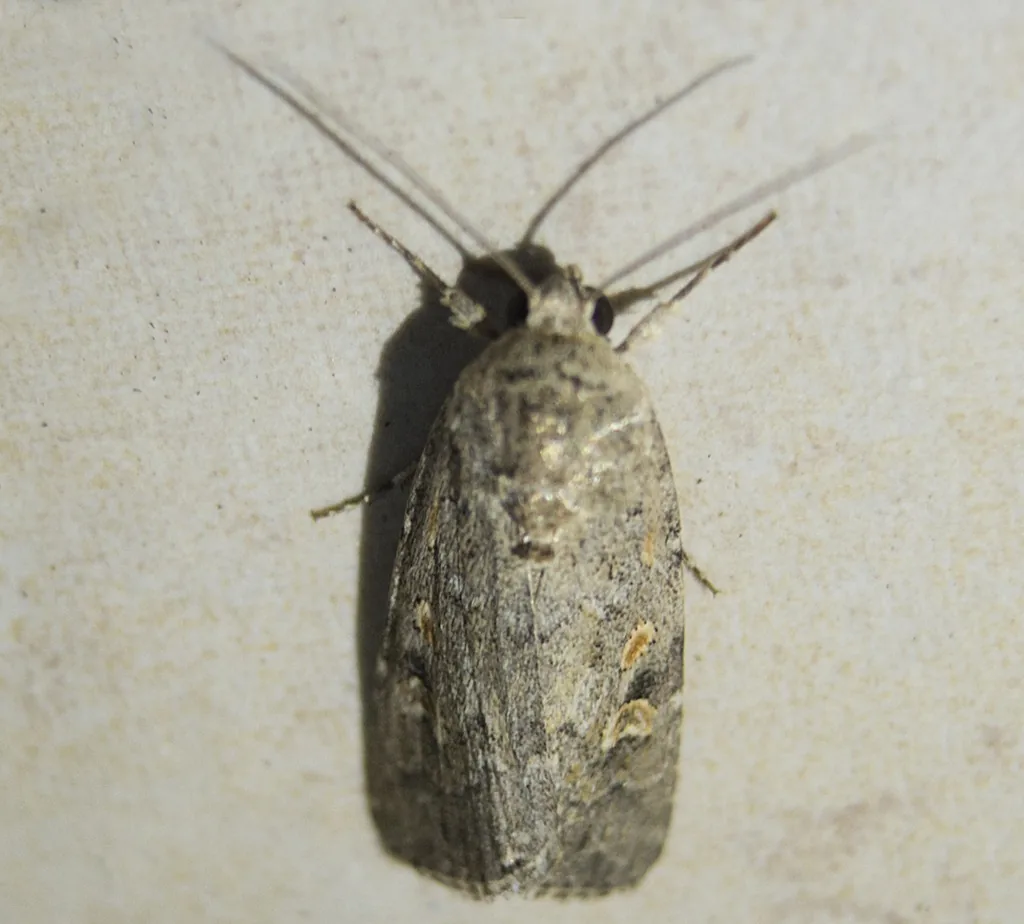
- The moth is mottled gray and brown, with a wingspan of about 1 inch. UF/IFAS gives a wingspan of 25 to 30 mm (about 1 to 1-1/8 inches), forewings with an irregular banding pattern and a light bean-shaped spot, and gray or white hind wings trimmed with a dark line at the edge.[2][3][4]
- Pupae are light brown and about 15 to 20 mm (about 5/8 to 3/4 inch) long, according to UF/IFAS.[4]
Look-alikes
| Look-alike | How to tell them apart |
|---|---|
| Southern armyworm | UF/IFAS says the two are easily confused in the southern states, but southern armyworm has a large dark spot on the side of the first abdominal segment that breaks the side stripe. When beet armyworm has a side spot, it sits on the thorax instead.[4] |
Where it lives
A major pest in the southwestern and southern United States and widespread in California, where it turns up in tomato fields every year. It migrates north in summer and occasionally invades vegetable crops in Kentucky, where it cannot overwinter. UF/IFAS says it was first found in North America about 1876 in Oregon and reached Florida in 1924. It rarely survives winter where frost kills its host plants, so overwintering is generally limited to Arizona, Florida and Texas, yet it invades the southern half of the country (Maryland to Colorado to northern California, and south) every year. Outside greenhouses it is rarely a pest except in southern states.[1][2][5][4]
Biology and life cycle
Eggs hatch in 2 to 3 days. Many small larvae die while wandering away from the egg mass, but the wandering spreads the infestation, and one larva may attack several plants in a row.[1]
Full-grown larvae pupate in the soil in a loose cocoon of soil particles and leaf bits, or in a small pocket just below the surface. UF/IFAS says the chamber is built from sand and soil particles held together with an oral secretion that hardens as it dries, and the pupal stage lasts six to seven days in warm weather.[1][2][4]
The life cycle takes about a month in warm weather, with three to five generations a year in California. In warm places such as Florida, UF/IFAS says all stages can be found year round, though development slows and numbers drop in winter; the life cycle can take as few as 24 days, and six generations have been reared during five months of Florida summer.[1][2][3][4]
It is migratory. In 2024, stable-isotope analysis of moths in the Florida Panhandle showed most had come from South Florida, the Caribbean or the central and southern United States, and larvae turned up in peanut fields there only in July and August.[5]
Moths mate soon after emerging and start laying eggs within two to three days. UF/IFAS says egg laying stretches over three to seven days, and moths usually die within nine to 10 days of emerging.[4]
Damage and signs
- Hosts include alfalfa, beans, beets, cole crops, corn, cotton, lettuce, onion, peppers, potatoes, peas and tomatoes. UF/IFAS adds asparagus, broccoli, celery, chickpea, eggplant, radish, spinach, sweet potato and turnip among vegetables; peanut, safflower, sorghum, soybean, sugarbeet and tobacco among field crops; and weeds such as lambsquarters, pigweed and purslane. In one study it cites, larvae grew best and matured fastest on pigweed, and cabbage was the poorest host.[1][4]
- Feeding on young growth can be very damaging to small transplants, often with fine webbing near the feeding sites, and older plants can be defoliated quickly. In Florida UF/IFAS calls it a serious defoliator of flower crops and cotton, but says much of that injury is induced by insecticide use that interferes with natural enemies. Young larvae feed in groups and skeletonize leaves; older larvae feed alone and eat large irregular holes.[1][4]
- On tomato it chews round or irregular holes in leaves and fruit; holes make fresh fruit unmarketable and let rot organisms in. In lettuce it feeds in the crown of seedlings and later bores into heads from below, where the damage can't be seen. UF/IFAS says larvae also burrow into the buds of cabbage-family crops, that tomato fruit is most at risk near maturity, and that early infestations in tomato do more harm than later ones.[2][3][4]
Health risk
It feeds on plants; none of the sources describes any harm to people.[1][2]
Control
Prevention
In Kentucky, watch fall plantings of beans, tomatoes and cabbage-family crops during August and September. Check for egg masses and young larvae, including on weeds near seedlings.[1][3]
UF/IFAS says pheromone traps can show when moths are present, and crops should be checked regularly, probably about twice a week, because moths often move in from nearby crops or weeds.[4]
Pheromones can also be used to disrupt mating; UF/IFAS cites an estimate that saturating the air around susceptible crops reduces mating by 97%.[4]
Sanitation
In fields, UC IPM advises disking right after harvest to kill larvae and pupae and destroying weeds along field borders.[3]
Biological control
Most Bacillus thuringiensis (Bt) products used against other caterpillars do not work on beet armyworm; the aizawai strain does. UC IPM lists Bt aizawai and spinosad for organic crops but warns that spinosad harms beneficial syrphid flies and parasitic wasps. Follow the label.[1][2][3]
UF/IFAS says a nuclear polyhedrosis virus from beet armyworm and the fungus Beauveria bassiana work fairly well in greenhouses, where sunlight does not break them down as fast, and insect-killing nematodes work best on larvae that drop to the soil to pupate. Larvae are also susceptible to neem products.[4]
Pesticides
Treat young larvae: once larvae are 1/2 inch or longer they become very hard to kill, and good spray coverage matters.[1]
Insecticide resistance
Kentucky Extension describes beet armyworm as resistant to most insecticides. In Florida Panhandle tests, a field population showed 10,071-fold resistance to bifenthrin (a pyrethroid) and 630-fold resistance to chlorantraniliprole (a diamide), and label-rate concentrations of either killed fewer than 80% of larvae.[1][6]
A follow-up study found the bifenthrin resistance stayed stable for 27 generations without exposure, while chlorantraniliprole resistance faded, falling from 629-fold to 15-fold, apparently because it carries a fitness cost.[7]
UF/IFAS calls insecticide resistance a major problem, possibly because beet armyworm attacks flowers, cotton and vegetables, crops that are sprayed often. It says frequent spraying favors beet armyworm, making it a secondary or induced pest in some crops, and that heavy spraying for it in celery has set off outbreaks of the American serpentine leafminer.[4]
Where sources disagree
Natural enemies: Kentucky Extension says beet armyworm has few parasites or predators that can effectively reduce its numbers. UC IPM says many natural enemies attack it, including the wasps Hyposoter exiguae and Chelonus insularis and a tachinid fly, and that a nucleopolyhedrovirus often reduces populations in fall and winter. UF/IFAS takes a middle view: many native natural enemies have adapted to it, including the wasps Chelonus insularis and Cotesia marginiventris and the tachinid fly Lespesia archippivora, while minute pirate bugs, bigeye bugs, damsel bugs and a predatory stink bug eat eggs and small larvae. But none except the virus is specific to beet armyworm, which may explain why they are not especially effective, and the virus is considered the most important mortality factor.[1][3][2][4]
Egg masses: Kentucky gives masses of up to 80 eggs, and up to 600 eggs per female over 3 to 7 days; UC IPM says a cluster may hold more than 100 eggs but usually fewer. UF/IFAS gives 50 to 150 eggs per mass and normally about 300 to 600 per female.[1][2][4]
Common questions
- What's eating holes in my late-summer vegetables?
- If you find smooth, striped caterpillars with a dark spot above the second pair of legs, and cottony egg masses on the leaves, it may be beet armyworm.[1][2][3]
- Where does it overwinter?
- UF/IFAS says it rarely overwinters where frost kills its host plants, so overwintering is generally limited to Arizona, Florida and Texas, and it reinvades the southern half of the country each year. Kentucky Extension says it can't overwinter in Kentucky and is killed by the first hard frosts; moths reaching the Florida Panhandle in 2024 came mostly from South Florida, the Caribbean or the central and southern United States.[4][1][5]
- How do I tell beet armyworm from southern armyworm?
- Look at the side of the body. UF/IFAS says southern armyworm has a large dark spot on the first abdominal segment that breaks the side stripe; a beet armyworm's side spot, when it has one, is on the thorax.[4]
Sources
- University of Kentucky Entomology, “ENTFACT-308: Beet Armyworm in Kentucky.” entomology.mgcafe.uky.edu/ef308 (accessed 2026-11-14)
- University of California Statewide IPM Program, “Tomato Pest Management Guidelines: Beet Armyworm.” ipm.ucanr.edu/agriculture/tomato/beet-armyworm/ (accessed 2026-11-14)
- University of California Statewide IPM Program, “Lettuce Pest Management Guidelines: Beet Armyworm.” ipm.ucanr.edu/agriculture/lettuce/beet-armyworm/ (accessed 2026-11-14)
- University of Florida/IFAS Extension (Featured Creatures), “Beet Armyworm, Spodoptera exigua (Hübner), EENY105/IN262 (Featured Creatures).” ask.ifas.ufl.edu/publication/IN262 (accessed 2026-11-14)
- Insects, via PubMed, “Dispersal Ecology of the Beet Armyworm in the Florida Panhandle: Implications for Outbreaks and Insecticide Resistance Spread (Calixto et al. 2025).” pubmed.ncbi.nlm.nih.gov/41302877/ (accessed 2026-11-14)
- Pest Management Science, via PubMed, “Contrasting susceptibility of lepidopteran pests to diamide and pyrethroid insecticides in a region of overwintering and migratory intersection (Rabelo et al. 2020).” pubmed.ncbi.nlm.nih.gov/32614113/ (accessed 2026-11-14)
- Insects, via PubMed, “Spodoptera exigua fitness and resistance stability to diamide and pyrethroid insecticides in the United States (Rabelo et al. 2022).” pubmed.ncbi.nlm.nih.gov/35447807/ (accessed 2026-11-14)
- iNaturalist, “Spodoptera exigua taxon page (order and family).” www.inaturalist.org/taxa/231425 (accessed 2026-11-14)