On this page
How to identify it
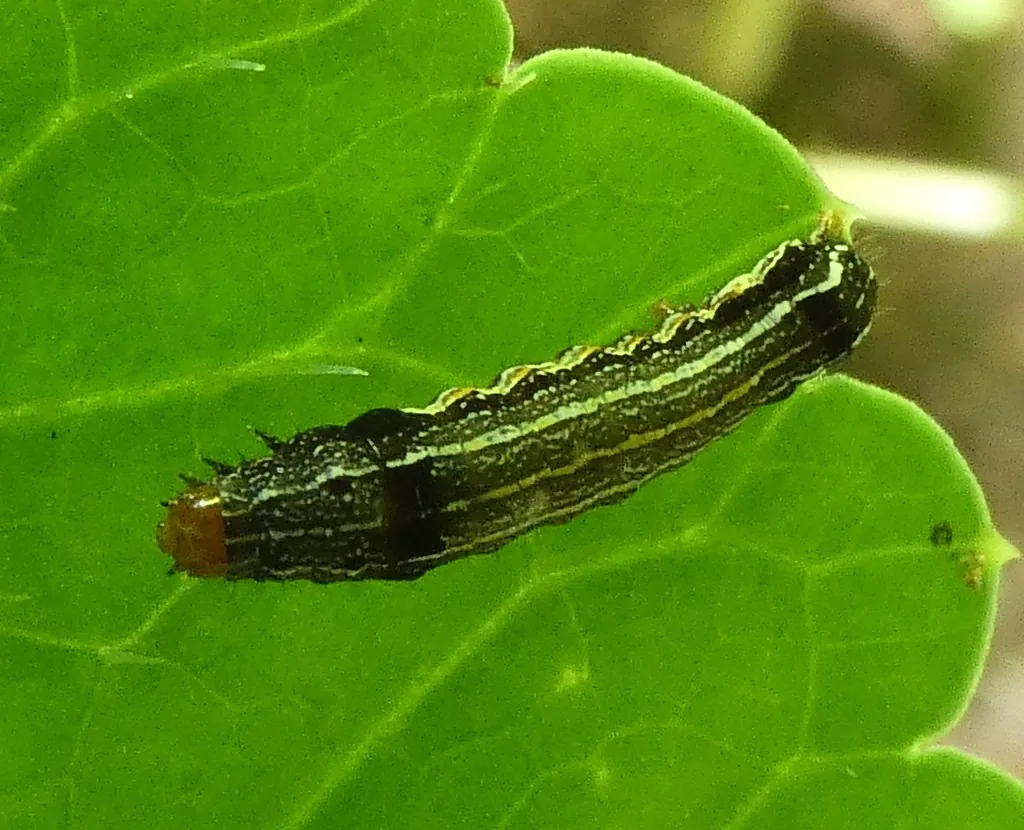
- Full-grown caterpillars are about 1 3/8 inches long (35 to 40 mm) and variable in color: gray, nearly black, greenish-gray or brown, sometimes with a green or pink tint. UF/IFAS gives six larval stages reaching about 35 mm (1 1/3 inches), green or blackish green, with a narrow white line down the back of larger larvae.[5][1][2][4]
- Look for a row of paired black triangular spots down the back and light side stripes tinged with orange or pink. EPPO notes a dark spot on the first abdominal segment that breaks the yellowish side line. UF/IFAS describes a broad yellowish or whitish side stripe interrupted by a dark spot on the first abdominal segment, sometimes weak, and a series of dark triangles along the body.[5][1][2][4]
- NC State describes the head as pale yellow with bright reddish-brown markings; EPPO describes older larvae with a reddish-brown head capsule with a Y-shaped mark.[5][1]
- Moths have pale yellowish to dark brown or gray forewings with a darker streak, a wingspan of about 13/16 to 1 3/8 inches, and white hind wings. UF/IFAS gives a wingspan of 33 to 38 mm (1 1/3 to 1 1/2 inches) and calls the wing pattern highly variable: some moths have a bean-shaped spot near the center of the forewing, others a broad black band to the margin; in males the spot is usually a dark streak, and the hind wings are opalescent white.[5][2][1][4]
- Eggs are flattened spheres about 0.45 mm (0.018 inch) across, greenish at first and turning tan, laid in clusters covered with scales. Pupae are mahogany brown and about 16 to 18 mm (0.63 to 0.71 inch) long.[4]
Look-alikes
| Look-alike | How to tell them apart |
|---|---|
| Yellowstriped armyworm | Also has paired triangular spots on the back, but its side stripes are yellow or yellow-orange and its brown head has a white inverted V.[5] |
Where it lives
Native to tropical and subtropical America. In the US it is common in the Southeast and lives year-round in Florida, California and New Mexico; moths move north each year as far as Tennessee and Virginia, and it has been found as far north as Kansas and northern Arkansas. Introduced to West and Central Africa (2016) and recorded in India (2019). UF/IFAS says it is found mainly in the southeastern states, west to Kansas and New Mexico, and is reported from California but is of no consequence there.[2][5][1][3][4]
Biology and life cycle
Females lay hundreds of eggs in masses on leaves, covered with scales from their bodies so the masses look fuzzy. Eggs hatch in 4 to 6 days (NC State) or 4 to 8 days (EPPO). UF/IFAS also gives four to six days for the egg stage.[5][1][4]
Larvae feed for about two and a half weeks through six (rarely seven) stages, then pupate in the soil 2 to 4 inches deep; moths emerge 9 to 13 days later. In summer, egg to adult takes about five weeks. UF/IFAS gives 14 to 20 days for the larval stage, pupation 5 to 10 cm (2 to 4 inches) deep in the soil and 11 to 13 days as a pupa.[5][1][2][4]
It does not go dormant, so where it's warm it breeds all year. NC State counts as many as five generations a year in Florida but only two or three in North Carolina; Arkansas gives four to five in warm climates. UF/IFAS estimates four generations a year in Florida at 30 to 40 days each; in northern Florida moths are found all year and can survive several days of freezing weather, but larvae turn up only in summer.[1][5][2][4]
Very broad diet: one Brazilian study lists 202 wild and crop host plants in 58 families. Pigweed (spiny amaranth) and pokeweed are favorites, and infestations can start on these weeds and spread to nearby crops. UF/IFAS adds that grasses are rarely eaten.[6][5][2][4]
Damage and signs
- Vegetable hosts include tomato, sweetpotato, potato, pepper, eggplant, beet, cabbage, collard, carrot, celery, okra, cowpea and corn; EPPO lists cotton, soybean, cassava and many ornamentals and cut flowers as well. UF/IFAS adds avocado, citrus, peanut, sunflower, velvet bean, tobacco and various flowers.[5][1][4]
- Young larvae skeletonize leaves, sometimes to full defoliation. Large larvae bore into tomatoes and cotton bolls and, when leaves run short, chew tender stems, branch tips and tubers near the soil surface. UF/IFAS says older larvae become solitary and bore readily into fruit, often damaging tomato in Florida.[1][5][3][4]
- It is usually a minor pest. Arkansas reports little impact there, and NC State says it is only an occasional problem in North Carolina.[1][2][5]
Health risk
It feeds on plants; none of the sources describes any harm to people or pets.[5][1]
Control
Prevention
Look for clusters of small caterpillars and skeletonized leaves; young larvae feed together in the open and are easy to spot. Weedy pigweed and pokeweed next to a garden are worth checking first.[1][2][5]
Biological control
Parasitic wasps and tachinid flies help keep it in check. Egg parasitoids such as Telenomus remus and the predatory stink bug Podisus nigrispinus show promise in studies. Larvae are susceptible to some Bt strains but highly tolerant of others, and the fungus Beauveria bassiana was somewhat effective in cabbage. UF/IFAS names braconid wasps such as Cotesia marginiventris, Chelonus insularis and Meteorus autographae, which was the dominant parasitoid in a Florida study, along with several tachinid flies, and says larvae are susceptible to the fungus Beauveria bassiana.[1][4]
Pesticides
Control is only occasionally needed. NC State says it rarely reaches numbers that warrant spraying in North Carolina. Where it does, conventional insecticides usually work and no strong resistance is known; neem products gave up to 20 percent larval mortality in one study. Follow the label. UF/IFAS says it is best controlled with foliar insecticides while larvae are small, that insecticides vary a lot in how well they work, and that larvae are difficult to control with botanical insecticides.[1][5][4]
Spreading beyond the Americas
Native to tropical America, it was found in Nigeria in 2016 on cassava and then in Benin, Cameroon and Gabon, and on soybean in India in 2019. The EU regulates it as a quarantine pest; adults have been intercepted there as hitchhikers.[1][3][7]
A climate model suggests suitable areas will expand and shift to higher latitudes as the climate warms.[7]
Where sources disagree
Night or day: EPPO says older larvae hide in leaf litter or foliage by day and feed at night. NC State says they feed freely in the daytime but gather around the bases of plants in the heat, and are on the foliage mornings, evenings and on cloudy days. UF/IFAS says larvae usually sit on the undersides of leaves and are most active at night.[1][5][4]
Larval head color: NC State describes a pale yellow head with reddish-brown markings and EPPO a reddish-brown head with a Y-shaped mark, while UF/IFAS says the head stays uniformly light brown or reddish-brown throughout development.[5][1][4]
Generations in Florida: NC State counts as many as five a year, while UF/IFAS estimates four.[5][4]
Pupal period: NC State says moths emerge 9 to 13 days after pupation, while UF/IFAS gives 11 to 13 days.[5][4]
Common questions
- What's boring into my tomatoes in Florida?
- Southern armyworm is one possibility: large larvae are known to bore into tomato fruit. Look for caterpillars with paired black triangles down the back.[1][2][5]
- When should armyworms be treated?
- Usually it doesn't need treating; it is a minor pest most years. Check plants for young larvae, which feed in groups and are easy to see, and treat only if damage builds.[1][5]
- Where do southern armyworms start in a garden?
- UF/IFAS says pigweed and pokeweed are favored, and many infestations begin on those weeds, with nearby crops damaged only after the weeds are eaten. Checking weedy edges first can catch them early.[4]
Sources
- European and Mediterranean Plant Protection Organization (EPPO Global Database), “Spodoptera eridania (PRODER) datasheet.” gd.eppo.int/taxon/PRODER/datasheet (accessed 2026-11-14)
- University of Arkansas Arthropod Museum, “Southern armyworm (Spodoptera eridania).” arthropod.uark.edu/southern-armyworm/ (accessed 2026-11-14)
- EFSA Journal, via PubMed, “Pest categorisation of Spodoptera eridania (EFSA Panel on Plant Health, 2020).” pubmed.ncbi.nlm.nih.gov/32626486/ (accessed 2026-11-14)
- University of Florida/IFAS Extension (Featured Creatures), “Southern Armyworm, Spodoptera eridania (Stoll), EENY-106/IN263.” ask.ifas.ufl.edu/publication/IN263 (accessed 2026-11-14)
- NC State Extension, “Pests of Sweetpotato (Insect and Related Pests of Vegetables): Southern Armyworm.” content.ces.ncsu.edu/insect-and-related-pests-of-vegetables/pests-of-sweetpotato (accessed 2026-11-14)
- Journal of Insect Science, via PubMed, “Immature stages of Spodoptera eridania: developmental parameters and host plants (Montezano et al. 2014).” pubmed.ncbi.nlm.nih.gov/25525103/ (accessed 2026-11-14)
- Biology (Basel), via PubMed, “Global Potential Geographical Distribution of the Southern Armyworm (Spodoptera eridania) under Climate Change (Zhang et al. 2023).” pubmed.ncbi.nlm.nih.gov/37508469/ (accessed 2026-11-14)
- iNaturalist, “Spodoptera eridania taxon page (order and family).” www.inaturalist.org/taxa/231424 (accessed 2026-11-14)