On this page
How to identify it
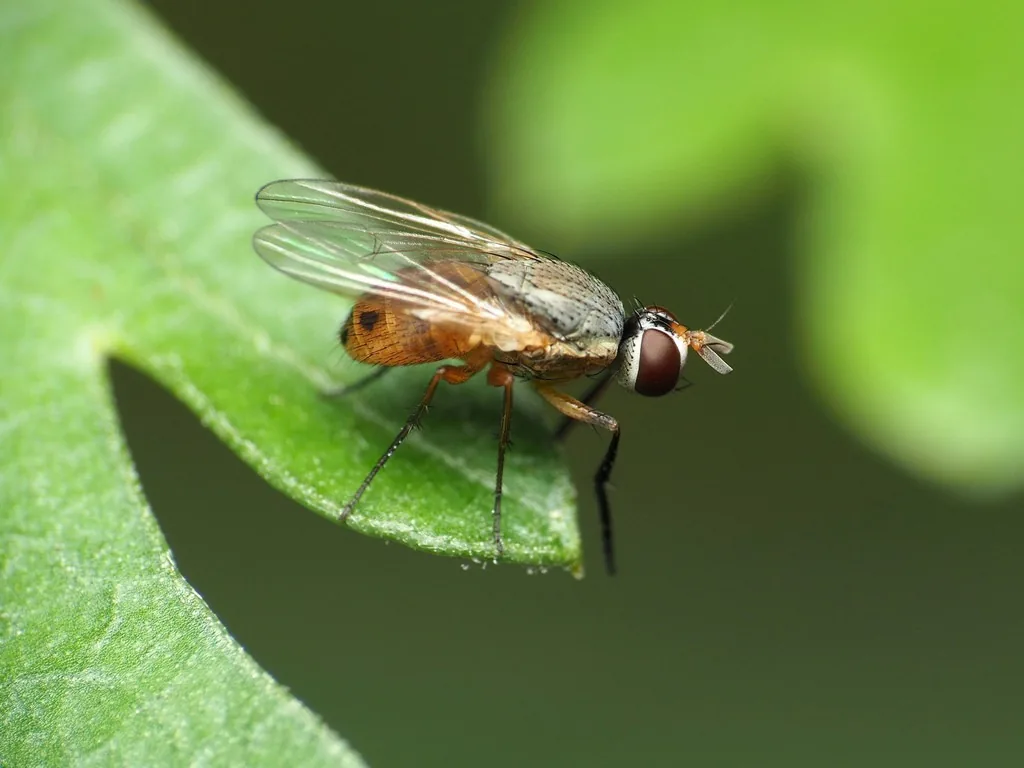
- Adult flies are about 1/8 inch long, about the size of horn flies, with clear wings, a gray thorax and a yellow abdomen bearing at least one pair of black spots; UGA calls the coloring distinct.[2][1]
- Larvae are legless, white, cylindrical maggots about 1/8 inch long when grown, occasionally found inside damaged stems.[2][1]
- Damage shows as yellowing confined to the top two to three leaves of a stem; the damaged leaves pull easily out of the sheath and may show feeding and decay at the base. Heavily infested fields look bronzed from a distance.[2][1]
Where it lives
UGA says it was first reported in the continental US in California in 2009 and in Georgia in 2010, while Mississippi State says it was first found in Georgia in 2010. It reached Mississippi in mid-summer 2012 and by the end of that season had spread to hayfields throughout the state, and damaging infestations have occurred across the Southeast. GBIF holds US records since 1990 from 29 states and the District of Columbia, most from California (208), then Texas and Florida.[2][1][4]
Biology and life cycle
Each stem maggot lives up to about 30 days. The egg is laid on the underside of a bermudagrass leaf; the larva moves into the stem for several days, then enters the soil to pupate, and adult flies live 14 to 21 days.[2]
The larva bores into the tip of a shoot and feeds there, near the uppermost node; Texas A&M researchers describe it feeding on the vascular tissue just above the terminal node. That kills the shoot tip and the emerging leaves.[1][2][3]
Several generations overlap in a field, and flies keep arriving from unmowed edges, tree lines and neighboring areas. Where it overwinters isn't known; UGA suggests pupae may survive in the soil or the population may move north each year from more tropical parts of Florida.[2]
Fine-stemmed bermudagrass varieties and well-fertilized, intensively managed fields are most susceptible.[1]
Numbers are usually low in spring and build through the growing season, so damage risk rises with each cutting. Warm, humid weather and undergrazing or delayed harvest favor it; drought, extreme heat, mowing, harvest and heavy grazing set it back.[1][2]
UGA says it reduces forage production only from late July to September, generally the third to fifth harvests of the year; populations build slowly in early summer and reach damaging levels in south Georgia before moving north.[2]
Damage and signs
- Heavy infestations can essentially stop a hayfield from growing, and yield losses across the Southeast have been estimated at 20 to 50 percent. In north-central Texas hayfields, researchers measured a loss of 8.90 pounds of hay per acre for each percent of stems damaged.[1][3]
- Pastures are seldom seriously affected because grazing keeps removing the susceptible shoots. The flies also attack turf bermudagrass in lawns, sports fields and golf courses, but frequent mowing prevents serious damage.[1]
- Producers often mistake the damage for drought stress, nutrient deficiency, leaf spot or senescence.[2]
Health risk
It is a plant-feeding fly that attacks only bermudagrass, and no cited source describes any risk to people or pets.[1][2]
Control
Prevention
Scout with a sweep net around 11 a.m. or as soon as the dew dries, swinging deep into the canopy because the flies rarely rise above 18 inches, and take at least 20 swings per sample. UGA suggests considering control when a sample holds at least 20 flies.[2]
Anything that speeds regrowth helps the stand tolerate the pest. UGA's cultural steps are harvesting routinely based on forage availability, leaving at least 3 inches of stubble, keeping fertility balanced and soil pH near neutral, and controlling other insects and weeds; it says these cannot replace sprays.[2]
Traps and physical control
If a field already has heavy damage, harvest it (a baler generally needs at least 12 inches of standing forage), clip it with a rotary mower, or graze it down, then plan to control the flies in the next regrowth.[1][2]
Pesticides
Only adult flies can be suppressed with insecticides; nothing available reaches the larvae inside the stems or the pupae, and no residual or systemic product works against this pest. Pyrethroids labeled for pastures and hayfields are the only effective products, and they work only on contact. UGA names zeta-cypermethrin, cyfluthrin, beta-cyfluthrin and lambda-cyhalothrin, and Mississippi State's table includes Baythroid XL (cyfluthrin) and Karate Z (lambda-cyhalothrin). Follow the label.[2][1]
Mississippi State suggests treating the next cutting when 15 to 20 percent or more of shoot tips were damaged in the previous one. UGA's baseline is a labeled pyrethroid 7 to 10 days after hay harvest and a second application 7 to 10 days later, applied early in the morning before the dew dries, when the flies are most active; Mississippi State's schedule starts 5 to 7 days after harvest as the field greens up, with a second spray 5 to 7 days later.[1][2]
Sprays timed for stem maggots come early in regrowth, while fall armyworm usually needs control later in the growth cycle, so keep scouting for armyworms rather than counting on the stem maggot sprays.[1]
UGA notes that Besiege, which combines chlorantraniliprole with lambda-cyhalothrin, gives long residual control of fall armyworm but no residual control of the stem maggot.[2]
Where the sources disagree
First U.S. report: UGA says it was first reported in the continental U.S. in California in 2009 and in Georgia in 2010, while Mississippi State says it was first found in Georgia in 2010.[2][1]
Spray timing: Mississippi State says to spray 5 to 7 days after harvest and again 5 to 7 days later, while UGA's baseline is 7 to 10 days after harvest and again 7 to 10 days later, and UGA research found the time of day matters more than the number of days after harvest.[1][2]
Where the larva feeds: Mississippi State says it feeds down to the first internode, UGA says only outward from the uppermost node, and Texas A&M researchers describe feeding on the vascular tissue just above the terminal node.[1][2][3]
When to treat: Mississippi State bases the decision on 15 to 20 percent or more damaged shoot tips in the previous cutting, while UGA suggests considering control when a sweep sample holds at least 20 flies.[1][2]
Common questions
- Why are the top leaves of my bermudagrass hay turning yellow?
- If the yellowing is only in the top two to three leaves and those leaves pull out easily, stem maggot larvae feeding inside the stem are a likely cause. Damage elsewhere on the plant probably has another cause.[2]
- Will bermudagrass stem maggots ruin my lawn?
- Unlikely. The flies do attack turf bermudagrass, but frequent mowing prevents serious damage.[1]
- Can I spray once to protect the whole cutting?
- No. Pyrethroids kill only the adult flies they contact, and no residual product works on this pest, so timing sprays to the days after harvest and to early morning matters.[2]
- Will a fall armyworm spray take care of stem maggots too?
- Not for long. Pyrethroids kill both pests on contact, but stem maggot sprays must go on early in regrowth, and UGA says Besiege, a long-lasting armyworm product, has no residual effect on the stem maggot.[2][1]
- How do I control stem maggots in grazed pastures?
- UGA says there is no definite strategy for grazed pastures, and most grazing operations see little impact. If damage gets severe, mow or clip the field and follow the hayfield spray protocol.[2]
Sources
- Mississippi State University Extension Service, “Bermudagrass Stem Maggot (Insects: Forage Pests).” extension.msstate.edu/agriculture/forages/insects-forage-pests/bermudagrass-stem-maggot (accessed 2026-11-13)
- University of Georgia Cooperative Extension, “Bermudagrass Stem Maggot Management in Pastures and Hayfields, Bulletin 1484.” fieldreport.caes.uga.edu/publications/B1484/managing-bermudagrass-stem-maggots/ (accessed 2026-11-13)
- J Econ Entomol 2019, via PubMed, “Economic Injury Level for Bermudagrass Stem Maggot (Diptera: Muscidae) in Bermudagrass Forage Production in Texas.” pubmed.ncbi.nlm.nih.gov/31214703/ (accessed 2026-11-13). Texas A&M AgriLife Research and Extension
- Global Biodiversity Information Facility (GBIF), “Atherigona reversura: U.S. occurrence records since 1990 by state (GBIF occurrence search).” api.gbif.org/v1/occurrence/search?taxonKey=1530754&country=US&hasGeospatialIssue=false&occurrenceStatus=PRESENT&year=1990%2C2026&facet=stateProvince&facetLimit=400&limit=0 (accessed 2026-11-13)
- Global Biodiversity Information Facility (GBIF), “Atherigona reversura Villeneuve, 1936 (GBIF Backbone Taxonomy).” api.gbif.org/v1/species/1530754 (accessed 2026-11-13)