On this page
How to identify it
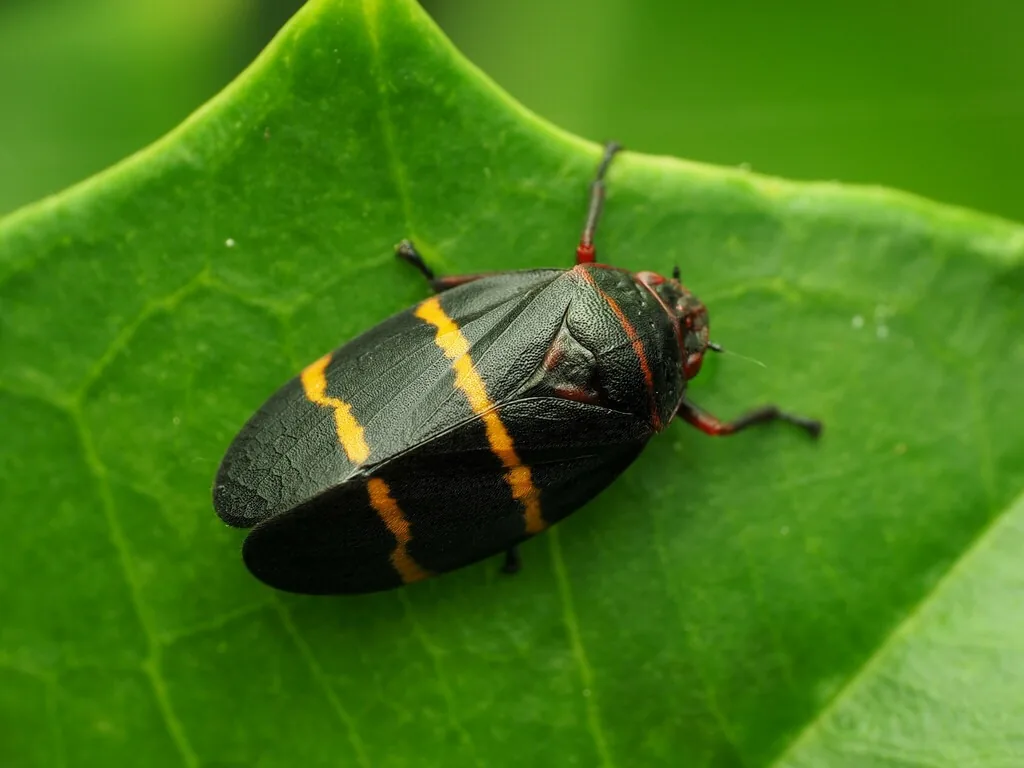
- Adults are about 1/3 inch long (Clemson says 0.38 inch; the Hawaii Invasive Species Council says 8-10 mm), dark brown to black and wedge-shaped, with the wings held rooflike over the back. Most have two red or orange stripes across the wings, which Missouri says may also be yellow, plus a narrow band across the thorax.[1][2][3][8]
- The eyes are bright red, the abdomen is bright red and shows in flight, and the underside is rusty.[1][5]
- Some adults have no bands and are all black except for the red eyes.[2][8]
- Nymphs are cream to yellow, white or orange with a brown head and red eyes, hidden in a white frothy spittle mass near the base of grass plants.[1][2]
Look-alikes
| Look-alike | How to tell them apart |
|---|---|
| Red-legged spittlebug | Prosapia ignipectus is all black except for red eyes and bright red leg bases, and feeds mainly on little bluestem. Sources differ on the twolined spittlebug's legs: Clemson describes them as red and the Hawaii Invasive Species Council as reddish black, while Missouri says all-black individuals lack the fire-red leg bases of the red-legged spittlebug.[8][5][2][3] |
| Other spittlebugs | Meadow, diamondback and other spittlebugs also hide in spittle as nymphs, but their adults are tan, gray or brown with different patterns and lack the two bright bands.[5] |
Where it lives
NC State reports it as a growing turf pest, especially in eastern North Carolina, Clemson covers it in South Carolina lawns, Mississippi State in Deep South lawns, peer-reviewed work calls it an economic turf pest of the southeastern U.S., and Missouri calls it a common froghopper. It was first detected in Hawaii in 2016, on rangeland on Hawaii Island. GBIF holds about 18,000 U.S. records since 1990 from 34 states and the District of Columbia, the most from North Carolina (2,799), Texas (2,495) and Florida (1,561).[1][2][4][9][8][6][10]
Biology and life cycle
Eggs overwinter in grass stems, under leaf sheaths and in debris, and most hatch in March and April in South Carolina. In summer, eggs take two weeks to hatch.[1][2]
Nymphs feed low on the grass where it is humid, moving deeper into the turf on hot, sunny days. When ready to molt they climb to the grass tips, where the spittle dries around them for the final molt.[1][2]
Nymphs feed for about a month, and a full life cycle takes about two months. In greenhouse tests development took 38.1 to 62.0 days, depending on the grass.[1][11]
Clemson gives two generations a year in South Carolina, NC State at least two in North Carolina, and Mississippi State two or three in the Deep South. Adults appear in June and peak in August and September.[2][1][4]
Adults are one to two weeks old before they lay eggs. By day they hide in hollies and shrubs; they are most active at night and may come to lights.[1][2]
The spittle protects nymphs from drying out and from predators. In lab tests fire ants ate all the eggs offered, and fire ants and tiger beetles killed exposed nymphs and every adult offered, even though the adults are warningly colored and can reflex-bleed.[1][9]
In Hawaii it is a pasture pest, mostly in kikuyu grass, with most activity from April to October. A 2024 study estimated it had spread to about 72,000 hectares in the North and South Kona districts of Hawaii Island, and a 2026 study says it now infests more than 143,000 hectares there. The Hawaii Invasive Species Council quotes the state Department of Agriculture as saying it infested 180,000 acres on Hawaii Island by 2021.[6][7][3]
Mississippi State says cool, wet springs are especially favorable to spittlebugs.[4]
Damage and signs
- Nymphs suck enough fluid to build their spittle that grass turns yellow, then brown, and severe infestations can kill turf; heavily infested lawns can squish underfoot.[1][2]
- Adults distort and discolor young holly leaves, blotch the undersides of older ones, and stipple grass blades. Clemson says second-generation damage is usually much more serious, and Mississippi State says the second generation most often causes damage.[2][8][4]
- Grasses differ. In a Georgia study of 56 turfgrasses, all centipedegrasses were highly susceptible, followed by bermudagrasses, seashore paspalums and zoysiagrasses, and some paspalum, bermudagrass and zoysiagrass cultivars recovered best after feeding.[11]
- In Hawaii pastures, the sites with the most spittlebugs lost an average of 30% of their grass cover. Kikuyu grass was the most susceptible of 12 forage grasses tested, while seven, including several Urochloa cultivars and a bahiagrass, resisted feeding.[6][7]
- Mississippi State says the adults' saliva can be toxic to grass and that centipede lawns are particularly susceptible, especially highly fertilized, well-watered lawns with heavy thatch.[4]
Health risk
It feeds on grasses and holly. NC State, Clemson, Mississippi State, the Missouri Department of Conservation and the Hawaii Invasive Species Council don't mention any risk to people or pets.[1][2][4][8][3]
Control
Prevention
Check for nymphs by parting the grass near the soil line, especially in July, and recheck after treatment since reinfestation is quick.[1][2]
Where you are replanting, consider the grass: centipedegrass was the most susceptible in turf trials, and resistant cultivars are being studied for pastures.[11][7]
In Hawaii, the Hawaii Invasive Species Council says to check turf down at the soil line for spittle masses before deciding to treat. Current recommendations there focus on intensive, targeted grazing of infested areas during the early and late nymph stages, with targeted and limited pesticide use in new and critical areas. It asks Hawaii Island residents to report unexplained dead grass to 643pest.org and not to move potted plants, soil or other live plant material from the west side to other parts of the island.[3]
Sanitation
Damage is worst where thatch is thick, so Clemson advises dethatching and topdressing when appropriate. Mississippi State advises avoiding excessive fertilizer, watering, mowing height or thatch build-up.[2][4]
Pesticides
If treatment is needed, aim it at the nymphs late in the day, when they are higher on the plants. Clemson says mowing and irrigating several hours beforehand improves control; Mississippi State says to mow and water just before treatment.[1][2][4]
Good coverage matters: NC State and Mississippi State say sprays work better than granules. Use an insecticide labeled for spittlebug control on turfgrass and follow the label.[1][4][2]
Where the sources disagree
Size: NC State says about 1/3 inch; Clemson says 0.38 inch; the Hawaii Invasive Species Council says 8-10 mm.[1][2][3]
Generations: Clemson says two a year in South Carolina; NC State says at least two in North Carolina; Mississippi State says two or three in the Deep South.[2][1][4]
Legs: Clemson says the adults have red legs; the Hawaii Invasive Species Council says reddish black; Missouri says all-black individuals lack the fire-red leg bases of the red-legged spittlebug.[2][3][5]
Which stage to target: Clemson says insecticide treatments should be directed toward the nymphs; the Hawaii Invasive Species Council says both adults and nymphs feed on grasses and the adults cause more damage.[2][3]
Extent in Hawaii: a 2024 study estimated about 72,000 hectares in North and South Kona; the Hawaii Invasive Species Council quotes the state Department of Agriculture as saying 180,000 acres by 2021; a 2026 study says more than 143,000 hectares.[6][3][7]
Mowing before treatment: Clemson says mow and irrigate several hours beforehand; Mississippi State says mow and water just before treatment.[2][4]
Common questions
- What is the white foam in my lawn?
- Spittle masses made by twolined spittlebug nymphs feeding at the base of the grass. Wipe some froth away and you will find the small nymph inside.[1][2][5]
- Which lawns get twolined spittlebugs?
- Centipedegrass and St. Augustinegrass are preferred, especially with heavy thatch, but bermudagrass, seashore paspalum and zoysiagrass can also support them.[2][11]
- Are the black bugs with orange stripes on my holly the same insect?
- Yes. The adults feed on the undersides of holly leaves and hide in hollies and other shrubs by day.[2][8]
- Are twolined spittlebugs in Hawaii?
- Yes. They were first detected on Hawaii Island rangeland in 2016 and have spread widely through kikuyu grass pastures there. The Hawaii Invasive Species Council asks residents to report unexplained patches of dead grass to 643pest.org.[6][7][3]
Sources
- NC State Extension, “Twolined Spittlebugs in Turf (TurfFiles).” content.ces.ncsu.edu/twolined-spittlebug-1-in-turf (accessed 2026-11-13)
- Clemson Cooperative Extension, Home & Garden Information Center, “Two-Lined Spittlebug (HGIC 2488).” hgic.clemson.edu/factsheet/two-lined-spittlebug/ (accessed 2026-11-13)
- Hawaii Invasive Species Council (Hawaii Department of Land and Natural Resources), “Two-lined spittlebug (TLSB).” dlnr.hawaii.gov/hisc/two-lined-spittlebug/ (accessed 2026-11-13). Quotes the Hawaii Department of Agriculture on first detection and extent.
- Mississippi State University Extension Service, “Twolined Spittlebug, Bug's Eye View No. 16 (B. Layton, 2015).” extension.msstate.edu/newsletters/bugs-eye-view/2015/twolined-spittlebug-no-16 (accessed 2026-11-13)
- Missouri Department of Conservation, “Spittlebugs and Froghoppers (Field Guide).” mdc.mo.gov/discover-nature/field-guide/spittlebugs-froghoppers (accessed 2026-11-13)
- Environmental Entomology, via PubMed, “Prosapia bicincta abundance, plant associations, and impacts on groundcover in Hawai'i Island rangelands (Wilson et al. 2024).” pubmed.ncbi.nlm.nih.gov/38956828/ (accessed 2026-11-13). Cited from the PubMed abstract.
- Journal of Economic Entomology, via PubMed, “Susceptibility of different forage grasses to feeding damage by Prosapia bicincta adults in Hawai'i (Wilson et al. 2026).” pubmed.ncbi.nlm.nih.gov/41092440/ (accessed 2026-11-13). Cited from the PubMed abstract.
- Missouri Department of Conservation, “Two-Lined Spittlebug (Field Guide).” mdc.mo.gov/discover-nature/field-guide/two-lined-spittlebug (accessed 2026-11-13)
- Journal of Economic Entomology, via PubMed, “Susceptibility of twolined spittlebug life stages to entomophagous arthropods in turfgrass (Nachappa et al. 2006).” pubmed.ncbi.nlm.nih.gov/17066803/ (accessed 2026-11-13). Cited from the PubMed abstract.
- Global Biodiversity Information Facility (GBIF), “Prosapia bicincta: U.S. occurrence records since 1990 by state (GBIF occurrence API).” api.gbif.org/v1/occurrence/search?taxonKey=2017569&country=US&hasGeospatialIssue=false&occurrenceStatus=PRESENT&year=1990%2C2026&facet=stateProvince&facetLimit=400&limit=0 (accessed 2026-11-13). 17,976 records; 39 facet entries = 34 states plus the District of Columbia, with 4 states also listed under lowercase duplicates; North Carolina 2,799, Texas 2,495, Florida 1,561; fetched 2026-11-13.
- Journal of Economic Entomology, via PubMed, “Evaluation of turfgrass species and cultivars for potential resistance to twolined spittlebug (Shortman et al. 2002).” pubmed.ncbi.nlm.nih.gov/12020030/ (accessed 2026-11-13). Cited from the PubMed abstract.
- Global Biodiversity Information Facility (GBIF), “Prosapia bicincta (Say, 1830) (GBIF Backbone Taxonomy).” api.gbif.org/v1/species/2017569 (accessed 2026-11-13). ACCEPTED; family Cercopidae