On this page
How to identify it
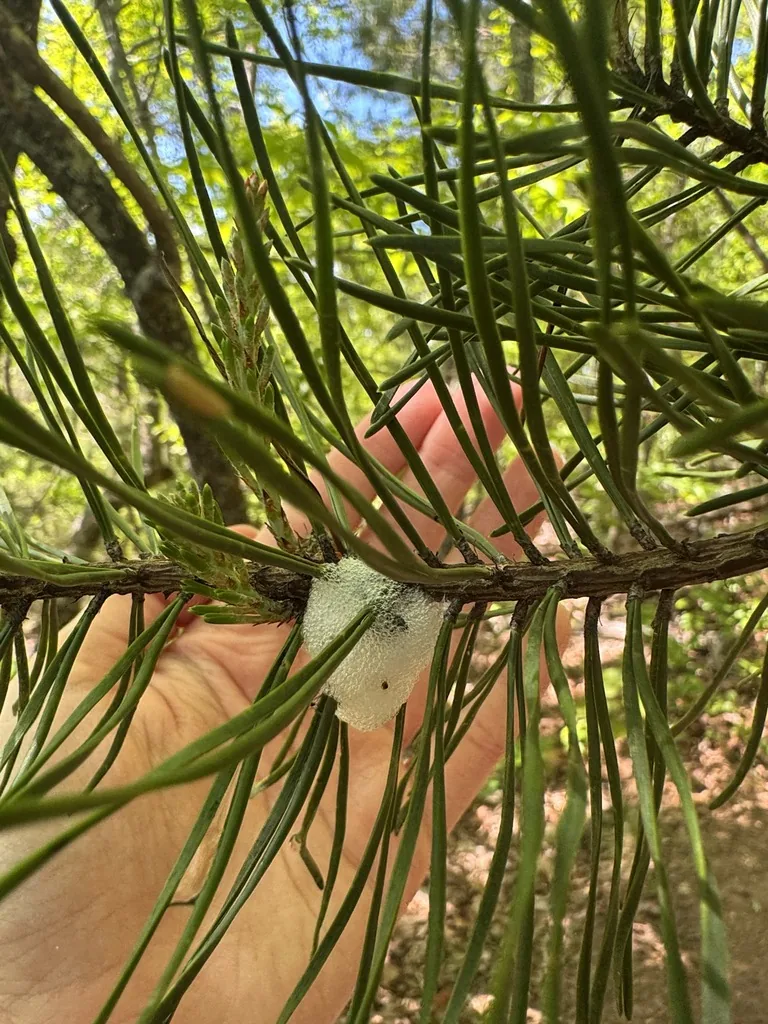
- In spring, look for white, frothy spittle masses on pine shoots; several nymphs may feed inside one mass. NRCan says that by July the nymphs gather under large spittle masses on the main stem.[1][2]
- Adults are 8 to 11 mm long, oval-elongate and tan to dark reddish brown, with two narrow, slanting light bands edged in darker color.[2]
- Other signs are small feeding scars on one-year-old shoots and, from fall to spring, egg bumps near the shoot tips.[1]
Look-alikes
| Look-alike | How to tell them apart |
|---|---|
| Saratoga spittlebug | The Saratoga spittlebug also damages pines, but its nymphs feed on sweetfern, blackberry and hawkweed under the trees. Only the adults feed on pines, from late June to frost, and UMass says removing the ground hosts can get rid of it locally.[1] |
Where it lives
UMass places it in the eastern United States and parts of Canada. NRCan calls it common throughout the eastern white pine range in Ontario.[1][2]
Biology and life cycle
Females lay eggs in July and August under the bark of twig tips, sometimes in dead wood, and the eggs spend the winter there. Nymphs hatch in May and suck sap under their spittle, moving inward toward the main stem through June and July.[1][2]
Adults feed on the same twigs through July and August. They excrete honeydew that can fall as a fine mist and grow black sooty mold.[1][2]
There is one generation a year in the northern part of its range.[1]
Damage and signs
- NRCan lists eastern white, jack, Scots and pitch pine as preferred hosts, with spruce, balsam fir, larch and hemlock also attacked. UMass adds Douglas-fir and Japanese black, loblolly and Virginia pine, and slash pine in the Southeast.[2][1]
- Heavy feeding causes flagging and kills twigs and branches. NRCan says two or three years of very heavy infestation can kill trees of any age or size, and in high years Scots pine can be badly stunted or killed.[2][1]
- In 1927, pine spittlebugs killed 70 percent of the Scotch pines in one Pennsylvania plantation.[1]
- NRCan says the spittlebug carries a fungus, Diplodia pini, that enters through its feeding punctures and causes most of the flagging blamed on the insect. Controlling the insect also controls the fungus.[2]
Health risk
It feeds on conifer sap. UMass Extension and Natural Resources Canada describe tree damage only and don't mention any risk to people or pets.[1][2]
Control
Prevention
Check pines for spittle on shoots and trunks in spring, and for egg bumps and feeding scars from fall to spring.[1]
Traps and physical control
Prune out dead and dying branches. UMass cites work suggesting that destroying these egg-laying sites may lessen injury.[1]
Biological control
A fungus, Entomophthora aphrophorae, can kill many nymphs, and NRCan says hot weather also causes heavy losses. Predatory stink bugs, damsel bugs, assassin bugs, wasps and spiders feed on them too.[1][2]
Pesticides
If you plan to treat, time it to the nymphs. UMass gives about 148 to 386 growing degree days (base 50°F from March 1), while Cornell's window ends at 298. Massachusetts made neonicotinoids state restricted-use on trees and shrubs from July 1, 2022.[1]
Common questions
- What is the white foam on my pine branches?
- Most likely spittle made by pine spittlebug nymphs feeding inside. Foam on sweetfern or brambles under the pines points to Saratoga spittlebug instead.[1][2]
- Is pine spittlebug foam harmful to the tree?
- The foam itself isn't, but the feeding is. Several years of heavy feeding kill twigs and branches and can kill trees, and NRCan says the insect spreads a fungus that causes most of the flagging.[1][2]
Sources
- UMass Extension Landscape, Nursery and Urban Forestry Program (Landscape Insect & Mite Guide), “Aphrophora cribrata and Aphrophora saratogensis (Pine Spittlebugs).” www.umass.edu/agriculture-food-environment/landscape/publications-resources/insect-mite-guide/aphrophora-cribrata-aphrophora-saratogensis (accessed 2026-11-13)
- Natural Resources Canada, “Pine spittlebug (Trees, insects and diseases of Canada's forests).” tidcf.nrcan.gc.ca/en/insects/factsheet/5701 (accessed 2026-11-13)
- iNaturalist, “Aphrophora cribrata taxon page (order and family).” www.inaturalist.org/taxa/213963 (accessed 2026-10-06)