On this page
How to identify it
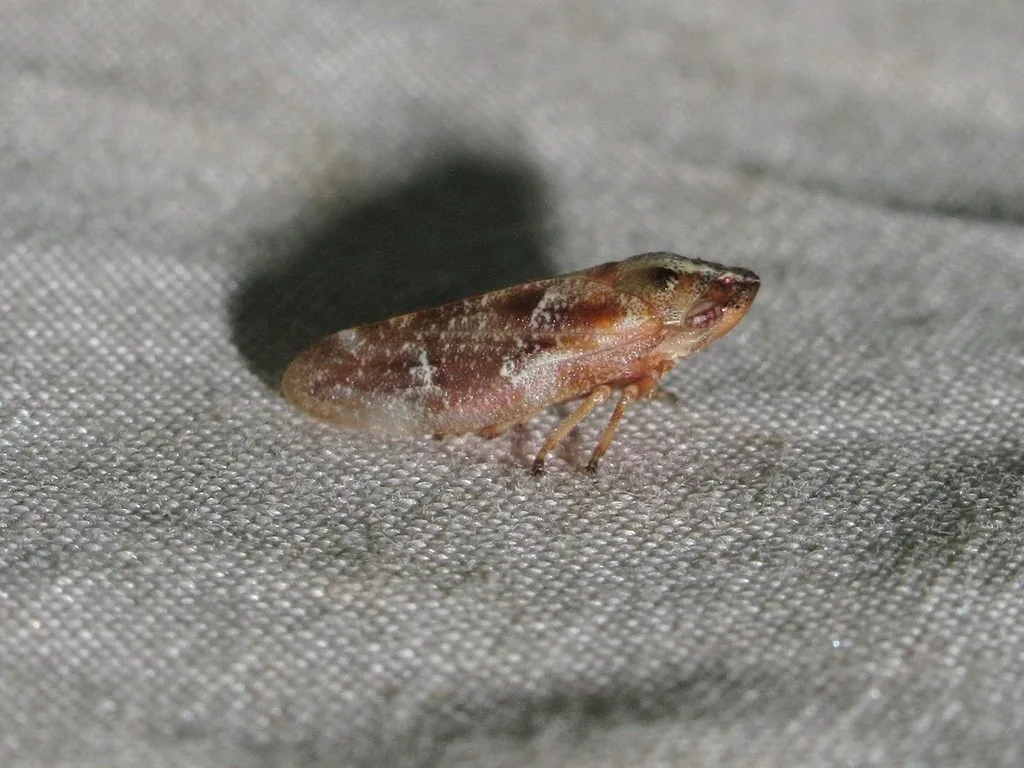
- Adults are boat-shaped and tan with whitish markings, including a white arrow-shaped mark on top. Sources differ on size: the Forest Service gives about 8 mm (0.3 inch), UMass 0.4 inch. Females are larger and have a swordlike egg-laying tube.[2][1]
- Young nymphs in spittle masses on ground plants have bright scarlet abdomens edged in black and jet-black heads; the last nymphal stage is dark brown.[2]
- On pines, the first sign is one or more reddish-brown dead branch tips (flagging) in the upper crown; scraping the bark of those shoots shows tan or brown feeding scars.[2]
- Eggs are about 2 mm long and teardrop-shaped, yellow at first and later purple with a reddish spot.[2][1]
Look-alikes
| Look-alike | How to tell them apart |
|---|---|
| Pine spittlebug | Pine spittlebug nymphs make their spittle on the pine twigs themselves. Saratoga spittlebug nymphs feed under spittle on plants of the forest floor, and only the adults feed on pines.[1] |
Where it lives
Native from Maine to Minnesota and in the southern parts of the adjacent Canadian provinces; it is named for Saratoga County, New York. Michigan DNR describes it as a problem of young red pine plantations in the Lake States.[2][3]
Biology and life cycle
There is one generation a year. Eggs laid under bud scales or in needle sheaths spend the winter on the pines.[1][2]
Nymphs hatch in early May, drop to the ground and feed under spittle on brambles, orange hawkweed, everlasting and aster; older nymphs move mostly to sweetfern and willow sprouts. Up to 50 can share one spittle mass. UMass lists blackberry, hawkweed and sweetfern as nymph hosts.[2][1]
Adults move up to pines in late June or early July and feed on twig sap into fall; UMass says until frost. The Forest Service puts most injury from mid-July to mid-August, and UMass says peak feeding lasts about two weeks around the end of July.[2][1]
Damage and signs
- Red pine is the preferred host, followed by jack pine; Scots pine is occasionally injured, and white pine is fed on but seldom badly damaged. Adults thought to be this species have also been collected from pitch pine, tamarack, balsam fir and northern white-cedar near infested red pine.[2]
- Feeding leaves dead, resin-filled pits in the twigs that block the flow of nutrients, so branches die. Continued heavy feeding causes top kill, crooked stems and dead trees, mainly on pines 2 to 15 feet tall.[1][2]
- UMass notes that at least 3 years of heavy feeding are needed to kill a tree and that it is unlikely on ornamental pines in well-managed plantings.[1]
- Plantations with plenty of alternate host plants suffer most, while naturally grown and larger trees are less injured. Michigan DNR describes a plantation where trees on 30 acres with moderate- to high-risk ground cover averaged 6 feet tall, against 12 feet on 10 acres of low-risk cover with no difference in soil.[2][3]
Health risk
It feeds on pine sap and ground plants. UMass Extension, the USDA Forest Service and Michigan DNR describe tree damage only and don't mention any risk to people or pets.[1][2][3]
Control
Prevention
Sweetfern is the key alternate host. The Forest Service and Michigan DNR rate planting sites by how much of the ground cover is sweetfern, and Michigan DNR advises planting susceptible pines only on no- or low-risk sites, which may mean leaving out small pockets where sweetfern dominates.[2][3]
Cut back the ground hosts, especially sweetfern. UMass says removing the nymphs' host plants can eliminate the insect locally. Michigan DNR says deep plowing buries sweetfern but harms sandy soils, shallow plowing or mowing makes it grow back unless repeated for two to three years, and herbicides appear the most reasonable way to suppress it.[1][3][2]
The Forest Service says stands over 10 feet tall that haven't been injured are safe.[2]
Traps and physical control
Prune out dead and dying branches. UMass cites work suggesting that removing these egg sites may lessen injury.[1]
Biological control
Weather kills many young nymphs, through drying out and hard frosts. Egg wasps parasitize no more than 5 percent of eggs and a parasitic fly up to half the adults, and ants, spiders and birds eat them too, but the Forest Service says no natural enemy is an effective control.[2]
Pesticides
The Forest Service refers growers to extension or state forestry staff for chemical control. UMass says to apply insecticides after bloom to protect pollinators, and Massachusetts made neonicotinoids state restricted-use on trees and shrubs from July 1, 2022.[2][1]
Common questions
- Why are branch tips dying at the top of my young red pine?
- Saratoga spittlebug feeding is one cause, especially if sweetfern grows under the trees. Look for tan or brown feeding scars under the bark of the dead shoots.[2][3]
- Where are the Saratoga spittlebug's spittle masses?
- Not on the pines: the nymphs make their spittle on sweetfern, brambles and other plants on the ground.[1][2]
Sources
- UMass Extension Landscape, Nursery and Urban Forestry Program (Landscape Insect & Mite Guide), “Aphrophora cribrata and Aphrophora saratogensis (Pine Spittlebugs).” www.umass.edu/agriculture-food-environment/landscape/publications-resources/insect-mite-guide/aphrophora-cribrata-aphrophora-saratogensis (accessed 2026-11-13)
- USDA Forest Service (Forest Insect & Disease Leaflets), “Saratoga Spittlebug (FIDL 3, revised Nov. 1978).” www.fs.usda.gov/foresthealth/docs/fidls/FIDL-03-SaratogaSpittlebug.pdf (accessed 2026-11-13)
- Michigan Department of Natural Resources, via Michigan Society of American Foresters, “Red Pine Insect and Disease Problems: A Summary (Robert L. Heyd, Michigan DNR Forest Health Specialist).” msaf.forest.mtu.edu/ForestInfo/MSUElibrary/RedPinePests.PDF (accessed 2026-11-13)
- Global Biodiversity Information Facility (GBIF), “Aphrophora saratogensis (Fitch, 1851) (GBIF Backbone Taxonomy).” api.gbif.org/v1/species/5867481 (accessed 2026-11-13)
- iNaturalist, “Aphrophora saratogensis taxon page (order and family).” www.inaturalist.org/taxa/213967 (accessed 2026-10-06)