On this page
How to identify it
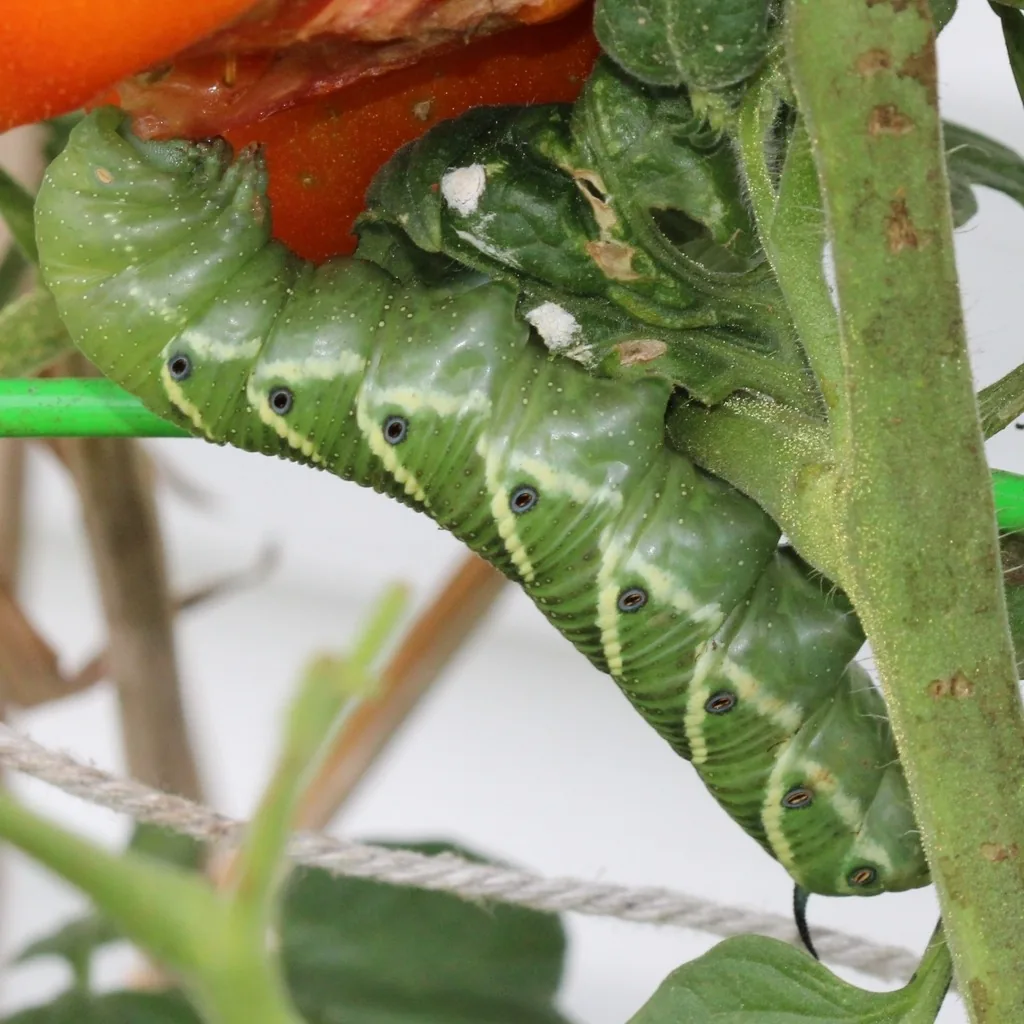
- Large caterpillars are green with eight white V-shaped marks along each side and a horn on the last body segment. Minnesota and Clemson describe the horn as black; Colorado State calls it dark green with black sides. UF/IFAS describes yellow-white V-shaped markings and a blackish horn, and says each instar looks much the same apart from size.[1][4][5][6][12]
- Small caterpillars are yellow to white with no markings. Darker forms of grown caterpillars exist but are less common.[1][7][6]
- Dark green or black droppings on leaves or on the ground under plants are often the first sign, since the green caterpillars blend in with the foliage.[1][2]
- Eggs are smooth and round, about 1/16 inch across, light green at first and turning white before they hatch. UF/IFAS says eggs are about 1 mm across, green to yellow-green and pearly, laid singly on the host plant in the evening.[4][5][12]
- The adult is a large, heavy-bodied gray-brown moth with a wingspan of 4 to 5 inches and five yellow spots along each side of the abdomen. UF/IFAS calls it the five-spotted hawkmoth, after the five pairs of orange-yellow marks along the gray abdomen; the wings are mottled gray, white and brown like tree bark.[1][7][3][12]
- The pupa, found in a small space underground, is large and dark reddish-brown, with a loop at one end that encases the developing moth's mouthparts.[12]
Look-alikes
| Look-alike | How to tell them apart |
|---|---|
| Tobacco hornworm (Manduca sexta) | Has seven diagonal white lines instead of V-shaped marks and a red, usually curved horn. Colorado State says it is the more common of the two in Colorado gardens and east of the Rockies, and Clemson says its range runs from southern Canada to Argentina, while the tomato hornworm's ends in the southern United States. UF/IFAS says the tobacco hornworm's moth, the Carolina sphinx, typically has six pairs of abdominal spots instead of five, and that gardeners in the South are more likely to find tobacco hornworms on their tomatoes.[7][6][4][8][12][14] |
| Hummingbirds (the adult moths) | Hornworm moths are often mistaken for hummingbirds as they hover over flowers. Colorado State notes the moths most often called hummingbird moths are other sphinx moths, chiefly the whitelined sphinx.[7][3][6] |
Where it lives
A garden pest from Minnesota and Colorado to California; adults fly long distances and can migrate into northern areas from the south. UF/IFAS says it ranges from northern Mexico to southernmost Canada, though not evenly; it is uncommon in the Southeast, and in Florida hornworm damage on tomato is usually caused by the tobacco hornworm despite the name.[1][7][2][12]
Biology and life cycle
Hornworms spend the winter as pupae in the soil. Moths emerge from late spring into summer: Colorado State gives late May and June, Clemson early June to as late as August, and Wisconsin late June.[1][2][6][4][3]
Females lay eggs singly on leaves; Clemson says they lay at night, one to five eggs per plant visit, and that eggs hatch in about four days depending on temperature.[2][8][4]
Caterpillars feed for about three to four weeks (Clemson says three, Wisconsin and Colorado State about a month), then drop off the plant and burrow into the soil to pupate.[1][8][4][3][7]
There are usually two generations a year, with a second round of caterpillars in mid to late summer. Colorado State says the second generation is mainly a feature of southern areas and warm summers, and Clemson says at least two occur each year in South Carolina.[8][1][3][7][4]
Besides tomato, they feed on potato, eggplant, pepper and tobacco, and on weeds such as horsenettle, jimsonweed and nightshade.[1][4][5]
Tomato and tobacco hornworms often occur together and are attacked by the same parasitic wasp. In heat experiments, the tomato hornworm grew faster and larger than the tobacco hornworm at high temperatures, and extreme heat killed the developing wasps but not the caterpillars.[9]
First instars stay on the leaf where they hatched. UF/IFAS says larvae generally stay on the same host plant until the fifth instar, but can move if they run out of food.[12]
UF/IFAS says wild tobacco is most likely the main natural host, and that adults, like the caterpillars, are most active from dusk to dawn, visiting flowers at night for nectar.[12]
UF/IFAS's tobacco hornworm sheet lists birds, small mammals, lacewing and lady beetle larvae that eat eggs and young caterpillars, and paper wasps that carry hornworms off to feed their young.[13]
Damage and signs
- Caterpillars eat entire leaves and small stems, starting near the top of the plant, and chew large pieces out of green fruit. They feed on the fruit surface, leaving large open scars, rather than boring in. UF/IFAS says feeding starts high in the canopy and can end in complete defoliation if the caterpillars aren't removed.[1][2][4][5][12]
- The last caterpillar stage eats nearly as much as all the younger stages combined. Wisconsin says larvae can eat up to four times their weight in leaves and fruit each day, and Iowa State says full-grown caterpillars seem to eat about a leaf an hour.[1][3][10]
- Damaged fruit often rots on the vine or is left with dry feeding scars, though leaf loss is much more common than fruit damage. UF/IFAS says fruit fed on by hornworms won't mature properly and has no market value.[3][4][5][12]
- Only the caterpillar stage causes damage, and it is usually worst in midsummer and in warm inland areas. The adult moths feed on nectar and do not harm plants.[2][3]
- Penn State notes hornworms are especially attracted to plants under drought stress.[5]
Health risk
Hornworms are plant pests: the caterpillar is the only stage that causes damage, and the moths feed on nectar. Iowa State notes the caterpillars won't hurt you when you pick them off.[2][3][10]
Control
Sanitation
Remove weeds where moths lay eggs, and till the soil after harvest to destroy pupae; Wisconsin says tillage can kill up to 90% of larvae in the soil. UF/IFAS lists managing nightshade-family weeds, encouraging natural enemies and crop rotation, and says tilling destroys the pupae.[1][2][3][12]
Traps and physical control
Handpicking is the most effective control: check plants at least twice a week in summer and drop caterpillars into soapy water or snip them with shears. UF/IFAS says to look carefully, including on the undersides of leaves, since young caterpillars blend in; bare stems and droppings are easier to spot.[1][2][3][4][14][12]
Search at dusk or dawn, when caterpillars feed on the outside of the plant and are easier to see.[7][6]
Biological control
Lady beetles, lacewings, paper wasps, Trichogramma egg parasites and parasitic wasps all attack hornworms and normally keep numbers down.[1][2][3]
Pesticides
Bacillus thuringiensis (Bt) or spinosad work best on young, small caterpillars and should be applied before defoliation is severe. UF/IFAS notes caterpillars must eat the Bt for it to work, and repeat applications may be needed because rain or irrigation washes it off.[1][2][10][12][14]
Wisconsin says hornworms rarely do enough damage to need insecticides in home gardens. Broad-spectrum products such as pyrethroids (bifenthrin, permethrin) or carbaryl also kill beneficial insects; check the label for days to wait before harvest.[3][1][6]
Hornworms covered in white cocoons
A small braconid wasp, Cotesia congregata, lays its eggs in or on hornworms, and the wasp larvae feed inside the caterpillar.[1][4][5][3][9]
The wasp larvae then spin cocoons on the hornworm's back that look like grains of white rice.[1][5][4]
Leave these hornworms in the garden. A parasitized hornworm has stopped feeding, and the wasps that emerge go on to parasitize other hornworms.[1][4][5][3]
Where sources disagree
Horn color: Minnesota calls the tomato hornworm's horn black and Clemson straight and black, while Colorado State describes it as dark green with black sides. Iowa State says only that the horn is red or green depending on the species, and Wisconsin red or black.[1][4][6][10][3]
Side markings: most sources describe eight V-shaped or chevron marks, but Wisconsin describes them as eight diagonal white stripes.[1][8][4][3]
Size: Minnesota, UC IPM and Wisconsin give up to 4 inches, Clemson 3 to 3 1/2 inches, Penn State about three, and Iowa State 4 to 5 inches.[1][2][3][4][5][10]
Where eggs go: Clemson and Wisconsin say the undersides of leaves, Colorado State the upper surface, and Minnesota both.[4][3][7][1]
Seeing the moths: Colorado State's IPM page and Wisconsin say they are often mistaken for hummingbirds at flowers, but Colorado State's Extension fact sheet says tomato hornworm moths fly after dusk and are rarely seen except at porch lights.[7][3][6]
Size: UF/IFAS Gardening Solutions says hornworms can grow up to four inches long, matching Minnesota, UC IPM and Wisconsin.[14][1][2][3]
Horn color: UF/IFAS calls the tomato hornworm's horn black or blackish, siding with Minnesota and Clemson.[12][14][1][4]
Common questions
- Is it a tomato hornworm or a tobacco hornworm?
- Look at the side markings and horn: eight V-shaped marks mean tomato hornworm; seven diagonal lines and a red, usually curved horn mean tobacco hornworm.[4][7][8]
- What are the white things stuck to a hornworm?
- They are cocoons of a parasitic wasp. The hornworm has already stopped feeding, so leave it alone and let the wasps emerge to parasitize more hornworms.[1][4]
- Will Bt kill a big hornworm?
- Bt works best on very young caterpillars, and small ones are easier to treat than large ones; big hornworms are easy to spot and handpick.[1][2]
- I'm in Florida. Is the hornworm on my tomatoes a tomato hornworm?
- Probably not. UF/IFAS says the tomato hornworm is uncommon in the Southeast and Florida damage on tomato is usually caused by the tobacco hornworm; check for seven diagonal lines and a red horn.[12][14]
Sources
- University of Minnesota Extension, “Tomato Hornworms.” extension.umn.edu/yard-and-garden-insects/tomato-hornworms (accessed 2026-11-11)
- University of California Statewide IPM Program, “Hornworms (Pest Notes, Home and Landscape).” ipm.ucanr.edu/home-and-landscape/hornworms/ (accessed 2026-11-11)
- University of Wisconsin-Madison Extension, “Hornworms (XHT1107).” hort.extension.wisc.edu/articles/hornworms/ (accessed 2026-11-11)
- Clemson Cooperative Extension Home & Garden Information Center, “Tomato Insect Pests (HGIC 2218).” hgic.clemson.edu/factsheet/tomato-insect-pests/ (accessed 2026-11-11)
- Penn State Extension, “Tomato Insect Pests in the Home Garden.” extension.psu.edu/tomato-insect-pests-in-the-home-garden (accessed 2026-11-11)
- Colorado State University Extension, “Hornworms and 'Hummingbird' Moths (Fact Sheet 5.517).” extension.colostate.edu/resource/hornworms-and-hummingbird-moths/ (accessed 2026-11-11)
- Colorado State University, College of Agricultural Sciences, “Hornworms (IPM Pests).” agsci.colostate.edu/agbio/ipm-pests/hornworms/ (accessed 2026-11-11)
- University of California Statewide IPM Program, “Tomato Pest Management Guidelines: Hornworms.” ipm.ucanr.edu/agriculture/tomato/hornworms/ (accessed 2026-11-11)
- Journal of Experimental Biology, via PubMed, “Malinski, Sorenson, Moore, Willett and Kingsolver (2023), Host species differences in the thermal mismatch of host-parasitoid interactions.” pubmed.ncbi.nlm.nih.gov/37338185/ (accessed 2026-11-11)
- Iowa State University Extension and Outreach, “Tomato Hornworm (Yard and Garden).” yardandgarden.extension.iastate.edu/encyclopedia/tomato-hornworm (accessed 2026-11-11)
- iNaturalist, “Manduca quinquemaculatus taxon page (order and family).” www.inaturalist.org/taxa/224420 (accessed 2026-10-06)
- University of Florida IFAS Extension, EDIS, “Tomato Hornworm, Manduca quinquemaculata (Haworth), EENY700/IN1206 (Featured Creatures).” ask.ifas.ufl.edu/publication/IN1206 (accessed 2026-11-14)
- University of Florida IFAS Extension, EDIS, “Tobacco Hornworm, Manduca sexta (Linnaeus), EENY692/IN1187 (Featured Creatures).” ask.ifas.ufl.edu/publication/IN1187 (accessed 2026-11-14)
- University of Florida IFAS Extension, “Hornworm Caterpillars (Gardening Solutions).” gardeningsolutions.ifas.ufl.edu/care/pests-and-diseases/pests/hornworm-caterpillars/ (accessed 2026-11-14)