On this page
How to identify it
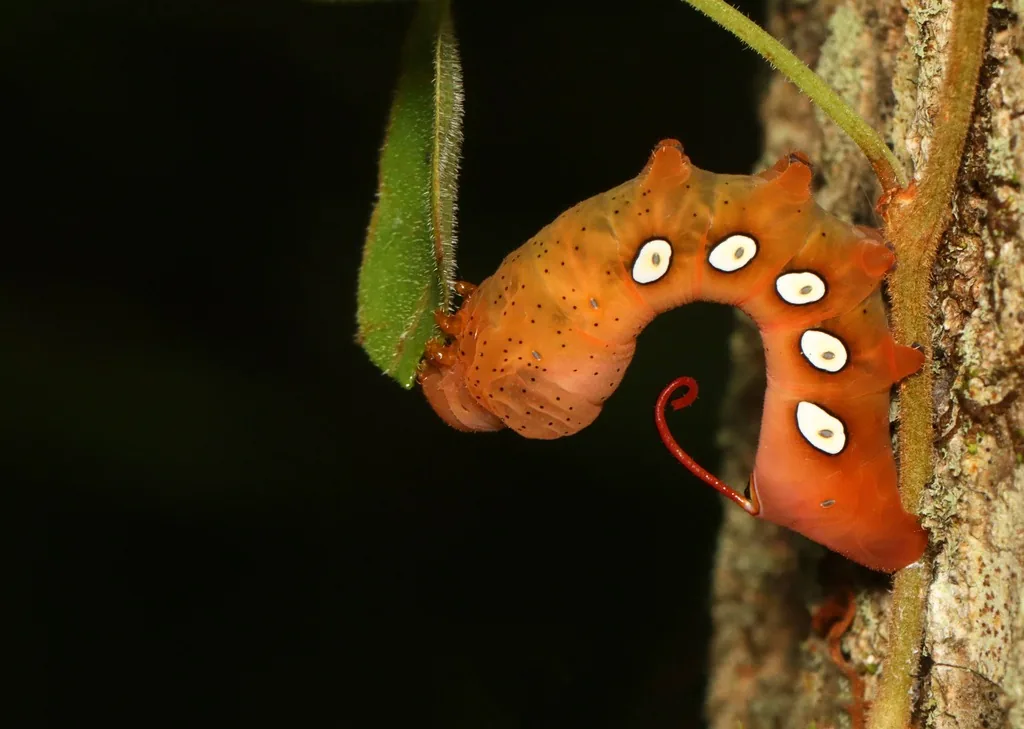
- Caterpillars grow up to 89 mm (3½ inches) long according to Minnesota Extension; UW-Milwaukee calls them finger-sized, 3 to 4 inches. They are green to orange, pink or reddish brown, with whitish round spots along the body and black flecks around the head; cinnamon, chocolate and black caterpillars have also been seen.[1][2]
- Young caterpillars have a thin, curled tail horn. At the third molt it shrinks away and is replaced by a lens-shaped, eyed button.[1][2]
- Alarmed or resting caterpillars tuck the first two body segments into the third, giving a swollen, blunt front end. This sphinx-like pose gives sphinx moths their name.[2]
- The adult, once called the satellite sphinx, is light brown shaded olive green to green, with pink streaks along the forewing vein ends and near its inner edge, and a dark squarish mark at the middle of the forewing's inner edge. BAMONA gives a wingspan of 3 1/4 to 4 1/2 inches (8.2 to 11.5 cm), and UW-Milwaukee says females are a bit larger than males.[2][3]
Look-alikes
| Look-alike | How to tell them apart |
|---|---|
| Abbott's sphinx | Another grape-family sphinx; its mature caterpillar is mottled brown with ten green square patches and an eye-like knob at the rear.[1] |
| Virginia creeper sphinx | MDC lists it with the pandorus and achemon sphinxes as caterpillars unwelcome in vineyards.[4] |
Where it lives
Eastern North America: UW-Milwaukee gives south Texas to Wisconsin to Nova Scotia to south Florida, and BAMONA gives Nova Scotia and Maine west through southern Wisconsin to central Kansas, south to south Florida and south Texas, wherever its grape-family host vines grow. GBIF holds about 8,900 U.S. records since 1990, the most from North Carolina (764), Virginia (625) and Texas (577). It is recorded in Minnesota, Missouri and Ohio extension and agency guides.[2][3][5][1][4][6]
Biology and life cycle
Females lay eggs one at a time on grape-family plants: grape, Virginia creeper and peppervine (Ampelopsis). Ohio State lists Virginia creeper, grape and porcelain berry as larval hosts.[2][6]
Adults fly at dawn and dusk along forest and river edges and vineyards, and nectar on and pollinate bouncing bet, white campion and petunias.[2][6][3]
Caterpillars pupate in chambers they dig in the soil, and the last generation of the year overwinters there as pupae, several inches deep.[2][1]
The number of generations depends on latitude: Minnesota Extension reports one a year, with adults in June and July and caterpillars from July into September; BAMONA gives one flight in the north from June to August and probably two in the south from April to October; UW-Milwaukee reports two in Wisconsin, three in Missouri and four in Louisiana.[1][3][2]
Virginia Tech's vineyard pest page shows a pandorus sphinx caterpillar collected from grape foliage that was parasitized by a braconid wasp; UW-Milwaukee notes that many parasites and parasitoids attack these caterpillars.[7][2]
Fun fact: do the caterpillar's bright side spots scare off predators? A 2023 Massachusetts field study put out 964 clay caterpillar models painted like pandorus sphinx caterpillars; 43% got bite marks, mostly from arthropods (67.5%), then birds, rodents and larger mammals, and the spots did not lower attacks, so the study found no support for the idea that they work as a warning or a distraction.[8]
Damage and signs
- Caterpillars chew holes in leaves; usually little damage occurs, though severe defoliation is possible in local spots.[1]
- The Missouri Department of Conservation lists pandorus sphinx caterpillars among those unwelcome in vineyards, and UW-Milwaukee says they sometimes cause minor problems there but control is usually unnecessary; most sphinx moths do not seriously injure their hosts.[4][2]
Health risk
UW-Milwaukee says sphinx caterpillar horns are harmless and that alarmed caterpillars defend themselves by regurgitating a sticky fluid at attackers such as ants and parasites. Neither UW-Milwaukee nor Minnesota Extension mentions bites, stings or any other effect on people or pets.[2][1]
Control
Traps and physical control
Step 1, tolerate or handpick: ornamental plants usually tolerate caterpillar feeding, so treatment is often unnecessary; when only a few caterpillars are present, remove them by hand.[1]
Biological control
Step 2, natural enemies: UW-Milwaukee notes that many parasites and parasitoids attack these caterpillars, and Virginia Tech reports one collected from grape foliage that was parasitized by a braconid wasp.[2][7]
Pesticides
Step 3, low-risk sprays for heavy feeding: Bacillus thuringiensis var. kurstaki (Bt) must be eaten, works best on very young caterpillars and does not affect bees or other insects. Spinosad works when eaten and somewhat on contact, lasts about one to two weeks and is toxic to bees when wet but much less once dry.[1]
Where the sources disagree
Caterpillar size: Minnesota Extension says up to 89 mm (3½ inches); UW-Milwaukee calls them finger-sized, 3 to 4 inches.[1][2]
Generations: Minnesota Extension reports one a year; BAMONA gives one flight in the north and probably two in the south; UW-Milwaukee reports two in Wisconsin, three in Missouri and four in Louisiana.[1][3][2]
Flight time: UW-Milwaukee says adults are found at dawn and dusk; BAMONA says they fly at dusk.[2][3]
Host vines: Minnesota Extension lists grape, Virginia creeper and woodbine; Ohio State adds porcelain berry; UW-Milwaukee and BAMONA name peppervine or ampelopsis.[1][6][2][3]
Common questions
- What is the huge spotted caterpillar on my grape vine?
- Possibly a pandorus sphinx caterpillar: green, orange, pink or reddish brown with whitish round spots, and an eyed button instead of a horn on older caterpillars. It feeds on grape and Virginia creeper.[1][2]
- Will it kill my vine?
- Usually not. Damage is generally light, and UW-Milwaukee says control is usually unnecessary even in vineyards.[1][2]
- Is the pandorus sphinx caterpillar dangerous to touch?
- UW-Milwaukee says sphinx caterpillar horns are harmless, and an alarmed caterpillar may regurgitate a sticky fluid. Neither UW-Milwaukee nor Minnesota Extension mentions bites or stings.[2][1]
Sources
- University of Minnesota Extension, “Caterpillars on ornamental plants (Yard and Garden).” extension.umn.edu/yard-and-garden-insects/caterpillars-ornamental-plants (accessed 2026-11-13)
- University of Wisconsin-Milwaukee Field Station, “Pandorus Sphinx (Bug of the Week).” uwm.edu/field-station/pandorus-sphinx/ (accessed 2026-11-13)
- Butterflies and Moths of North America (BAMONA), “Pandorus Sphinx Eumorpha pandorus.” www.butterfliesandmoths.org/species/Eumorpha-pandorus (accessed 2026-11-13)
- Missouri Department of Conservation, “Sphinx Moths (Hawk Moths) (Field Guide).” mdc.mo.gov/discover-nature/field-guide/sphinx-moths-hawk-moths (accessed 2026-11-13)
- Global Biodiversity Information Facility (GBIF), “Eumorpha pandorus: U.S. occurrence records since 1990 by state (GBIF occurrence search).” api.gbif.org/v1/occurrence/search?taxonKey=5123999&country=US&hasGeospatialIssue=false&occurrenceStatus=PRESENT&year=1990%2C2026&facet=stateProvince&facetLimit=400&limit=0 (accessed 2026-11-13). State counts are records reported, not abundance. 8,905 records on 2026-11-13.
- Ohio State University Extension (CFAES), “It's a Bird, It's a Plane, It's a Moth: The Sphinx Moths of Ohio.” cfaes.osu.edu/fact-sheet/its-bird-its-plane-its-moth-sphinx-moths-ohio (accessed 2026-11-13)
- Virginia Tech, Department of Entomology, “Sphinx moths (Virginia vineyard pests).” www.virginiafruit.ento.vt.edu/sphinx.html (accessed 2026-11-13)
- Ecol Evol 2023;13(7):e10334, via PubMed, “Sphingid caterpillars conspicuous patches do not function as distractive marks or warning against predators.” pubmed.ncbi.nlm.nih.gov/37492454/ (accessed 2026-11-13)
- Global Biodiversity Information Facility (GBIF), “Eumorpha pandorus Hübner (GBIF Backbone Taxonomy).” api.gbif.org/v1/species/5123999 (accessed 2026-11-13)
- iNaturalist, “Eumorpha pandorus taxon page (order and family).” www.inaturalist.org/taxa/47914 (accessed 2026-10-06)