On this page
How to identify it
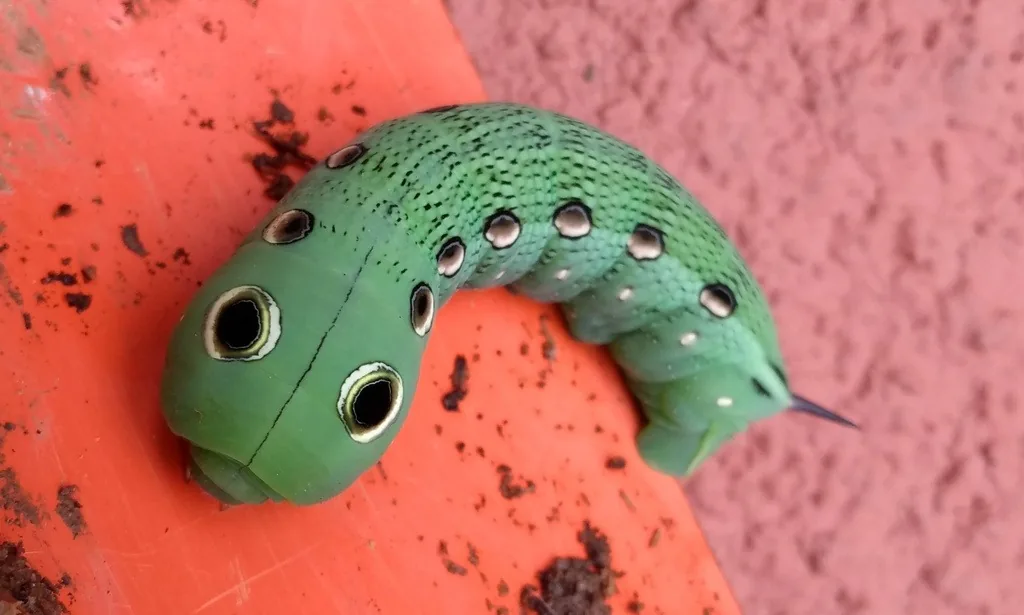
- Caterpillars grow to about 3 inches long, carry a horn at the rear and presumably gain protection by mimicking snakes.[1]
- The moth has a wingspan of 2 3/8 to 3 1/8 inches (6 to 8 cm). Its narrow forewings are pale brown with darker lengthwise lines, and the dark hindwings carry a band of pale, wedge-shaped marks.[1][5][6]
- Caterpillars come in a green form and a brown form. Bermuda's environment department describes one large eyespot followed by six smaller ones along the body, and NC State notes the eyespot pair sits on the first abdominal segment.[1][6][4]
- They are called sphinxes because the caterpillar can rear up and pull its head and the first three body segments back into the abdomen, a pose that looks a little like a sphinx.[1]
- Fun fact: the caterpillars fluoresce brightly under ultraviolet light, which makes them easy to find with a blacklight at night.[4]
- Adult moths visit flowers such as four o'clocks, honeysuckle and milkweed for nectar.[1]
Look-alikes
| Look-alike | How to tell them apart |
|---|---|
| Tomato hornworm | Another sphinx moth caterpillar with a rear horn; the tersa sphinx feeds on pentas and buttonweed rather than tomatoes.[1] |
Where it lives
Butterflies and Moths of North America gives the range as Massachusetts south to south Florida and west to Nebraska, New Mexico and southern Arizona, continuing south through Mexico, the West Indies and Central America to Argentina. NC State reports two or more generations a year in North Carolina, and the moth reaches Bermuda as a migrant.[5][1][6]
Biology and life cycle
Caterpillars feed on pentas, broadleaf buttonweed, candy corn vine, catalpa, firebush and smooth buttonplant, and have been reported on joe-pye weed.[1][5]
Sphingidae of the United States calls it a species of suburban yards that does well where pentas are planted. Eggs are laid one at a time on the leaves, often on the undersides near the tips. Young caterpillars feed near the tops of the plants and older ones lower down and deeper inside, and they wander to neighboring plants, so several sizes can turn up on one plant. They do not feed in groups.[4]
When full grown, the caterpillar crawls to the soil and burrows into plant debris to pupate; the tan pupa has eyespots down the abdomen and is usually under leaf litter.[1]
Adults start drinking nectar at sunset. Females release a scent (pheromone) that calls males from a long distance.[1]
Damage and signs
Health risk
Harmless to people and pets despite the horn.[1]
Control
Traps and physical control
Pick caterpillars off the plants by hand; insecticides are rarely needed.[1]
Where to look: check the tops of pentas, sometimes inside the flower clusters, for small caterpillars, and lower and deeper in the plant for big ones. Caterpillars can be found from May to November over most of the range and all year in the Deep South.[4]
Pesticides
In the rare case there are too many caterpillars to pick off, NC State says any insecticide labeled for landscape use should give more than adequate control.[1]
Where sources disagree
Season and generations: NC State reports two or more generations a year in North Carolina. Butterflies and Moths of North America gives one brood in the north from May to October and several broods in Florida and Louisiana from February to November. Sphingidae of the United States says adults fly from May to November and all year in the Deep South.[1][5][4]
Lights: NC State says males come to lights but females seldom do; Sphingidae of the United States says both sexes come to light, with males more common.[1][4]
Common questions
- What is the big caterpillar with eyespots on my pentas?
- Likely a tersa sphinx caterpillar, which mimics a snake.[1][2]
- Can the horn sting?
- No; the caterpillars are harmless.[1]
- Will tersa sphinx caterpillars kill my pentas?
- Texas A&M shows young caterpillars chewing pentas flower buds so the flowers never open. NC State says the caterpillars can be plucked off by hand, and spraying is needed only in the rare case there are too many to pick.[2][1]
- How can I find them at night?
- Shine an ultraviolet light on the plants: the caterpillars fluoresce brightly, which makes them easy to spot.[4]
Sources
- NC State Extension, “Tersa Sphinx (PDIC Factsheet).” content.ces.ncsu.edu/tersa-sphinx (accessed 2026-11-12)
- Texas A&M AgriLife Extension (Insects in the City), “Early instar tersa moth caterpillar on penta (Insects in the City image page).” citybugs.tamu.edu/factsheets/landscape/chewing/chewing-damage/early-instar-tersa-moth-caterpillar-on-penta/ (accessed 2026-11-12)
- iNaturalist, “Xylophanes tersa taxon page (order and family).” www.inaturalist.org/taxa/69737 (accessed 2026-11-12)
- Sphingidae of the United States of America, “Xylophanes tersa.” www.sphingidae.us/xylophanes-tersa.html (accessed 2026-11-12)
- Butterflies and Moths of North America, “Tersa Sphinx Xylophanes tersa.” www.butterfliesandmoths.org/species/Xylophanes-tersa (accessed 2026-11-12)
- Government of Bermuda, Department of Environment and Natural Resources, “Tersa Sphinx Moth (Xylophanes tersa).” environment.bm/tersa-sphinx (accessed 2026-11-12)