On this page
How to identify it
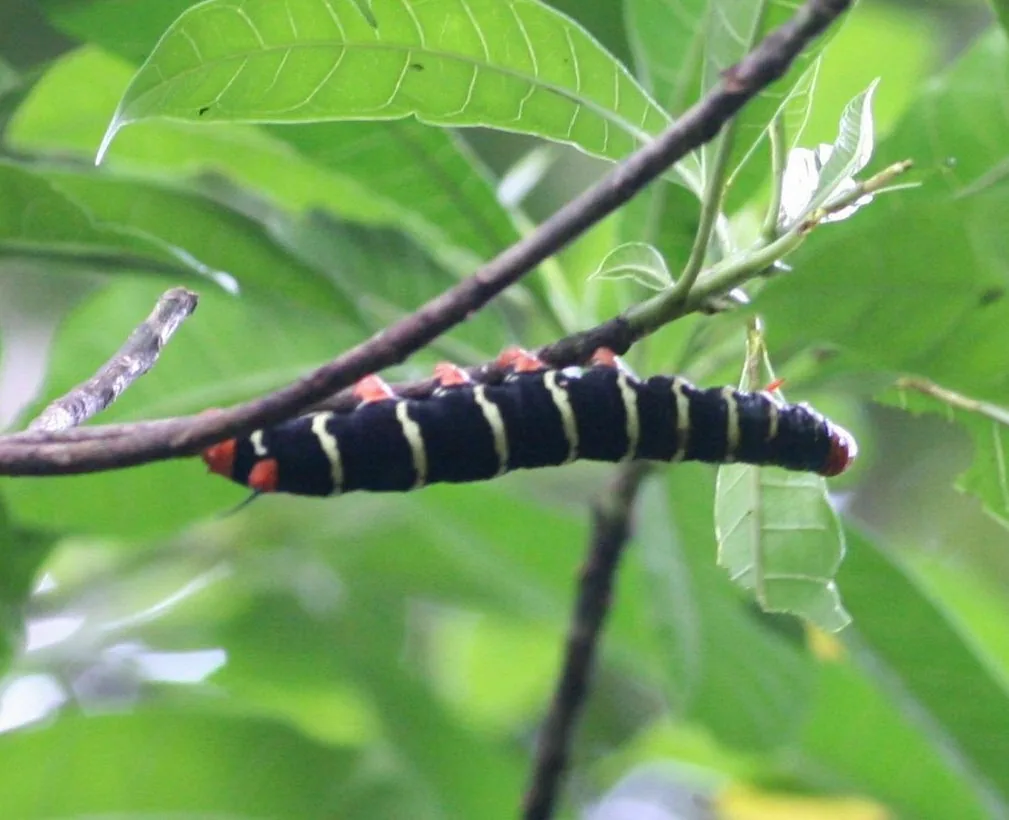
- Caterpillars are black with warning-yellow bands and a red-orange head and collar, with a long, spindly black horn near the rear; mature larvae are more than 15 cm long. The pattern is the same from the first instar on, so even tiny ones are easy to recognize. UF/IFAS adds that the horn, on the eighth abdominal segment, is about one inch long and sits on a raised orange button, that the legs and prolegs are orange with black spots, and that newly molted larvae are ringed light yellow and dark gray for several hours before turning yellow and black.[6][5][10]
- The adult is a very large moth with a wingspan of about 5 to 5 1/2 inches (12.7 to 14 cm). The forewings are dark brown to gray with blurry gray and white markings, the hindwings dark with white along the inner margin, and the body banded gray-white and black. UF/IFAS adds a dark spot at the base of the forewing's front edge.[4][6][5][10]
- Males are darker gray with more black markings; females are lighter and slightly larger.[5][6]
- Eggs are smooth, pale green ovals laid in clusters of 50 to 100 on the leaves. The pupa is about 7 cm long, yellow at first, darkening to reddish-brown. UF/IFAS gives the eggs as about 2.2 to 2.5 mm (0.09 to 0.1 in) long, smooth except for minute punctures; new pupae are yellow, show brown spots within two to three hours, and harden to a uniform dark reddish-brown about 7.0 cm long.[6][10]
- Fun fact: the caterpillars glow (fluoresce) under ultraviolet light.[5]
Look-alikes
| Look-alike | How to tell them apart |
|---|---|
| Tomato and tobacco hornworms | Other sphinx moth caterpillars also carry a horn near the rear. The frangipani hornworm's black body with yellow bands, red-orange head and its plumeria and allamanda host plants set it apart; the adult's large size, overall gray look and dark hindwings make it unmistakable.[6][5][4] |
Where it lives
Widespread in tropical and subtropical lowland America, from southern Brazil, Paraguay and Uruguay north through Central America, Mexico and the West Indies to south Florida, southern Mississippi, Texas and southern Arizona. U.S. breeding populations are in southern Florida; strays have reached Nebraska, Pennsylvania, Virginia, Louisiana and Ohio. GBIF U.S. records come mostly from Florida and Texas, and in Puerto Rico it is one of the most reported sphinx moths. UF/IFAS lists Florida records from Collier, Dade, Highlands, Lee, Monroe, Palm Beach and Sarasota counties, plus Sanibel Island and the Florida Keys, and expects more records in southern counties where plumeria grows.[4][6][5][9][10]
Biology and life cycle
Caterpillar hosts are frangipani (Plumeria rubra and other Plumeria) and allamanda, all in the dogbane family. These plants have a toxic white latex; the caterpillar is reported to detoxify and store the toxins, and a study on allamanda suggests it gets rid of some plant compounds in its droppings. UF/IFAS lists Plumeria rubra, P. alba and P. obtusa, Allamanda cathartica and Himatanthus sucuuba as hosts, possibly Adenium, and names two native vines of south Florida salt marshes and mangrove edges, rubber vine (Rhabdadenia biflora) and devil's potato (Echites umbellata), as possible Florida hosts. A jasmine record may be an error, since Plumeria rubra is sometimes called jasmine.[4][6][2][10]
Its gut enzymes can break down the latex proteins of its plumeria host, part of how it copes with the plant's defenses.[8]
The bold colors warn predators, mostly birds, that it tastes bad. Disturbed caterpillars wave the front or rear of the body, and they bite when handled. UF/IFAS notes that some cuckoos in Belize eat the caterpillars anyway, and that the caterpillar has been suggested as a coral snake mimic in Costa Rica.[6][10]
The larval stage lasts about 24 to 30 days with five or six molts, followed by a prepupa of about 4 days and a pupa of about 22 days in leaf litter or a chamber in the soil. Adults live a week or two.[6]
In Florida there are several adult flights from March to September. The moths feed on nectar at night, including rosy periwinkle, and come to lights. UF/IFAS says the moths nectar on rosy periwinkle, and in Brazil they have been recorded on Caryocar brasiliense, where they may be minor pollinators alongside bats.[4][6][10]
Damage and signs
- Females lay many eggs per plant, so caterpillars usually feed in groups and can defoliate a frangipani in a few days. UF/IFAS says a group can defoliate a frangipani in a few days or a couple of weeks; one caterpillar can eat three large leaves a day, starting at the leaf tip, they may chew the stems when leaves run out, and in southern Florida they are typically present from July to September.[4][5][6][10]
- Even so, the trees are not killed by the caterpillars. UF/IFAS likewise says the feeding typically does not cause severe damage and trees typically survive defoliation.[6][10]
Health risk
Caterpillars bite when handled. Their hairs have caused keratitis: in one case, a man clearing his garden without eye protection had a caterpillar flung into his eye, and many tiny hairs lodged in his cornea; they worked their way out over two weeks with treatment.[6][1]
Control
Prevention
Treatment is often unnecessary: the caterpillars can strip a plumeria quickly, but the tree is not killed and BAMONA lists no conservation concern for the moth. UF/IFAS agrees that the feeding typically does not cause severe damage.[6][4][10]
Traps and physical control
Hand-pick the caterpillars: they are large, live in groups and are easy to find on plumeria in daylight. UC IPM recommends hand-picking or snipping for hornworms in general. Wear gloves, since they bite, and protect your eyes when clearing infested plants, since the hairs have injured a gardener's eye. UF/IFAS calls hand-picking probably the best way to remove them from trees.[5][7][6][1][10]
Biological control
For hornworms in general, UC IPM says Bacillus thuringiensis (Bt) or spinosad are effective against smaller larvae, and natural enemies normally keep numbers down. UF/IFAS likewise says a biorational product with spinosad or Bt will also work against the frangipani hornworm.[7][10]
Where sources disagree
Native or not in Trinidad and Tobago: the University of the West Indies guide says it is not believed native there and probably established as frangipani was planted, while BAMONA and other range accounts treat the Caribbean as part of its range.[6][4]
Forewing color: BAMONA describes the forewing as dark brown with gray and white markings; the Sphingidae of the US site calls the moth overall gray, males darker gray than females.[4][5]
Caterpillar length: the University of the West Indies guide gives mature larvae as more than 15 cm long, while UF/IFAS says they can reach up to 6 inches.[6][10]
Common questions
- What is the big black-and-yellow caterpillar on my plumeria?
- It is most likely the frangipani hornworm, the caterpillar of the tetrio sphinx. It is black with yellow bands, a red-orange head and a long black horn, grows more than 15 cm long, and feeds on frangipani and allamanda.[6][4][5]
- Will the caterpillars kill my frangipani?
- No. They can strip the leaves in a few days, but the trees are not killed. UF/IFAS says a tree can be stripped in a few days or a couple of weeks, but trees typically survive.[4][6][10]
- Is the frangipani hornworm dangerous?
- It bites if handled, and its hairs caused keratitis when a caterpillar was flung into a gardener's eye, so wear gloves and eye protection.[6][1]
- When do frangipani hornworms show up in Florida?
- UF/IFAS says the caterpillars are typically present from July to September in southern Florida, and adult moths fly in several flights from March to September.[10]
Sources
- Journal Français d'Ophtalmologie (via NCBI PubMed), “Keratitis due to caterpillar of Pseudosphinx tetrio hairs (Journal Français d'Ophtalmologie, 2001; abstract).” pubmed.ncbi.nlm.nih.gov/11460061/ (accessed 2026-11-12)
- Plants (via NCBI PubMed), “Phytochemical and biological study of trophic interaction between Pseudosphinx tetrio larvae and Allamanda cathartica (Plants, 2023; abstract).” pubmed.ncbi.nlm.nih.gov/36771605/ (accessed 2026-11-12)
- iNaturalist, “Pseudosphinx tetrio taxon page (order and family).” www.inaturalist.org/taxa/124467 (accessed 2026-11-12)
- Butterflies and Moths of North America (BAMONA), “Tetrio sphinx, Pseudosphinx tetrio.” www.butterfliesandmoths.org/species/Pseudosphinx-tetrio (accessed 2026-11-12)
- Sphingidae of the United States of America, “Pseudosphinx tetrio.” www.sphingidae.us/pseudosphinx-tetrio.html (accessed 2026-11-12)
- University of the West Indies, St. Augustine, “Pseudosphinx tetrio (Frangipani Sphinx Moth), The Online Guide to the Animals of Trinidad and Tobago.” sta.uwi.edu/fst/lifesciences/sites/default/files/lifesciences/documents/ogatt/Pseudosphinx_tetrio%20-%20Frangipani%20Sphinx%20Moth.pdf (accessed 2026-11-12)
- University of California Statewide IPM Program, “Hornworms (Home and Landscape).” ipm.ucanr.edu/home-and-landscape/hornworms/ (accessed 2026-11-12). General hornworm advice; not specific to the tetrio sphinx.
- Planta 241(1), 2015, via PubMed, “Peptidases and peptidase inhibitors in gut of caterpillars and in the latex of their host plants.” pubmed.ncbi.nlm.nih.gov/25246317/ (accessed 2026-11-12). Cited from the PubMed abstract.
- Global Biodiversity Information Facility (GBIF), “Pseudosphinx tetrio: occurrence records.” www.gbif.org/species/1863366 (accessed 2026-11-12). State and country counts from the GBIF occurrence API, read 2026-11-12.
- University of Florida IFAS Extension, EDIS (Featured Creatures), “Tetrio Sphinx, Giant Gray Sphinx, Frangipani Hornworm, Pseudosphinx tetrio (Linnaeus), EENY344/IN621 (J. C. Dunford and K. A. Barbara; Featured Creatures).” ask.ifas.ufl.edu/publication/IN621 (accessed 2026-11-14)