On this page
How to identify it
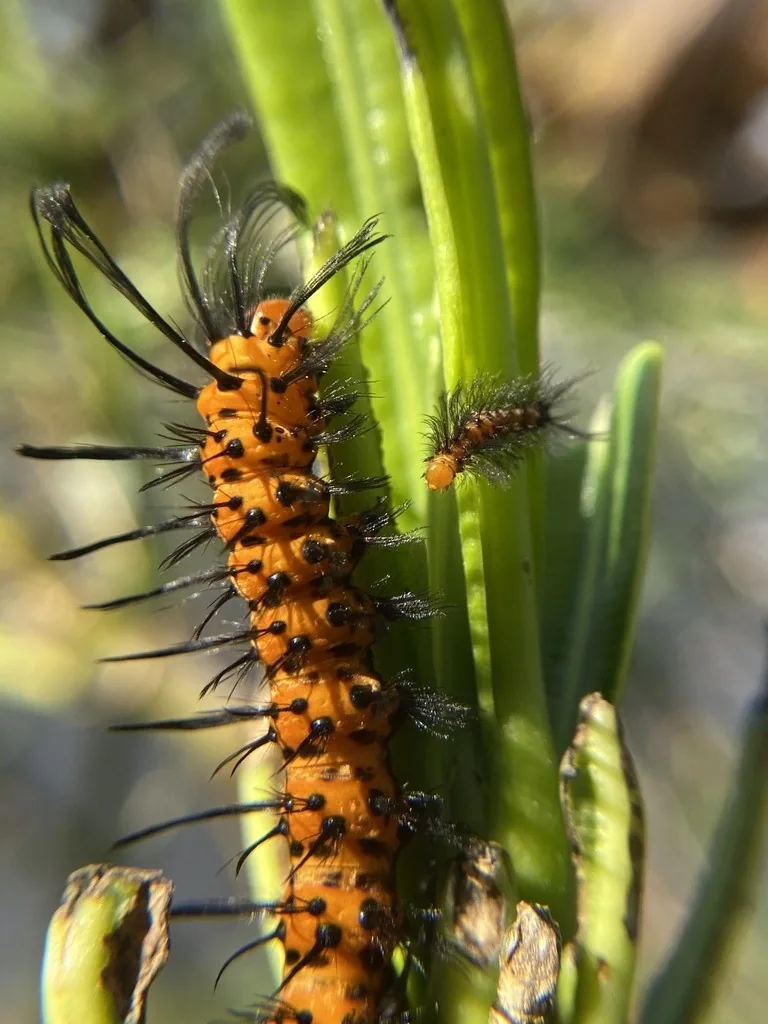
- Caterpillars are bright orange with bristly black hairs, from about 3 mm at hatching to roughly 40 mm when full grown.[1]
- Adults, called polka-dot wasp moths, are metallic blue to blue-green with white spots on the wings and body and red at the end of the abdomen, with a wingspan of roughly 2 inches (4.2 to 5.2 cm in Butterflies and Moths of North America, 45 to 51 mm in Animal Diversity Web). They fly by day. UF/IFAS gives 45 to 51 mm, says males and females look much alike and fly slowly, and explains that wasp moths are named for their resemblance to wasps.[2][1][3]
- Eggs are tiny, less than 1 mm across, laid in clusters of 12 to 75 on the undersides of oleander leaves.[1]
- Pupae are smooth and brown inside a thin cocoon made of silk and caterpillar hairs. UF/IFAS says the pupae gather in groups in depressions on tree trunks or where walls meet the eaves of buildings.[1][3]
Look-alikes
| Look-alike | How to tell them apart |
|---|---|
| Scarlet-bodied wasp moth | Another day-flying wasp moth, but the polka-dot wasp moth's wings and body are dark metallic blue with white spots and only the tip of the abdomen is red.[2] |
| Spotted oleander caterpillar | A related species, Empyreuma pugione, that UF/IFAS says turns up occasionally in south Florida and the Keys.[3] |
Where it lives
Native from South America through Central America and Mexico to the Caribbean, Florida and parts of the southeastern United States. The North American subspecies is locally common in all of Florida except the northwest. UF/IFAS says it lives year-round in south Florida and the Keys but is usually killed by winter cold in northern and north-central Florida, recolonizing those areas each spring. It is thought to have switched to oleander after the Spanish brought the plant in the 17th century, and its range now matches oleander's except that it is not found in California.[1][2][3]
Biology and life cycle
Young caterpillars feed in groups on the undersides of leaves and move down the plant as they grow. From about the fourth stage they feed alone and can eat whole leaves except for the veins. UF/IFAS says egg masses hold 12 to 75 eggs that hatch in two to six days. The group-feeding stage averages about 8.5 days in summer and the solitary stage about 19 days, and the fourth to sixth stages can defoliate whole bushes.[1][3]
There are generally three generations a year, and in Florida adults of the North American subspecies fly in all months.[1][2]
Besides oleander, the caterpillars eat devil's potato (Echites umbellata), thought to be the original host plant.[2][1]
Oleander is poisonous in all parts, and the moths carry heart poisons (cardiac glycosides): a 1973 study found them in the polka-dot moth. UF/IFAS says birds and small mammals don't eat the caterpillars because of their poisonous diet.[4][5][3]
The adults court with ultrasonic calls in the hours before dawn, and females also answer the calls of hunting bats, apparently as a defense. UF/IFAS adds that the moths don't use airborne sex pheromones: females perch on oleander and give an ultrasonic call, inaudible to people, that draws males from great distances.[1][6][3]
Damage and signs
- The caterpillars skeletonize oleander leaves, eating the tissue between the veins. That spoils the plant's looks and, according to Animal Diversity Web, leaves it more open to other insects. UF/IFAS says even total defoliation won't kill the plant, but if it happens year after year the plant may be more open to pests such as scale insects.[1][3]
- Butterflies and Moths of North America calls it a pest of cultivated oleander, and it flourishes in southern Florida.[2][1]
Health risk
None of the sources reports this caterpillar stinging, but MedlinePlus warns that brightly colored caterpillars with bristles or a fuzzy look may be venomous and should not be touched; caterpillar hairs can cause rash, itching, hives or blisters, and rarely a severe allergic reaction. Oleander itself is poisonous to eat.[7][4]
Control
Prevention
Look on the undersides of oleander leaves for egg clusters and groups of young caterpillars, which feed there together before spreading out on their own. If you handle the caterpillars, wear gloves: MedlinePlus advises not touching bristly, brightly colored caterpillars. UF/IFAS says early infestations are easy to spot because the young caterpillars turn new shoots light brown; at that stage they are very easy to control.[1][7][3]
No oleander cultivar resists the caterpillar, though UF/IFAS says it has been suggested that dwarf cultivars may be less susceptible.[3]
Traps and physical control
On bushes under about 2 m, UF/IFAS suggests snipping off the damaged foliage with its group of caterpillars, sealing it in a plastic bag and freezing it for 24 hours; large caterpillars can be hand picked and frozen or dropped into soapy water. Wash your hands right after handling the cut material, since every part of oleander is poisonous.[3][4]
Biological control
UF/IFAS lists predatory stink bugs, tachinid flies, parasitic wasps and red imported fire ants as natural enemies, and says viral, fungal and bacterial diseases can kill huge numbers in some years. Leave dark, limp diseased caterpillars on the bush so the disease spreads.[3]
Pesticides
UF/IFAS treats insecticides as a last resort, since the caterpillar does not kill oleander. It names Bacillus thuringiensis, a microbial insecticide that kills only caterpillars and is not toxic to beneficial insects. Follow the label.[3]
If the hairs touch your skin
Press sticky tape such as duct or masking tape on the spot and pull it off, repeating until the hairs are gone. Wash with soap and water, then ice the area, 10 minutes on and 10 minutes off. If hairs get in the eyes, flush with plenty of water and get medical help, and get care if hairs are breathed in. Poison control: 1-800-222-1222.[7]
Where the sources disagree
North Florida: Butterflies and Moths of North America calls the North American subspecies locally common in all of Florida except the northwest, while UF/IFAS says winter cold usually kills it in northern and north-central Florida and it recolonizes those areas each spring.[2][3]
Common questions
- What are the orange hairy caterpillars on my oleander?
- Most likely oleander caterpillars, the young of the polka-dot wasp moth. They are bright orange with tufts of black hair.[1][2]
- Are oleander caterpillars poisonous to touch?
- None of the sources reports them stinging, but MedlinePlus advises against touching any bristly, brightly colored caterpillar because the hairs can irritate skin and eyes. Use gloves or tools.[7]
- Will oleander caterpillars kill my oleander?
- No. UF/IFAS says even total defoliation won't kill the plant, though repeated defoliation year after year may leave it more open to pests such as scale insects.[3]
Sources
- Animal Diversity Web (University of Michigan Museum of Zoology), “Syntomeida epilais (Animal Diversity Web account).” animaldiversity.org/accounts/Syntomeida_epilais/ (accessed 2026-11-11)
- Butterflies and Moths of North America (BAMONA), “Polka-Dot Wasp Moth, Syntomeida epilais (species account).” www.butterfliesandmoths.org/species/Syntomeida-epilais (accessed 2026-11-11)
- University of Florida IFAS Extension (EDIS), “Oleander Caterpillar, Syntomeida epilais Walker, EENY-009/IN135 (H. J. McAuslane; Featured Creatures).” ask.ifas.ufl.edu/publication/IN135 (accessed 2026-11-14)
- MedlinePlus, U.S. National Library of Medicine, “Oleander poisoning (Medical Encyclopedia).” medlineplus.gov/ency/article/002884.htm (accessed 2026-11-11)
- Proceedings of the Royal Society B, via PubMed, “Cardiac glycosides (heart poisons) in the polka-dot moth Syntomeida epilais (Rothschild et al. 1973).” pubmed.ncbi.nlm.nih.gov/4146014/ (accessed 2026-11-11)
- Journal of Comparative Physiology A, via PubMed, “Is it a bat or a male? A female moth (Syntomeida epilais) adapts its acoustic signals for defense or courtship (Coro 2025).” pubmed.ncbi.nlm.nih.gov/40140060/ (accessed 2026-11-11)
- MedlinePlus, U.S. National Library of Medicine, “Caterpillars (Medical Encyclopedia).” medlineplus.gov/ency/article/002860.htm (accessed 2026-11-11)
- iNaturalist, “Syntomeida epilais taxon page (order and family).” www.inaturalist.org/taxa/120875 (accessed 2026-11-11)