On this page
How to identify it
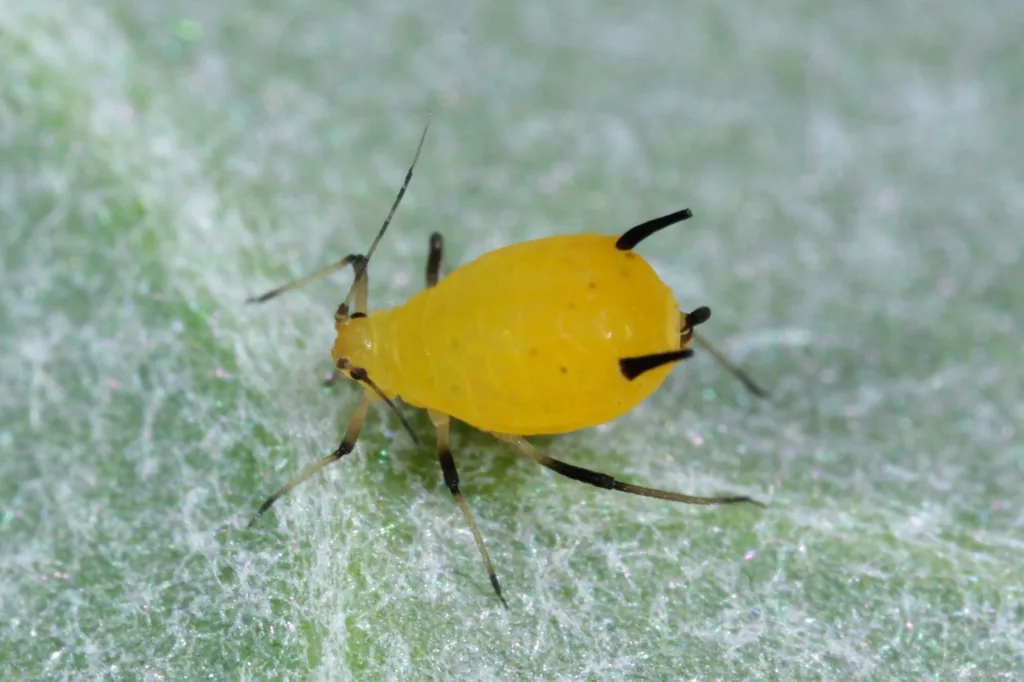
- Oleander aphids are bright yellow with black legs, antennae and cornicles (the two tail pipes). UF/IFAS says wingless females also have a black tail tip (cauda), winged females are yellow and black with dark wing veins, and adults are 1.5 to 2.6 mm long; nymphs look like smaller wingless adults.[1][2][3][4]
- They cluster on terminal growth, often densely. Winged adults usually appear once a plant gets crowded or starts to decline and fly to new plants.[1][3]
- All are females that give birth to live young without mating; there are no males and no egg stage.[1][3]
- Ants often tend the colonies for their honeydew, so following ants can lead you to small colonies.[2]
Look-alikes
| Look-alike | How to tell them apart |
|---|---|
| Other aphids | Look for the combination of a bright yellow body and black legs, antennae and cornicles, on milkweed, oleander or their relatives.[1][2] |
Where it lives
Illinois Extension says it is native to the Mediterranean region, where its main host is oleander, and South Dakota State says it reached the U.S. on oleander. NC State finds it on oleander in southeastern North Carolina and on butterfly weed across the rest of the state, and South Dakota State and Illinois Extension report it on milkweeds in their states. UF/IFAS calls it cosmopolitan in tropical to warm temperate regions and says it probably originated in the Mediterranean, home of its main host, oleander.[3][2][1][4]
Biology and life cycle
Females produce only female nymphs, which molt five times as they mature and then produce more nymphs.[1]
Because they reproduce without mating, and winged adults move in from elsewhere, populations can explode in a short time.[1][2][3]
On milkweed they take up the plant's cardenolide toxins, which South Dakota State says are toxic to predators, so predators sometimes leave them alone. UF/IFAS says the aphids also load these cardiac glycosides, which are heart poisons, into their cornicle secretions; together with their warning colors this protects them from certain birds and spiders.[2][4]
Parasitic wasps lay eggs in the nymphs. UF/IFAS says a parasitized aphid becomes a papery, light brown, swollen mummy, and a single wasp emerges once it has eaten the aphid's body.[4]
Damage and signs
- Hosts include oleander and its relative vinca, butterfly weed and scarlet milkweed, common and swamp milkweed, and wax plant (Hoya). UF/IFAS adds other milkweed relatives (Gomphocarpus and Calotropis), occasional plants in the aster, morning glory and spurge families, and citrus.[1][2][4]
- They suck sap from the phloem and excrete sticky honeydew, which grows sooty mold. Heavy colonies deform terminal growth and stunt plants.[1][2][3]
- It can transmit plant viruses, including sugarcane mosaic and papaya ringspot viruses, but UF/IFAS says the main concern in Florida is the large, unsightly colonies; for nurseries, repeated heavy infestations through the year can stunt plants.[4]
Health risk
It feeds only on plants; none of these sources reports a risk to people or pets.[1][2]
Control
Prevention
Don't fertilize milkweed, since aphids multiply faster on plants high in nitrogen, and keep plants watered so they tolerate feeding. On oleander, UF/IFAS says cultural control works best: less watering, pruning and fertilizing means fewer tender shoots, the aphid's favorite food.[2][4]
Traps and physical control
On milkweed, squish colonies with your fingers (gloves help, it is sticky). A strong stream of water also knocks them off, but it can wash away monarch eggs and small caterpillars too. UF/IFAS also suggests pruning out and discarding infested shoots on small plants grown for butterflies.[2][3][4]
Biological control
Parasitic wasps, lady beetles, syrphid fly larvae and lacewings often bring populations down quickly.[1][3]
Pesticides
Do not spray milkweed meant for monarchs; anything that kills the aphids will also kill monarch caterpillars. On oleander and other ornamentals, insecticidal soap or horticultural oil can be used: water first and spray early in the morning or late in the evening so residue dries before direct sun. UF/IFAS says soaps and oils are often effective and other insecticides aren't necessary in home gardens, given how well natural enemies work.[2][3][1][4]
Where sources disagree
Natural enemies: NC State and Illinois Extension say predators and parasites often reduce oleander aphid colonies quickly, while South Dakota State says the milkweed toxins the aphids carry sometimes keep predators away. UF/IFAS says the toxins protect them from certain birds and spiders but don't appear to harm parasitoids and insect predators, and that natural biological control can be quite effective.[1][3][2][4]
Water sprays: Illinois Extension says a strong stream of water is often all that is needed, while South Dakota State advises against high-pressure water because it can remove monarch caterpillars. UF/IFAS lists a strong stream of water as one option on smaller plants grown for butterflies.[3][2][4]
Common questions
- What are the yellow aphids on my milkweed?
- Oleander aphids, also called milkweed aphids. They also infest oleander and butterfly weed.[1][2][3]
- Should I spray milkweed?
- No. Insecticides would also kill monarch caterpillars. Squish the aphids by hand, skip fertilizer, and let natural enemies work.[2][3]
- Why do they build up so fast?
- Every oleander aphid is a female that gives birth to live young without mating, and winged adults keep arriving from other plants.[1][3]
- Do oleander aphids spread plant diseases?
- They can transmit some plant viruses, including sugarcane mosaic and papaya ringspot viruses, but UF/IFAS says the main problem in Florida is the large, unsightly colonies themselves.[4]
- What are the swollen tan aphids in the colony?
- Probably mummies: aphids killed by a tiny parasitic wasp developing inside. UF/IFAS describes them as papery, light brown and swollen, and a new wasp emerges from each one, a sign natural control is at work.[4]
Sources
- NC State Extension, “Oleander Aphid.” content.ces.ncsu.edu/oleander-aphid (accessed 2026-11-11)
- South Dakota State University Extension, “Are Aphids on Milkweed Really a Bad Thing?.” extension.sdstate.edu/are-aphids-milkweed-really-bad-thing (accessed 2026-11-11)
- University of Illinois Extension, “More than monarchs: What are those bugs on my milkweed? (Good Growing, 2021).” extension.illinois.edu/blogs/good-growing/2021-07-30-more-monarchs-what-are-those-bugs-my-milkweed (accessed 2026-11-11)
- University of Florida IFAS Extension (EDIS), “Oleander Aphid, Aphis nerii Boyer de Fonscolombe, EENY247/IN520 (H. J. McAuslane; Featured Creatures).” ask.ifas.ufl.edu/publication/IN520 (accessed 2026-11-14)
- iNaturalist, “Aphis nerii taxon page (order and family).” www.inaturalist.org/taxa/71154 (accessed 2026-10-06)