On this page
How to identify it
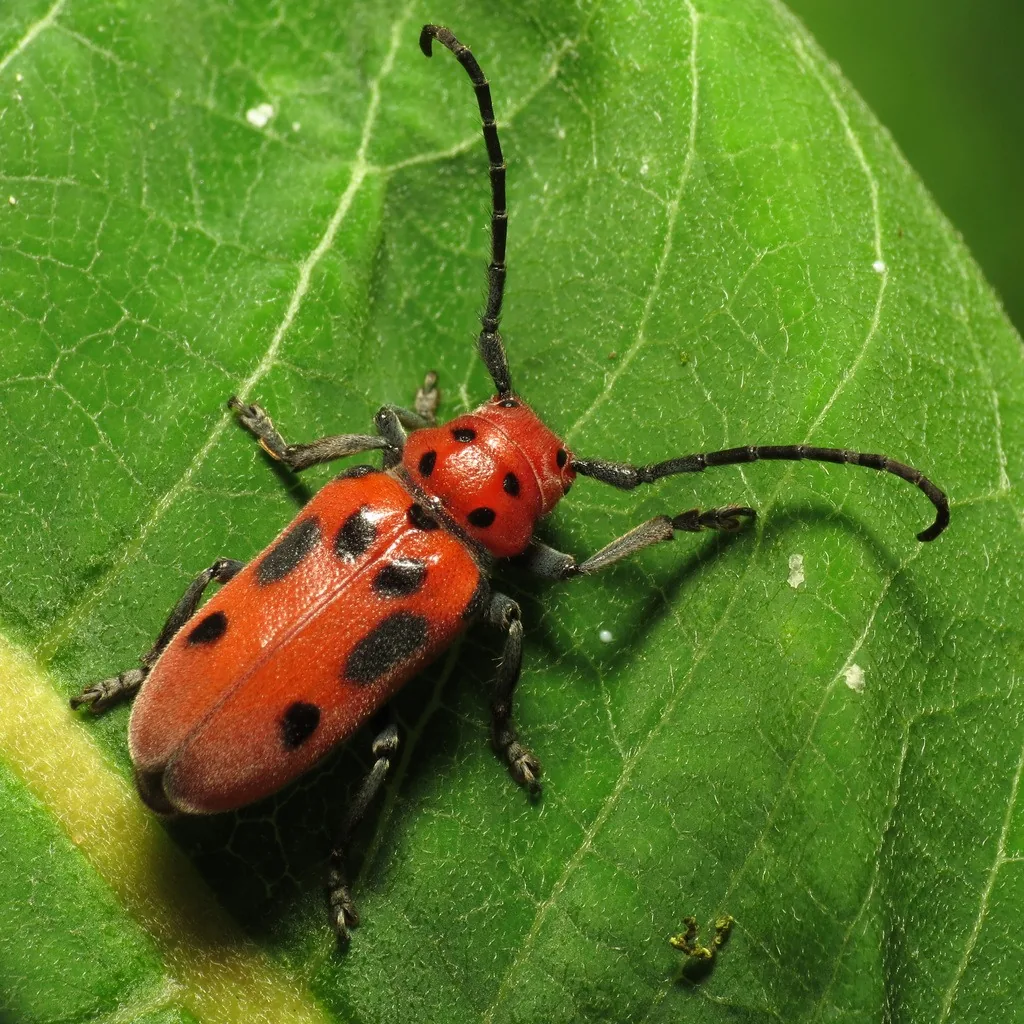
- Milkweed longhorns are reddish to red-orange with black spots and about 10 to 16 mm (roughly 3/8 to 5/8 inch) long; the red milkweed beetle is darker red than the western species.[1]
- The red milkweed beetle has all-black antennae and all-black legs, fairly large black spots, and an elongated middle spot on each wing cover.[2]
- The antennae are at least half as long as the body, and each antenna base splits an eye in two, so the beetle seems to have four eyes. Both the genus name and the species name mean four-eyed.[2][3]
- Males are smaller than females.[3]
- Held in the fingers, the beetles make a shrill squeak; they also make a softer purring sound that may be used between possible mates.[1][3]
Look-alikes
| Look-alike | How to tell them apart |
|---|---|
| Red-femured milkweed borer (Tetraopes femoratus) | Its antennae have white rings, its legs are partly reddish and its black spots are smaller. It is variable and widespread and feeds on several kinds of milkweed.[2] |
| Other milkweed longhorns | Several other Tetraopes species live in the West and patterns vary a lot; one small species, T. discoideus, is only 7 to 9 mm. In the East, the blackened milkweed beetle (T. melanurus) has heavy black, heart-shaped markings at the rear of the wing covers and feeds mostly on butterfly weed.[1][2][3] |
Where it lives
Colorado State calls it the most common milkweed longhorn in the eastern United States, reaching into eastern Colorado, where it is found mostly in the southeastern counties. The Missouri Department of Conservation says at least three species are common in the East and that each species' range follows its favorite milkweeds. GBIF holds about 30,000 US records since 1990 from 30 states, counting the District of Columbia, most from Illinois, New York and Pennsylvania.[1][2][7]
Biology and life cycle
Adults spend nearly all their time on milkweed, feeding, resting and mating, and typically live about a month. Mating is seen most often on cool, overcast days.[1]
Females lay eggs at the base of milkweed stems, sometimes inserting them into the stem, and may also lay them on dried milkweed stubs or a nearby grass stalk. The newly hatched larvae tunnel through the soil or just under the skin of the stem to reach the roots.[1][3]
Larvae feed on the roots through late summer and fall and probably into early spring, living in the soil around small roots or tunneling into large taproots. When full grown they move a few inches from the plant, pupate in a chamber of packed soil, and emerge as adults about a month later. There is one generation a year.[1][3][2]
A study of the beetle's sodium-potassium pump, the enzyme milkweed toxins attack, found it three times more tolerant of root extracts than of leaf toxins, and two amino acid changes accounted for more than half of that tolerance. The beetle stores milkweed toxins in its own tissues.[4]
Like some other milkweed leaf feeders, adults cut leaf veins before feeding beyond the cut, which blocks the flow of sticky latex to the spot where they eat.[5][3]
Beetles from a population on a smaller milkweed with thinner stems and rhizomes (Asclepias verticillata) were smaller than those on common milkweed, and smaller beetles lived shorter lives and had fewer ovarioles and smaller eggs.[6]
Damage and signs
Health risk
None of these sources reports bites, stings or any harm to people. The beetle's warning colors signal that it is unpalatable or sickening to predators because of the milkweed chemicals it takes in.[1][2][3][4]
Control
Prevention
Neither Colorado State nor the Missouri Department of Conservation recommends controlling milkweed longhorns. Both describe beetles that live and feed only on milkweeds, and the Missouri Department of Conservation says to look for them on milkweeds and dogbanes in prairies and along roadsides.[1][2]
Where sources disagree
Where the eggs go: Colorado State calls the egg-laying site a subject of continued discussion. Most milkweed longhorns lay at the root crown, but the red milkweed beetle may also lay on dried milkweed stubs or nearby grasses; the UW-Milwaukee Field Station says eggs go at the base of the stem, sometimes into it.[1][3]
Which milkweeds: the Missouri Department of Conservation says the red milkweed beetle specializes on common milkweed and sometimes uses other milkweeds or dogbanes. The UW-Milwaukee Field Station notes records on swamp, whorled and green milkweeds, and a 1976 study followed a population that had shifted to whorled milkweed.[2][3][6]
Where the larvae feed: Colorado State says larvae on small-rooted milkweeds live in the soil and chew the roots, while large taproots get tunneled. The UW-Milwaukee Field Station describes larvae in the soil and notes some sources say they bore in and feed inside the root, where they spend the winter.[1][3]
Common questions
- What are the red beetles with black spots on my milkweed?
- Most likely red milkweed beetles or a related milkweed longhorn. The red milkweed beetle has all-black antennae and legs; a white-ringed antenna points to the red-femured milkweed borer.[1][2]
- Will they kill my milkweed?
- The sources describe adults chewing leaves, buds and flowers and larvae feeding on roots, but none of them treats the beetle as a pest that needs control.[1][2][3]
- Why did the beetle squeak when I picked it up?
- Milkweed longhorns rub ridges on the thorax together to squeak when held, apparently as a warning.[1][3]
- Why are they so brightly colored?
- The red is a warning. The beetles take in milkweed toxins that make them unpalatable or sickening to predators.[2][4]
Sources
- Colorado State University Extension (Colorado Insects of Interest, W. Cranshaw), “Milkweed Longhorns (Colorado Insects of Interest).” wci.extension.colostate.edu/wp-content/uploads/sites/14/2017/03/Milkweed.longhorns.pdf (accessed 2026-11-11)
- Missouri Department of Conservation, “Milkweed Longhorns (field guide).” mdc.mo.gov/discover-nature/field-guide/milkweed-longhorns (accessed 2026-11-11)
- University of Wisconsin-Milwaukee Field Station, “Red Milkweed Beetle (Family Cerambycidae), Bug of the Week (K. Redmond, 'the BugLady').” uwm.edu/field-station/red-milkweed-beetle/ (accessed 2026-11-11). University field station's natural-history column
- Proceedings of the National Academy of Sciences, via PubMed, “Tissue-specific plant toxins and adaptation in a specialist root herbivore (Agrawal and Hastings 2023).” pubmed.ncbi.nlm.nih.gov/37216531/ (accessed 2026-11-11). Cited from the PubMed abstract.
- Science, via PubMed, “Vein-cutting behavior: insect counterploy to the latex defense of plants (Dussourd and Eisner 1987).” pubmed.ncbi.nlm.nih.gov/3616620/ (accessed 2026-11-11). Cited from the PubMed abstract.
- Oecologia, via PubMed, “Consequences for the milkweed longhorn beetle of a host-plant shift from Asclepias syriaca to A. verticillata (Price and Willson 1976).” pubmed.ncbi.nlm.nih.gov/28309199/ (accessed 2026-11-11). Cited from the PubMed abstract.
- Global Biodiversity Information Facility (GBIF), “Tetraopes tetrophthalmus: US occurrence records since 1990 by state (GBIF occurrence search API).” api.gbif.org/v1/occurrence/search?taxonKey=5002722&country=US&hasGeospatialIssue=false&occurrenceStatus=PRESENT&year=1990%2C2026&facet=stateProvince&facetLimit=400&limit=0 (accessed 2026-11-11). State counts are records reported (iNaturalist research-grade, museum specimens, surveys), not abundance.
- iNaturalist, “Tetraopes tetrophthalmus taxon page (order and family).” www.inaturalist.org/taxa/118559 (accessed 2026-11-11)