On this page
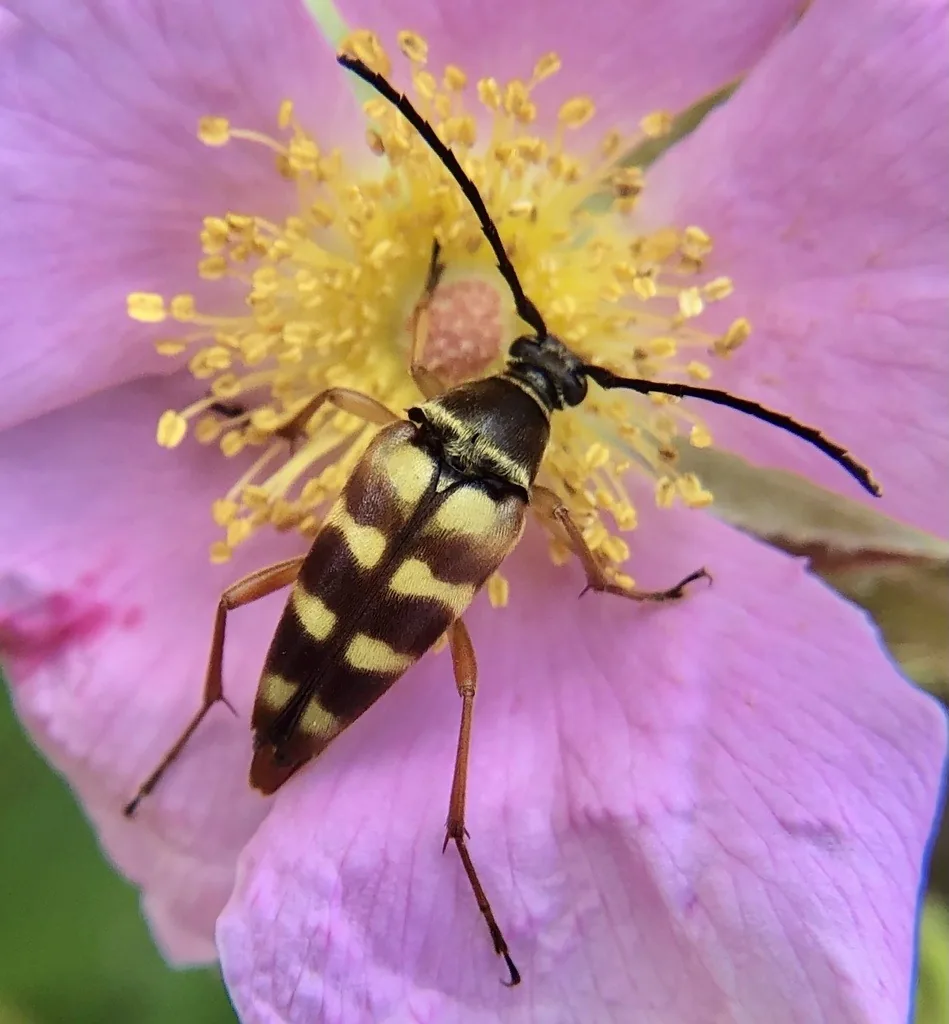
How to identify it
Where it lives
Eastern North America from Nova Scotia to Florida, south Texas, eastern Colorado and southern Manitoba. It is found statewide in Kentucky, MDC calls it common in Missouri, genetic studies sampled it at 17 sites across Indiana, and in southern Illinois it has been collected near or in oak-hickory forest.[5][1][2][6]
Biology and life cycle
Adults are found in fields and other open places where flowers are blooming, and also around lights at night.[1]
The larvae feed on decaying oak and hickory wood.[1]
To complete its life cycle it needs open flowering habitat, such as shrubland, grassland or pasture, where adults feed and mate, next to woodland that holds dead and decaying wood for the larvae.[3]
In Indiana, genetic differences between its populations were explained far better by how well suitable habitat connects across the landscape than by distance alone.[2][3]
Adults are active by day and are most often collected on flowers. In Kentucky, nearly all records come from June and July, and adults have been taken on viburnum, black cohosh, Queen Anne's lace, milkweed, elderberry, red clover and daisies.[5]
Published flower records also include yarrow, wild hydrangea, spiraea, New Jersey tea, thistles, sweet clover, sumac, blackberries and goldenrod.[5]
Fun fact: Kentucky researchers think it is the most abundant Typocerus there because its larvae can use both hardwoods and conifers.[5]
Damage and signs
- The larvae feed on decaying oak and hickory wood, and the adults feed at flowers.[1]
Health risk
It is a flower-visiting beetle, and none of these sources describes any risk to people.[1][2]
Control
Prevention
No control is needed. Adults are flower visitors that researchers treat as pollinators, and the larvae develop in decaying wood.[1][2][3]
Where sources disagree
Larval food: MDC says the larvae feed on decaying oak and hickory wood, while the Kentucky survey, citing a world catalog, lists a much wider range of larval hosts, including birch, American beech, tuliptree, cottonwood, willow, sassafras and conifers such as pitch pine and eastern redcedar.[1][5]
Common questions
- Is the banded longhorn a pest of trees?
- MDC says its larvae feed on decaying oak and hickory wood, and researchers describe the species as needing dead and decaying wood for its larvae.[1][3]
- Why do I see banded longhorns on flowers?
- Adults visit flowers for nectar and feed and mate in open flowering habitat. Researchers study the species as a pollinator.[1][3][2]
- Do banded longhorns come to lights?
- Yes. MDC notes that adults turn up around lights at night as well as on flowers.[1]
- When are banded longhorns out?
- Mostly in early to midsummer: in Kentucky, nearly all collection records are from June and July.[5]
- Is the banded longhorn harmful?
- No. Adults visit flowers for nectar and are studied as pollinators, and the larvae feed in decaying wood; none of these sources describes any risk to people or healthy trees.[1][2][5]
Sources
- Missouri Department of Conservation, “Banded Longhorn (Field Guide).” mdc.mo.gov/discover-nature/field-guide/banded-longhorn (accessed 2026-11-12)
- Molecular Ecology (Wiley), indexed in PubMed (PMID 27552358), “Abdel Moniem, Schemerhorn, DeWoody and Holland. Landscape genetics of a pollinator longhorn beetle [Typocerus v. velutinus (Olivier)] on a continuous habitat surface. Molecular Ecology 25: 5015-5028 (2016), doi:10.1111/mec.13819 (abstract).” doi.org/10.1111/mec.13819 (accessed 2026-11-12)
- Frontiers in Genetics (Frontiers Media), full text in PubMed Central (PMC7136975), “Borthwick et al. Alternative Quantifications of Landscape Complementation to Model Gene Flow in Banded Longhorn Beetles [Typocerus v. velutinus (Olivier)]. Frontiers in Genetics 11: 307 (2020), doi:10.3389/fgene.2020.00307.” doi.org/10.3389/fgene.2020.00307 (accessed 2026-11-12)
- iNaturalist, “Typocerus velutinus taxon page (order and family).” www.inaturalist.org/taxa/131862 (accessed 2026-11-12)
- Zootaxa 5229(1), 2023, via Plazi TreatmentBank, “The longhorn beetles (Coleoptera: Cerambycidae) of Kentucky with notes on larval hosts, adult nectar use, and semiochemical attraction (Chapman, Richards and Dupuis), Typocerus velutinus treatment.” treatment.plazi.org/id/7E6F5F56FFEEFFF3CCCFFF25FB3F314C (accessed 2026-11-12)
- The Great Lakes Entomologist 23(3), via Crossref, “Typocerus deceptus in Southern Illinois (Coleoptera: Cerambycidae).” doi.org/10.22543/0090-0222.1710 (accessed 2026-11-12). Cited from the abstract.