On this page
How to identify it
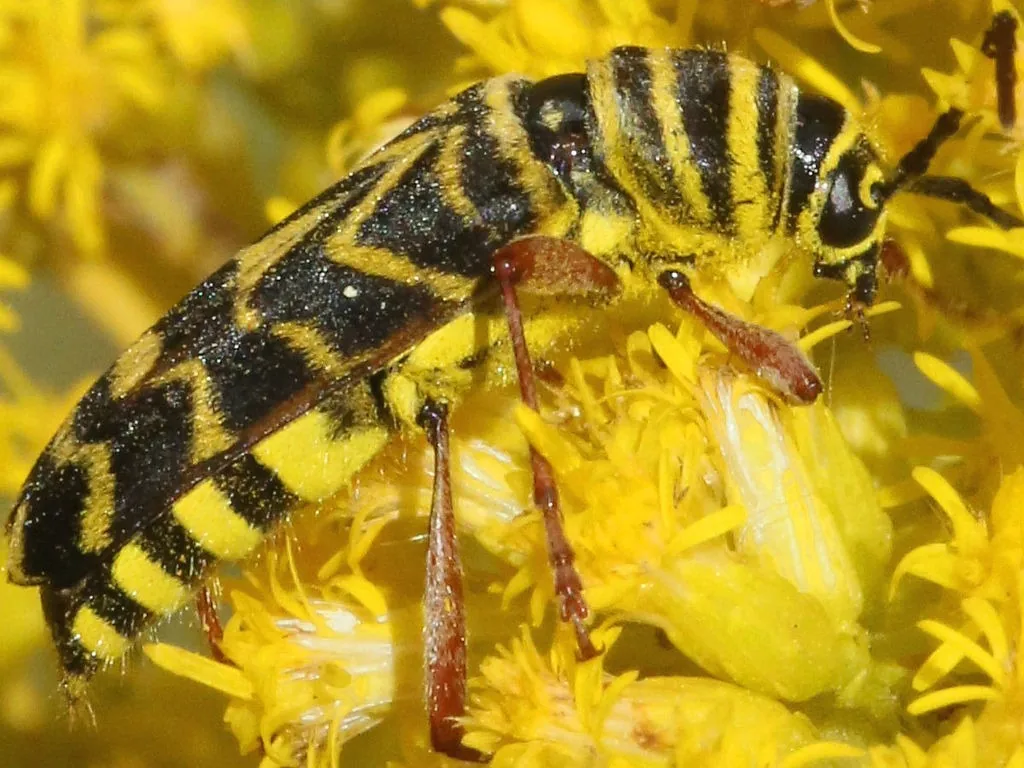
- Adults are slender longhorned beetles with a jet-black body encircled by bright yellow bands; a W-shaped band crosses the wing covers. The Forest Service leaflet describes reddish legs and black antennae, and says males and females look alike.[2][1]
- Size estimates differ: UMass gives 1/2 to 1 inch, the Forest Service leaflet about 3/4 inch (1.9 cm).[1][2]
- Larvae are white, legless and cylindrical, about an inch long and a quarter inch thick when mature.[1][2]
- Signs change through the year: wet spots on the bark around bud swell, white wood dust pushed out of holes in late spring and early summer, and yellow dust by late summer, sometimes piling in a ring around the base of a heavily infested tree. UMass adds holes, sap staining or leaking, and pushed-out frass and wood chips.[2][1]
- Older infestations show dead and broken limbs and knotty swellings on the trunk.[2]
Look-alikes
| Look-alike | How to tell them apart |
|---|---|
| Painted hickory borer | Ohio State University Extension says this close relative shares similar markings and is often misidentified as the locust borer, but it emerges in spring, often from firewood, and infests only trees dead less than a year or recently cut wood. Locust borers emerge in late summer to early fall, when goldenrod blooms.[7] |
Where it lives
The Forest Service leaflet says its original range probably matched that of black locust, along the Allegheny Mountains from Pennsylvania to Georgia and in the Ozarks, and that planting the tree spread the borer over most of the United States, from eastern Canada south to the Gulf States and west to Washington, Colorado and Arizona. UMass says it is found in most places black locust occurs and can be particularly damaging in the Northeast and central US. GBIF holds about 18,900 records, about 16,400 from the US and 2,400 from Canada; its roughly 15,300 US records since 1990 come mostly from New York, Massachusetts and Ohio.[2][1][9][4]
Biology and life cycle
Adults appear when goldenrod blooms and are most abundant in September, commonly feeding on goldenrod pollen. UMass says they are seen from early September until the first frost.[2][1]
Egg laying runs from early afternoon until late evening, from late August through early October. The Forest Service says females lay eggs prolifically under bark scales, in callus tissue around pruning wounds and in bark cracks; UMass says a female lays one to several eggs in bark cracks and crevices, sometimes in old emergence holes.[2][1]
Females choose the shady side of the trunk when the air is warmer than 75°F and sunlit trunks when it is below 70°F, so densely shaded stands get fewer eggs in cool weather.[2]
Eggs hatch in about a week. Young larvae bore into the inner bark and spend the winter in small hibernation cells.[1][2]
When buds swell in spring, larvae bore into the wood, making tunnels 3 to 4 inches long and pushing out their frass. Most mature and pupate by mid-July, and adults emerge through the larval openings. There is one generation a year.[2][1]
Rival males fight for females: a study of mating contests found challengers using seven tactics, including wedging, prying, biting and kicking, and smaller males did as well as larger ones by picking different tactics.[5]
Damage and signs
- The Forest Service leaflet says it attacks only black locust and its cultivars and that honey locust is not affected; UMass lists only black locust as a host.[2][1]
- Larval tunnels weaken trunks and branches so they break in the wind, leaving deformed trees or clumps of sprouts. UMass says the tree is often not killed outright; Missouri says infestations often kill weakened or damaged locusts.[2][1][3]
- UMass says it prefers trees at least 4 years old and attacks trunks much less once they reach 15 cm across. The Forest Service says that in stands 10 or more years old, fast-growing dominant trees are usually able to withstand attack, while slower growing overtopped trees are badly damaged or killed, and drought-weakened trees on poor sites are especially susceptible.[1][2]
Health risk
The sources describe it only as a borer of black locust and a pollen-feeding beetle; no cited source describes any risk to people or pets.[2][1][3]
Control
Prevention
Keep trees healthy and vigorous, grow them on a suitable site and water during drought; the Forest Service says the healthier the tree, the lower the incidence of borer damage.[1][2]
Callus tissue around pruning wounds is an ideal egg-laying site, according to the Forest Service leaflet.[2]
For woodlots, mixed plantings and thinning out overtopped, intermediate or decadent trees reduce injury, and the Forest Service says spraying is not considered practical in a forest. UMass says resistant cultivars exist, while the Forest Service found good growing conditions mattered more than genetic resistance.[2][1]
Sanitation
Old black locusts with dying tops serve as brood trees. The Forest Service advises cutting them during the dormant period and peeling or burning them to destroy the larvae. UMass suggests removing goldenrod near ornamental trees, since adults feed there.[2][1]
Traps and physical control
Check the sunny side of young trees for holes, leaking sap and pushed-out frass, especially trees showing dieback.[1]
Pesticides
UMass lists several insecticide active ingredients for this borer and advises applying after bloom to protect pollinators. Check that any product is currently registered and that its label covers borers on trees.[1]
A beetle dressed as a wasp
Its black and yellow pattern copies stinging insects such as yellowjackets and paper wasps, which the Missouri Department of Conservation says gives it some protection from predators.[3][6]
The mimicry may go beyond looks: a 2017 study found that females release spiroacetals, compounds that are common in the alarm pheromones of vespid wasps.[6]
Where the sources disagree
Size: UMass gives 1/2 to 1 inch for adults; the Forest Service leaflet gives about 3/4 inch (1.9 cm).[1][2]
Tree death: UMass says the tree is often not killed outright; the Missouri Department of Conservation says infestations often kill weakened or damaged locusts, and the Forest Service says overtopped trees are badly damaged or killed and that epidemic populations sometimes kill even large dominant trees.[1][3][2]
Eggs: UMass says a female lays one to several eggs in bark cracks and crevices; the Forest Service says females lay eggs prolifically.[1][2]
Resistance: UMass says resistant cultivars exist; the Forest Service says studies with genetically identical cuttings showed good growing conditions matter more than genetic resistance.[1][2]
Common questions
- What is the black and yellow beetle on my goldenrod?
- In early fall it is often the locust borer, which feeds on goldenrod pollen as an adult. Ohio State Extension notes that the similar painted hickory borer emerges in spring instead.[1][2][7]
- What is oozing from my black locust trunk?
- Sap around small holes, with sawdust-like frass, points to locust borer larvae; the Forest Service says sap oozes around small holes when larvae start boring into the wood as buds swell in spring.[1][2]
- Does the locust borer attack honeylocust?
- The Forest Service leaflet says honey locust is not affected and that the borer attacks only black locust and its cultivars; UMass also lists only black locust.[2][1]
- How do I protect a black locust?
- Keep it vigorous and watered in drought, check the sunny side of the trunk for holes and pushed-out frass, and remove nearby old locusts with dying tops, which the Forest Service says serve as brood trees.[1][2]
Sources
- UMass Extension Landscape, Nursery and Urban Forestry Program (Landscape Insect & Mite Guide), “Megacyllene robiniae (Locust Borer).” www.umass.edu/agriculture-food-environment/landscape/publications-resources/insect-mite-guide/megacyllene-robiniae (accessed 2026-11-13)
- USDA Forest Service, “The Locust Borer, Forest Insect and Disease Leaflet 71 (J. R. Galford, revised April 1984).” www.fs.usda.gov/foresthealth/docs/fidls/FIDL-71-LocustBorer.pdf (accessed 2026-11-13). Scanned PDF; text read by OCR. Its 1984 pesticide recommendations are not repeated here.
- Missouri Department of Conservation, “Locust Borer (Field Guide).” mdc.mo.gov/discover-nature/field-guide/locust-borer (accessed 2026-11-13)
- Global Biodiversity Information Facility (GBIF), “Megacyllene robiniae: U.S. occurrence records since 1990 by state (GBIF occurrence search).” api.gbif.org/v1/occurrence/search?taxonKey=1150515&country=US&hasGeospatialIssue=false&occurrenceStatus=PRESENT&year=1990%2C2026&facet=stateProvince&facetLimit=400&limit=0 (accessed 2026-11-13)
- Environmental Entomology, via PubMed, “Male Megacyllene robiniae (Coleoptera: Cerambycidae) use multiple tactics when aggressively competing for mates (Ray, Ginzel and Hanks 2009).” pubmed.ncbi.nlm.nih.gov/19389292/ (accessed 2026-11-13)
- Journal of Chemical Ecology, via PubMed, “Evidence that cerambycid beetles mimic vespid wasps in odor as well as appearance (Mitchell et al. 2017).” pubmed.ncbi.nlm.nih.gov/27995365/ (accessed 2026-11-13)
- Ohio State University Extension, “Painted Hickory Borers Flare-Up from Firewood (J. Boggs, April 2, 2019), Buckeye Yard and Garden onLine.” bygl.osu.edu/node/1223 (accessed 2026-11-13)
- Global Biodiversity Information Facility (GBIF), “Megacyllene robiniae (Forster, 1771) (GBIF Backbone Taxonomy).” api.gbif.org/v1/species/1150515 (accessed 2026-11-13)
- Global Biodiversity Information Facility (GBIF), “Megacyllene robiniae: occurrence records by country (GBIF occurrence search).” api.gbif.org/v1/occurrence/search?taxonKey=1150515&facet=country&facetLimit=20&limit=0 (accessed 2026-11-13)