On this page
How to identify it
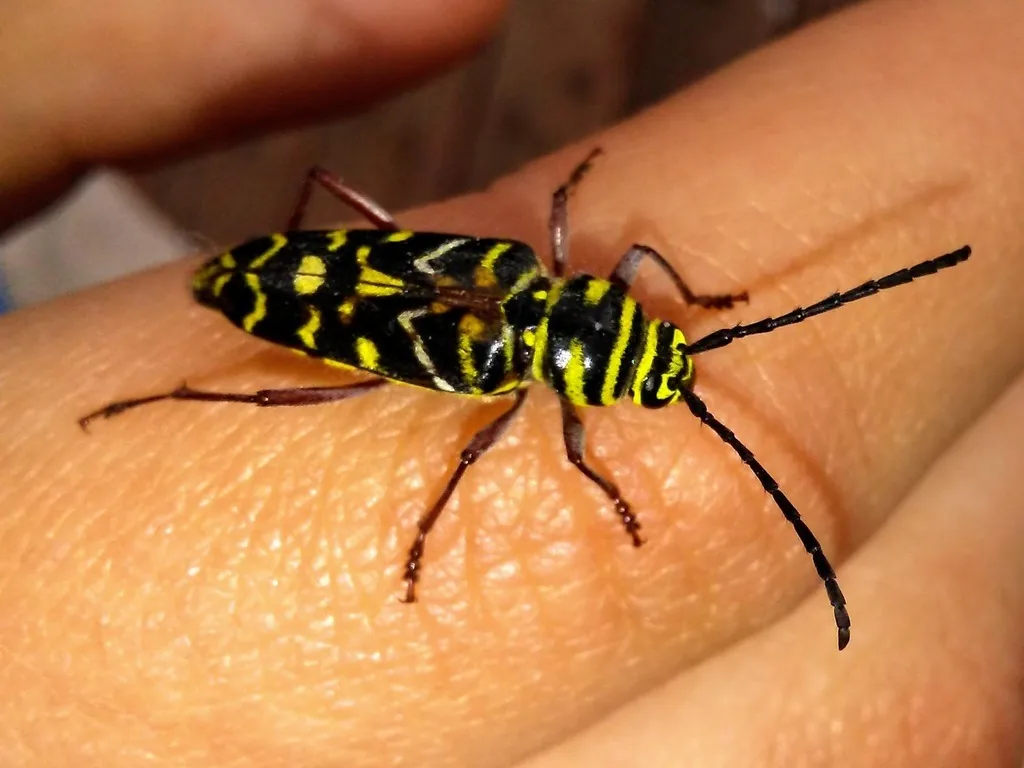
- Ohio State says adults are just over an inch long and black with yellow bands and chevrons across the back; Virginia says it looks very much like the closely related locust borer, which has a yellow W-shaped band across the wing covers.[3][2]
- Adults are active in spring and early summer, often appearing indoors when firewood stored in a warm house or garage speeds their emergence.[3][2][4]
Look-alikes
| Look-alike | How to tell them apart |
|---|---|
| Locust borer | Nearly identical in color and pattern, but locust borer adults emerge in late summer to early fall, often on goldenrod, and Virginia says they attack black locust and its ornamental cultivars; painted hickory borers emerge in spring and use many hardwoods.[1][5][2] |
Where it lives
It is a native beetle, commonly reported emerging from firewood and logs in Ohio, Virginia and Kansas.[1][2][4]
Biology and life cycle
Larvae develop in stressed, dying or recently cut hickory and other hardwoods; Ohio State says they infest only trees that died within a year or wood cut within a year, and K-State says logs cut the previous winter are their preferred egg-laying sites. See where the sources disagree on hosts.[2][1][4]
When infested wood is cut for firewood, the larvae come along, and indoor warmth can bring adults out early. K-State gives a one-year life cycle.[3][5][4]
Damage and signs
- Ohio State says it presents no risk to wood furniture, flooring, paneling or other processed wood in homes, or wood used in construction; Virginia calls it a nuisance but not a structural pest.[1][5][2]
- Ohio State calls it a forest products pest because it may infest fresh-cut logs used for lumber or firewood, and the beetles are a nuisance when they emerge indoors.[1][2]
Health risk
Ohio State and Virginia describe it only as a nuisance indoors and don't mention any risk to people or pets.[1][5][2]
Control
Prevention
Ohio State says not to store firewood inside a home: keep it outside, bring in only small amounts as needed, and keep long-term woodpiles a distance away from the house.[5]
Traps and physical control
Ohio State says no controls are needed; just usher any beetles that emerge indoors out the door.[3]
Where the sources disagree
Hosts: Ohio State lists hickory, ash, black locust, hackberry, honeylocust, oak, Osage orange, walnut, butternut and occasionally maple; K-State lists ash, black walnut, hackberry, mulberry and oak; Virginia says hickory and other hardwoods.[1][4][2]
Season: K-State says it is active only in spring; Ohio State's 2016 alert says spring and early summer.[4][3]
Common questions
- Are the yellow-and-black beetles coming out of my firewood dangerous to my house?
- No. Ohio State says painted hickory borers infest only recently dead trees and raw wood such as firewood, and pose no risk to furniture, floors or house framing.[1][5][2]
- How do I tell a painted hickory borer from a locust borer?
- Mostly by season: painted hickory borers emerge in spring, while locust borers show up in late summer and early fall, often on goldenrod.[1][5][2]
Sources
- Ohio State University Extension, “Painted Hickory Borers Flare-Up from Firewood (Buckeye Yard & Garden onLine).” bygl.osu.edu/node/1223 (accessed 2026-11-13)
- Virginia Cooperative Extension, “Locust Borer, ENTO-141 (P. L. S. Wooden, T. A. Dellinger and E. R. Day; revised July 31, 2026; includes a note on the painted hickory borer).” www.pubs.ext.vt.edu/ENTO/ENTO-141/ENTO-141.html (accessed 2026-11-13)
- Ohio State University Extension, “Painted Hickory Borers Show Up in Homes (Buckeye Yard & Garden onLine).” bygl.osu.edu/node/89 (accessed 2026-11-13)
- Kansas State University Agricultural Experiment Station and Cooperative Extension Service, “Borers: Common Kansas Species (Home and Horticultural Pests), MF-2735 (R. J. Bauernfeind, October 2006).” bookstore.ksre.ksu.edu/pubs/borers-common-kansas-species-home-and-horticultural-pests_MF2735.pdf (accessed 2026-11-13)
- Ohio State University Extension, “A Pantry Pest "Morphs" Into Bark Beetles: firewood nuisance pests (Buckeye Yard & Garden onLine).” bygl.osu.edu/node/2108 (accessed 2026-11-13)
- Global Biodiversity Information Facility (GBIF), “Megacyllene caryae (Gahan, 1908) (GBIF Backbone Taxonomy).” api.gbif.org/v1/species/9075985 (accessed 2026-11-13)
- iNaturalist, “Megacyllene caryae taxon page (order and family).” www.inaturalist.org/taxa/126148 (accessed 2026-10-06)