On this page
How to identify it
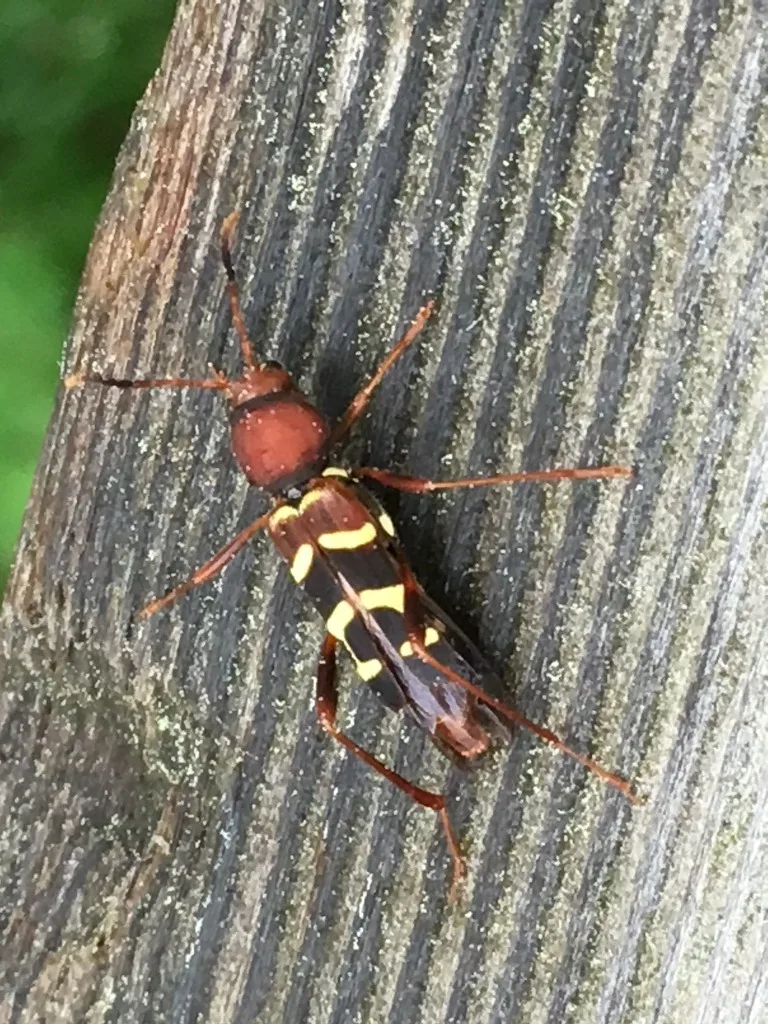
- Adults are 1/2 to 5/8 inch, with a reddish head and thorax, dark wing covers crossed by four narrow yellow bands (the middle two chevron-shaped) and long reddish legs; they resemble wasps.[1][2]
- Grubs are pale, legless and grow to almost 1 inch.[1]
- Its antennae are about half as long as the body, and new adults leave trees through round exit holes.[1]
Look-alikes
| Look-alike | How to tell them apart |
|---|---|
| Ichneumon wasps | MDC lists ichneumon wasps as a similar species. The redheaded ash borer is a longhorned beetle with dark wing covers crossed by four narrow yellow bands and a reddish head and thorax.[2][1] |
Where it lives
It is native to North America and has been introduced to Eurasia and South America. MDC calls it a common Missouri longhorned beetle, NC State reports two or three generations a year in North Carolina, and GBIF holds about 3,800 U.S. records since 1990 from 48 state-level areas (GBIF counts the District of Columbia as one), the most from Texas (862), Pennsylvania (209) and North Carolina (173).[5][2][1][6]
Biology and life cycle
Females chew notches in the bark and lay eggs under it, in newly planted living trees, dying or dead hardwoods and felled logs with the bark still on; debarked logs are safe from this beetle.[1]
Young grubs feed on the sapwood just beneath the bark, then tunnel into the heartwood, which they may turn almost completely to powder. They spend the winter inside the host, probably as pupae.[1]
NC State says adults emerge as the weather warms in spring and are active until it cools in autumn, with two or three generations a year in North Carolina. In east-central Illinois trapping from 2009 to 2012 it was among the most abundant longhorned beetles, and cerambycine species like it became active in an orderly progression from early spring through late fall.[1][7]
In 2004 researchers reported that males release a pheromone, (2S,3S)-hexanediol, that attracts both males and females, the first fully verified report of an aggregation pheromone produced by a longhorned beetle.[8]
Its genome, sequenced in 2025, is about 508 Mb with 12,899 genes.[5]
Damage and signs
- Grubs attack nearly all dying and dead hardwoods, preferring ash, hackberry, hickory, oak and persimmon; fruit trees and even grapevines may be attacked. In saplings, the larvae work through the inner bark and wood, and infested trees may break off in high winds.[1][2][5]
- They can damage logs intended for lumber and emerge from firewood carried indoors. Kentucky entomologists say the chance of firewood borers infesting structural wood in the house is very low, because they attack only certain woods and need wood much moister than house framing.[2][3]
- They also do good: MDC notes that the larvae help break down dead wood and enrich the soil.[2]
Health risk
MDC says adults resemble wasps, but it is a longhorned beetle that bores in wood, and NC State says beetles emerging from firewood indoors can be a nuisance. MDC, NC State, Kentucky and NPIC don't mention any risk to people or pets.[2][1][3][4]
Control
Prevention
Keep trees healthy: prune out dead and dying branches, mulch, water during dry spells, and fertilize or lime only according to a soil test. NC State warns that too much nitrogen can make trees more attractive to borers; the beetle is sometimes a pest of young nursery stock given plenty of water and nitrogen. NPIC adds that most wood borers look for damaged or stressed trees.[1][4]
Sanitation
NPIC says to inspect firewood for signs of beetle damage before moving or using it, because moving infested firewood can infect new trees. Kentucky says to bring in small amounts of firewood at a time.[4][3]
Traps and physical control
Kentucky says to shake, jar or knock logs together sharply to dislodge insects, and brush off obvious structures such as webbing or cocoons, before bringing firewood inside.[3]
Pesticides
There is no control recommended for larvae already inside living trees. Permethrin or another pyrethroid can be used to prevent further attack on an infested tree still alive enough to save; keep pyrethroids away from pools, ponds and streams because they are toxic to fish. Never spray firewood: NPIC warns burning treated wood could be a health hazard.[1][4]
Where the sources disagree
Hosts: MDC says the larvae feed on dead or dying hardwoods; NC State says it also breeds in newly planted living trees and that fruit trees and even grapevines may be attacked.[2][1]
Preferred trees: MDC names oak, hickory, persimmon, hackberry and ash; the 2025 genome paper names ash, hickory and oak.[2][5]
Winter stage: NC State says it spends the winter inside a host tree, probably as a pupa; the other sources do not say.[1]
Common questions
- What is the wasp-like beetle that came out of my firewood?
- Often a redheaded ash borer, which develops in bark-covered logs; Kentucky says roundheaded borers sometimes emerge after logs are brought indoors.[1][2][3]
- Does it sting?
- MDC says adults resemble wasps, but it is a longhorned beetle. MDC and NC State don't mention any risk to people or pets.[2][1]
- Will it infest my house or furniture?
- Very unlikely. Kentucky says firewood borers have a very low potential to infest structural wood, because they need wood much moister than that in a home.[3]
- Where did it come from indoors?
- Usually from bark-covered firewood: NC State says it breeds in dying or dead hardwoods and felled logs that still have the bark, and MDC says it can emerge from firewood carried indoors and not yet burned. NPIC says to inspect firewood before moving or using it.[1][2][4]
Sources
- NC State Extension, “Redheaded Ash Borer (PDIC Factsheet).” content.ces.ncsu.edu/redheaded-ash-borer (accessed 2026-11-13)
- Missouri Department of Conservation, “Red-Headed Ash Borer (Field Guide).” mdc.mo.gov/discover-nature/field-guide/red-headed-ash-borer (accessed 2026-11-13)
- University of Kentucky Entomology, “Firewood Insects (ENTFACT-626).” entomology.mgcafe.uky.edu/ef626 (accessed 2026-11-13)
- National Pesticide Information Center, “Wood Boring Beetles.” www.npic.orst.edu/pest/woodborer.html (accessed 2026-11-13)
- J Hered 2025;116(4):558-67, via PubMed, “Insights into longhorn beetle (Cerambycidae) evolution from comparative analyses of the red-headed ash borer (Neoclytus acuminatus acuminatus) genome.” pubmed.ncbi.nlm.nih.gov/40120100/ (accessed 2026-11-13)
- Global Biodiversity Information Facility (GBIF), “Neoclytus acuminatus: U.S. occurrence records since 1990 by state (GBIF occurrence API).” api.gbif.org/v1/occurrence/search?taxonKey=4293134&country=US&hasGeospatialIssue=false&occurrenceStatus=PRESENT&year=1990%2C2026&facet=stateProvince&facetLimit=400&limit=0 (accessed 2026-11-13). 3,827 records from 48 state-level areas; Texas 862, Pennsylvania 209, North Carolina 173; fetched 2026-11-13.
- Ann Entomol Soc Am 2014;107(1):211-26, via PubMed, “Seasonal phenology of the cerambycid beetles of east-central Illinois.” pubmed.ncbi.nlm.nih.gov/24683267/ (accessed 2026-11-13)
- J Chem Ecol 2004;30(8):1493-507, via PubMed, “Male-produced aggregation pheromone of the cerambycid beetle Neoclytus acuminatus acuminatus.” pubmed.ncbi.nlm.nih.gov/15537155/ (accessed 2026-11-13)
- Global Biodiversity Information Facility (GBIF), “Neoclytus acuminatus (Fabricius, 1775) (GBIF Backbone Taxonomy).” api.gbif.org/v1/species/4293134 (accessed 2026-11-13)
- iNaturalist, “Neoclytus acuminatus taxon page (order and family).” www.inaturalist.org/taxa/121732 (accessed 2026-10-06)