On this page
How to identify it
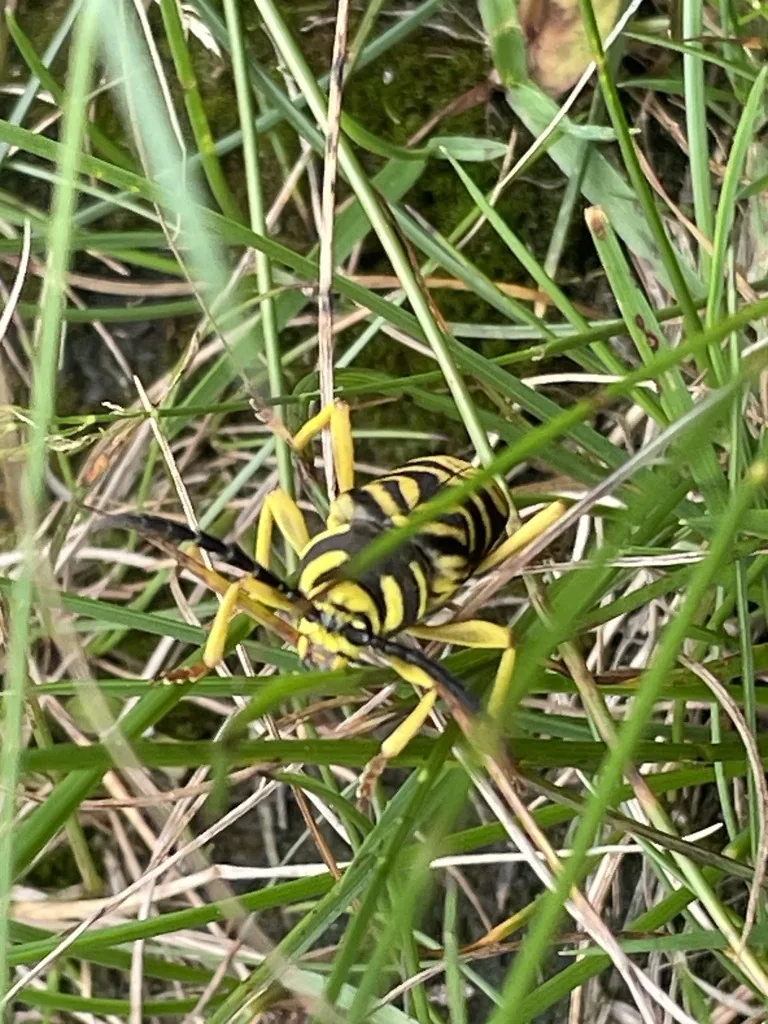
- Adults are stout black beetles about 1 inch long with bright yellow bands, including a W-shaped band near the base of the wing covers, plus yellow legs and black antennae.[1][2]
- Grown larvae are rosy-white, cylindrical grubs up to about 2 inches long, with tiny legs.[1][2]
- Signs include small wet spots of leaking sap or frass on the bark, then long-lasting ridges in the bark and C-shaped cat-face scars where bark falls off old galleries.[1][2]
- Up close, the head is bright yellow, the wing covers carry five dark-yellow bands with a W-shaped one near the base, and the yellow wing tips each have a small black spot. A pinned adult in Canada's forest insect collection measures 27 mm.[2][4]
- Eggs are elongate, whitish and about 1/8 inch long. Males have longer, wider antennae than females.[2][5]
Look-alikes
| Look-alike | How to tell them apart |
|---|---|
| Locust borer | Similar yellow-and-black coloring, in a different pattern.[1] |
| Painted hickory borer | UMass says the adult looks very similar in color to the sugar maple borer but with a different pattern.[1] |
Where it lives
Found throughout the range of sugar maple: most of the eastern United States and adjacent Canada, south into the southern Appalachians, where it is more common at higher elevations, and west to Minnesota. Canada's forest service lists it in eastern Canada.[1][2][4]
Biology and life cycle
Sugar maple is the only known host. Adults emerge in late spring, and females lay single eggs in bark slits and crevices in summer, mostly on the lower 30 feet of the trunk.[1][2]
Larvae mine under the bark the first year and overwinter, tunnel just under the bark the second year, then bore into the wood to pupate; the life cycle takes two years.[1][2]
The female cuts a slit in the bark and lays a single egg in it, and larvae hatch 7-10 days later. In a New York study females averaged 41.3 eggs each and preferred the southern and eastern sides of the trunk.[1][5]
Canada's forest service says the two-year life cycle spreads over three calendar years; in the fall of the second year the larvae tunnel about 10 cm deep into the sapwood to make the chamber where they overwinter and pupate.[4]
Damage and signs
- Galleries can girdle and kill branches, and small trees can snap where a gallery circles the stem.[2]
- Infested trees may lose vigor and grow smaller leaves that drop early, but trees are rarely killed; exposed galleries can let in stain and rot fungi and degrade lumber.[1][2]
- Old roadside trees and trees in sugarbushes are often damaged. Severe defoliation by forest tent caterpillar or saddled prominent can make maples more attractive; borer activity may begin 3-4 years after the defoliation and peak 6-8 years after.[1]
- Larval galleries disrupt sap flow and reduce the tree's vigor; some branches die once cut off from the sap supply, and with many galleries the whole tree may die.[4]
Health risk
Control
Prevention
Keep maples vigorous with the right site, good planting and care; stressed, slow-growing trees are attacked more often. In woodlots, don't overharvest and don't let livestock graze maple stands.[1][2][4]
Traps and physical control
Inspect shade trees for wet spots of sap, small piles of sap-soaked bark dust and bark cracks, especially in July and August when eggs are laid. In summer, Canada's forest service says you can destroy young larvae by cutting through the bark into the galleries with a knife, or kill larvae in ornamental trees by pushing a wire deep into the galleries.[2][1][4]
Cut and promptly destroy heavily infested trees or tree parts so adults can't emerge; the Forest Service also advises pruning dead or dying branches well below the attack.[4][2]
Biological control
Woodpeckers are the main natural enemy. UMass says they may cause at least 46% mortality; in a New York study hairy woodpeckers accounted for 43% of mortality in naturally infested trees and 74% of late-stage larvae. Parasitic wasps are rare and not important in control.[1][5]
Pesticides
Because trees are rarely killed, insecticides are usually unnecessary in home landscapes. If treatment is warranted, UMass lists systemic active ingredients including azadirachtin, cyantraniliprole, emamectin benzoate, imidacloprid and neem oil, timed against adults before egg laying and after bloom to protect pollinators. In Massachusetts, neonicotinoids for tree and shrub pests have been state restricted use since July 1, 2022.[1]
Where sources disagree
Hosts: the Forest Service and UMass call sugar maple its only known host, while Natural Resources Canada lists red, silver and sugar maple.[2][1][4]
Tree death: UMass says it is typically not a tree killer and trees are rarely killed, while Natural Resources Canada says the whole tree may die if there are many galleries and calls it the most destructive maple pest in Canada.[1][4]
Pruning: the Forest Service advises pruning dead or dying branches well below the attack, while UMass says pruning out infested branches is not an option because the damage is on the trunk.[2][1]
Egg laying: the Forest Service says eggs are laid from mid-June into August; UMass says egg laying begins in late July and early August.[2][1]
Common questions
- What causes long ridges and scars on my sugar maple's trunk?
- Sugar maple borer galleries are a common cause; the bark ridges last for many years.[1][2]
- Will sugar maple borer kill my tree?
- Rarely, though it can kill branches and weaken the tree.[1][2]
- Can I get the borer out of my maple myself?
- Sometimes. Look in summer for sap-soaked dust piles on the trunk; Canada's forest service says the young larvae can be destroyed by cutting through the bark into the galleries with a knife, or by pushing a wire deep into the galleries.[4]
- What eats sugar maple borers?
- Mostly woodpeckers. Hairy woodpeckers dig out the larvae and in one New York study accounted for 43% of borer mortality in infested trees.[5][1]
Sources
- UMass Extension Landscape, Nursery and Urban Forestry Program (Landscape Insect & Mite Guide), “Glycobius speciosus (Sugar Maple Borer).” www.umass.edu/agriculture-food-environment/landscape/publications-resources/insect-mite-guide/glycobius-speciosus (accessed 2026-11-12)
- USDA Forest Service (Forest Insect & Disease Leaflets), “Sugar Maple Borer (Forest Pest Leaflet 108, revised Aug. 1971).” www.fs.usda.gov/foresthealth/docs/fidls/FIDL-108-SugarMapleBorer.pdf (accessed 2026-11-12)
- iNaturalist, “Glycobius speciosus taxon page (order and family).” www.inaturalist.org/taxa/204683 (accessed 2026-11-12)
- Natural Resources Canada, Canadian Forest Service, “Sugar maple borer, Trees, insects and diseases of Canada's forests.” tidcf.nrcan.gc.ca/en/insects/factsheet/838 (accessed 2026-11-12)
- Environmental Entomology (2023), via PubMed, “Life history and bionomics of Glycobius speciosus (Coleoptera: Cerambycidae: Cerambycinae: Clytini).” pubmed.ncbi.nlm.nih.gov/37235636/ (accessed 2026-11-12). Cited from the PubMed abstract.