On this page
How to identify it
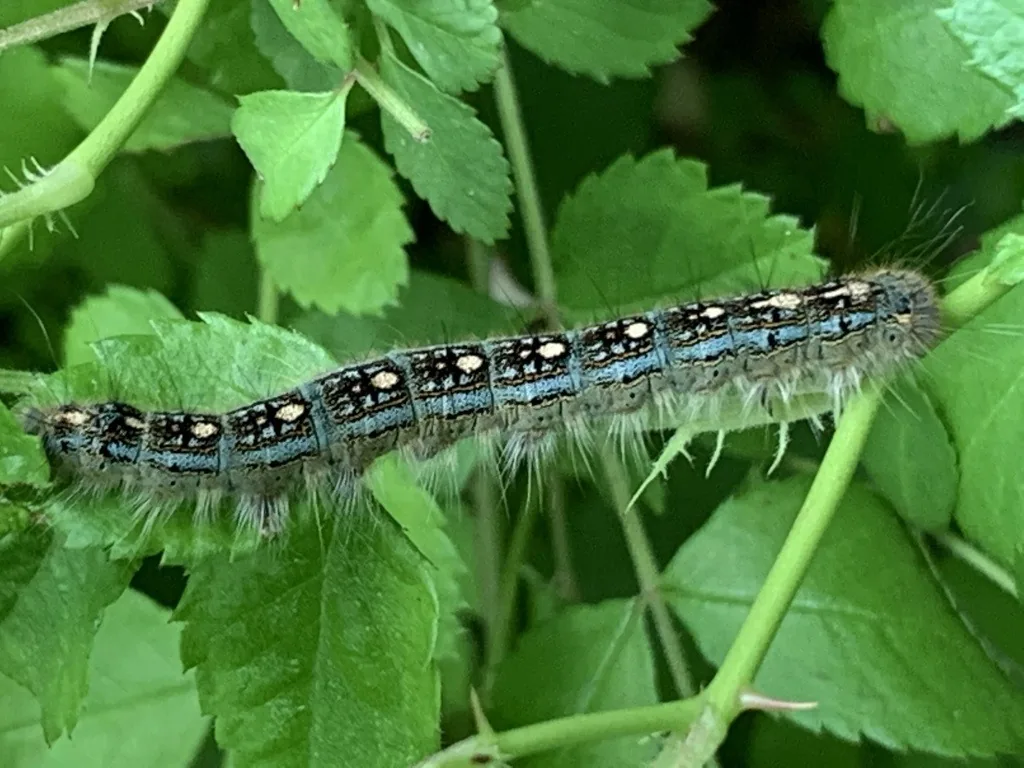
- Full-grown caterpillars are about 2 inches long, mostly blue and black, with a row of white keyhole- or footprint-shaped spots down the back.[1][2]
- Many hairs stick out along the sides of the body, and UC IPM notes wavy reddish-brown lines along the dark blue body.[1][3]
- Instead of a tent, caterpillars spin a thin silk mat on trunks and branches, where they gather and rest while molting.[1][2][5]
- Egg masses are gray, shiny bands wrapped around small twigs, with squared-off ends.[2][1]
- Adults are tan moths, about 1.6 inches, with two dark brown stripes across each forewing; they fly at night and come to lights.[2][1]
Look-alikes
| Look-alike | How to tell them apart |
|---|---|
| Eastern tent caterpillar | Builds a large silk tent in branch crotches, and its egg masses have tapered ends instead of square ones.[2][4] |
| Western tent caterpillar | A western species that feeds in groups inside silk tents and is reddish brown with tufts of orange to white hairs.[3] |
| Fall webworm | Makes large, obvious webs, while the forest tent caterpillar makes no tent or web of that kind.[2] |
Where it lives
Found throughout most of the United States and Canada wherever hardwood trees grow; the Minnesota DNR says it occurs throughout the range of hardwood forests in North America. GBIF's US records since 1990 come from coast to coast, with by far the most from Texas, then Florida and New York.[1][5][10]
Biology and life cycle
Caterpillars hatch in early to mid-May, about when aspen leaves open, and climb into the canopy to feed on expanding buds and leaves.[1][2]
They feed in groups while small, then wander more on their own; large caterpillars tend to feed at night and hide near the ground by day.[2]
After five to six weeks of feeding, around late June, they spin pale yellow cocoons in folded leaves or on plants and buildings.[1][2]
Moths emerge about two weeks later, in mid-July, live roughly five days, and lay 100 to 350 eggs in bands around twigs; there is one generation a year.[1]
Outbreaks come in cycles. The Minnesota DNR says they happen every 10 to 16 years and may last two to four years; in 2001 they defoliated more than 7.5 million acres of Minnesota hardwoods, the most ever recorded there.[5]
Starvation is the main reason outbreaks end: after a year or two of buildup there isn't enough foliage, and starvation typically kills up to 95% of the caterpillars in an outbreak's final year. Late spring frosts and cool, wet springs also knock young populations down.[6]
Damage and signs
- Hosts include quaking aspen, balsam poplar, basswood, oak, ash, birch, sugar maple and fruit trees; red maple and conifers are rarely eaten.[1][2]
- Feeding usually doesn't kill trees, which can grow a second set of leaves the same season; healthy trees tolerate two or three years of heavy defoliation.[1][2]
- Trees may die after four or more years of heavy defoliation in a row, or when also stressed, such as by drought.[1]
- When trees are stripped, hungry caterpillars move to nearby plants, including vegetables, small fruits and nursery stock.[1]
- A European plant health panel calls it one of the most serious hardwood forestry pests in North America, with western Canadian outbreaks covering up to 200,000 square kilometers.[7]
- Trees that are drought-stressed, root-damaged or over-mature are the ones most likely to die after defoliation.[6]
Health risk
Forest tent caterpillars don't bite people or harm animals; they are a nuisance on buildings, and crushed caterpillars can make roads greasy and slippery.[1]
Control
Prevention
Turn off outdoor lights during the moth flight in July. Fewer moths drawn to your yard may mean fewer egg masses on nearby trees.[6][1]
Traps and physical control
Remove and destroy egg masses from twigs of small trees before they hatch in spring.[1][2]
Brush caterpillars and cocoons off houses, decks and picnic tables with a stiff broom, or knock them off with a spray of water.[1]
Biological control
Cold or wet springs, starvation, disease and parasites, including a large gray fly, usually end outbreaks on their own.[1][2]
Bacillus thuringiensis (Bt) is effective and spares beneficial insects; apply it while caterpillars are 1 inch or smaller, usually early to mid-May.[1]
Pesticides
Insecticidal soap, spinosad and azadirachtin also conserve beneficials; large caterpillars are hard to kill and keep feeding before sprays take effect.[1]
Spraying only cuts caterpillar numbers and defoliation that spring; it doesn't affect next year's population, because moths from outside the treated area fly in and lay eggs. The Minnesota DNR doesn't use insecticides against large outbreaks.[6]
The big gray flies that follow an outbreak
During outbreaks, a large gray fly, Sarcophaga aldrichi, feeds on forest tent caterpillars and becomes abundant when they are numerous.[1][2]
The fly doesn't bite and is harmless, though it lands on everything, including people, and it plays an important part in ending outbreaks.[1]
If caterpillars get on your skin
MedlinePlus says most caterpillars are harmless, but the hairs of some cause allergic reactions in the skin, eyes or lungs. If hairs get on your skin, lift them off with sticky tape, then wash with soap and water; flush eyes with plenty of water and get medical help.[9]
Where sources disagree
Outbreak cycles: the Minnesota DNR says outbreaks come every 10 to 16 years and last two to four years, while a European pest review puts them nine to 13 years apart, lasting two to three years.[5][7]
When trees die: University of Minnesota Extension says healthy trees tolerate two to three years of heavy defoliation and may die after four or more, while the European review says three straight years of heavy defoliation, or repeated defoliation with drought, can kill many trees.[1][7]
Animals: University of Minnesota Extension says the caterpillars don't harm animals, but after a 2017 outbreak in Saskatchewan veterinarians reported four horses with a rare heart-sac infection possibly linked to eating the caterpillars. Cause and effect wasn't proven; the authors advise keeping horses from eating them.[1][8]
Common questions
- Why can't I find a tent?
- This species doesn't build one. It spins only a thin silk mat on the trunk or branches where caterpillars rest together.[2][1]
- Will forest tent caterpillars kill my trees?
- Usually not. Trees can releaf the same season and tolerate a few years of defoliation, though four or more years, or drought stress, can kill them.[1]
- Do forest tent caterpillars bite?
- No. They don't bite people or harm pets; they are a nuisance when they gather on buildings or get crushed on roads.[1]
Sources
- University of Minnesota Extension, “Forest Tent Caterpillars (reviewed 2018).” extension.umn.edu/yard-and-garden-insects/forest-tent-caterpillars (accessed 2026-11-11)
- UMass Extension Landscape, Nursery and Urban Forestry Program, “Malacosoma disstria, Forest Tent Caterpillar (Landscape Insect and Mite Guide).” www.umass.edu/agriculture-food-environment/landscape/publications-resources/insect-mite-guide/malacosoma-disstria (accessed 2026-11-11)
- University of California Statewide IPM Program, “Tent Caterpillars (Home and Landscape).” ipm.ucanr.edu/home-and-landscape/tent-caterpillars/ (accessed 2026-11-11)
- University of Kentucky Entomology, “ENTFACT-423: Eastern Tent Caterpillar (revised January 2026).” entomology.mgcafe.uky.edu/ef423 (accessed 2026-11-11)
- Minnesota Department of Natural Resources, “Forest tent caterpillar.” www.dnr.state.mn.us/treecare/forest_health/ftc/index.html (accessed 2026-11-11)
- Minnesota Department of Natural Resources, “Forest tent caterpillar management.” www.dnr.state.mn.us/treecare/forest_health/ftc/management.html (accessed 2026-11-11)
- EFSA Journal, via PubMed, “Pest categorisation of Malacosoma disstria (EFSA Panel on Plant Health 2022).” pubmed.ncbi.nlm.nih.gov/35386570/ (accessed 2026-11-11)
- Canadian Veterinary Journal, via PubMed, “Septic fibrinous pericarditis in 4 horses in Saskatchewan following an outbreak of forest tent caterpillars in 2017 (Chapuis et al. 2020).” pubmed.ncbi.nlm.nih.gov/32655155/ (accessed 2026-11-11)
- MedlinePlus, U.S. National Library of Medicine, “Caterpillars (Medical Encyclopedia).” medlineplus.gov/ency/article/002860.htm (accessed 2026-11-11)
- Global Biodiversity Information Facility (GBIF), “Malacosoma disstria: US occurrence records since 1990 by state (GBIF occurrence search API).” api.gbif.org/v1/occurrence/search?taxonKey=5101763&country=US&hasGeospatialIssue=false&occurrenceStatus=PRESENT&year=1990%2C2026&facet=stateProvince&facetLimit=400&limit=0 (accessed 2026-11-11)
- iNaturalist, “Malacosoma disstria taxon page (order and family).” www.inaturalist.org/taxa/81663 (accessed 2026-11-11)