On this page
How to identify it
- Grown caterpillars are smooth, twiglike inchworms about 2 inches long (UMass says up to 2 inches, the Forest Service slightly more). In outbreaks most are dull slate black with a bright rusty head; a few are green, yellow, or mottled brown, tan and rose. UMass notes that lighter caterpillars make up more of the population in low years.[1][2]
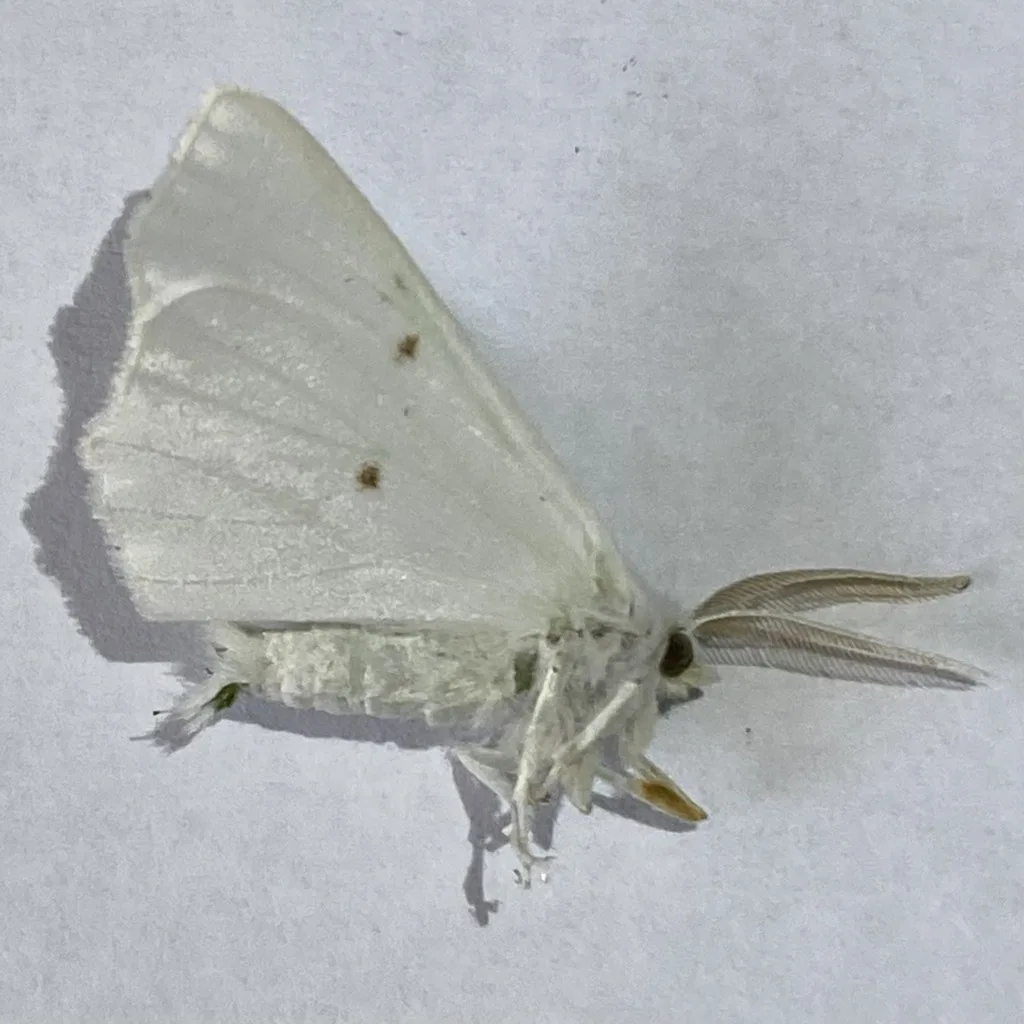
- Adults are pure white moths with a 1 to 1.5 inch wingspan; males have feathery antennae.[1][2]
- Eggs are laid in compact masses on the undersides of branches, and UMass adds twigs and trunks. The Forest Service gives 1 to 250 eggs per mass; the UK assessment puts the average at about 50 to 60. Eggs start bright green and turn dull gray, brown or bronze by winter.[1][2][3]
- Both sexes are powdery white with a light tan spot on the underside of each wing. Males have feathery antennae; females have straight, beaded antennae and a stockier abdomen.[2]
Where it lives
Native to North America and not known anywhere else. It occurs through most of the eastern United States and southeastern and south-central Canada, recorded from Nova Scotia to mid-Florida and west to Texas and Saskatchewan. The UK assessment says outbreaks have been limited to the Appalachian Mountains, though one reached St. John's, Newfoundland.[2][3]
Biology and life cycle
Eggs overwinter and hatch in spring, from late April in the southern Appalachians to mid-May or June in the Northeast; tiny caterpillars can drift on silk threads.[2]
Caterpillars feed for about a month according to UMass, or about six weeks according to the UK assessment. They pupate in loose, netlike cocoons on partly eaten leaves, or, when trees are stripped, on branch tips, in bark crevices, on stumps or in the undergrowth. Moths emerge after about 10 days as pupae: in early July in the southern Appalachians, and in late July or August farther north.[1][2][3]
Near heavy infestations, swarms of male moths drawn to town lights can look like midsummer snow.[2]
There is one generation a year throughout its range, largely because the eggs wait about nine months before hatching. Mating follows soon after the moths emerge, and each female dies shortly after laying her eggs.[3][2]
Caterpillars wander through touching tree crowns, hang from silk threads and cross the ground. The UK assessment says the moths can readily fly 100 to 200 km.[2][3]
Damage and signs
- Favorite hosts are ash, hickory and walnut; beech, cherry, elm, maple, oak, willow and many others are also eaten, while yellow-poplar is rarely touched.[2]
- Young caterpillars chew holes from the underside of leaves; older ones eat all but the midrib and stem, and outbreaks can strip whole trees.[1][2]
- Stripped trees usually leaf out again, but two or more summers of defoliation lead to limb dieback and death, especially in oaks then attacked by the twolined chestnut borer.[2]
- Preferred hosts shift with what's available. In a 1991 to 1993 Pennsylvania outbreak, black cherry, red and sugar maple and American beech were favored; in St. John's, Newfoundland, planted sycamore maple, Norway maple and basswood took the most damage. Yellow-poplar and cucumber magnolia are rarely attacked.[3]
- The Forest Service adds that it periodically damages apple crops and seriously weakens valuable shade trees.[2]
Health risk
No cited source describes any risk to people or pets; the caterpillars feed on tree leaves.[1][2][3]
Control
Prevention
If an outbreak is expected, check susceptible trees for overwintering egg masses, then watch for feeding caterpillars from mid-May through June.[1]
Traps and physical control
Prune off and destroy egg masses on small twigs and branches before they hatch.[1]
Biological control
Egg parasitoids do the most good. UMass names Telenomus droozi and Ooencyrtus ennomophagus and says they can destroy more than 80 percent of eggs in an outbreak; the UK assessment cites up to 89 percent for T. droozi in one Appalachian outbreak. The 1971 Forest Service leaflet instead singles out Telenomus alsophilae. More than 40 other parasites and predators, including birds, spiders, ground beetles and parasitic flies, attack the caterpillars, pupae and moths, but the Forest Service says they mostly soften outbreaks rather than prevent them.[1][3][2]
Pesticides
The UK assessment says Bacillus thuringiensis (Bt) appears to be the most common control used in North America, and UMass lists Bt subspecies kurstaki among its options. Spraying large forest trees is a job for professionals; follow the label.[3][1]
Outbreak history
The Forest Service counted at least 20 major outbreaks in eastern North America; the UK assessment cites at least 18 major infestations in the eastern United States between 1900 and 1961. The earliest recorded outbreaks were in the 1800s around New York City and Philadelphia.[2][3]
A southern Appalachian outbreak that began in the early 1950s lasted more than a decade and peaked in 1960 across about 607,000 hectares. A 1991 to 1993 outbreak in Pennsylvania's Allegheny National Forest overlapped with spongy moth and cherry scallop shell moth and covered about 176,037 hectares.[3]
In St. John's, Newfoundland, where it had been called rare, an urban outbreak lasted from 2002 to 2006.[3]
Great Britain lists it as a provisional quarantine pest. The 2025 assessment judged that it could likely establish outdoors in the UK if it arrived.[3]
Common questions
- What are the black inchworms stripping my trees?
- In late spring and early summer, often elm spanworms; despite the name they feed on many hardwoods.[1][2]
- Why are white moths swarming my porch light in summer?
- Near outbreaks, elm spanworm moths, mostly males, can gather at lights in huge numbers.[1][2]
- Will trees stripped by elm spanworm die?
- Usually not after one year: stripped trees normally leaf out again later in the summer. Two or more summers of defoliation in a row can cause limb dieback and death, especially in oaks that are then attacked by the twolined chestnut borer.[2]
Sources
- UMass Extension Landscape, Nursery and Urban Forestry Program (Landscape Insect & Mite Guide), “Ennomos subsignaria (Elm Spanworm).” www.umass.edu/agriculture-food-environment/landscape/publications-resources/insect-mite-guide/ennomos-subsignaria (accessed 2026-11-13)
- USDA Forest Service (Forest Insect & Disease Leaflets), “Elm Spanworm (Forest Pest Leaflet 81, revised March 1971).” www.fs.usda.gov/foresthealth/docs/fidls/FIDL-81-ElmSpanworm.pdf (accessed 2026-11-13)
- Defra UK Plant Health Risk Register (UK government), “Rapid Pest Risk Analysis (PRA) for Ennomos subsignaria (February 2025).” planthealthportal.defra.gov.uk/assets/PRA_Ennomos_subsignaria_2025.pdf (accessed 2026-11-13)
- Global Biodiversity Information Facility (GBIF), “Ennomos subsignaria (Hübner) (GBIF Backbone Taxonomy).” api.gbif.org/v1/species/1957870 (accessed 2026-11-13)