On this page
How to identify it
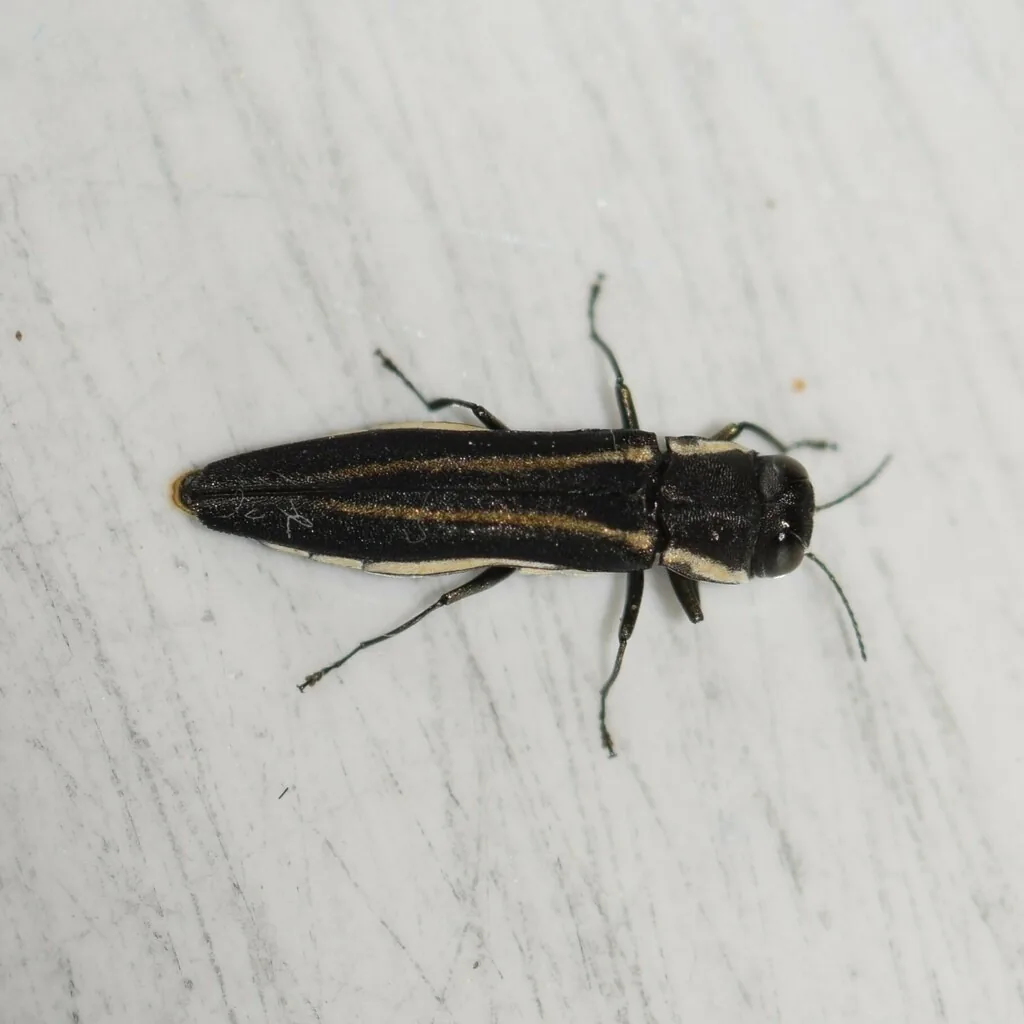
- Adults are slender, metallic blue-black beetles with a pale yellow to golden stripe down each wing cover. UMN gives a length of 1/4 to 1/2 inch and NC State 0.2 to 0.5 inch; NC State notes the stripes can be faint.[1][2]
- Larvae are pale or cream-colored, flattened, up to about 1 inch long, with a pair of pincer-like spines at the tail end.[1][2]
- Infested oaks wilt and die back from the top of the canopy; NC State says the foliage turns brown in late summer. UMN says the frass-packed galleries can only be seen when the bark is removed, that adults leave D-shaped exit holes about 1/8 inch across that can be hard to see, and that other problems can cause similar dieback.[1][2]
Look-alikes
| Look-alike | How to tell them apart |
|---|---|
| Bronze birch borer | A related metallic borer of birch, bronze rather than striped.[1] |
Where it lives
It is native to eastern North America and attacks oaks in both the red and white oak groups: white, chestnut, northern red and scarlet oak in North Carolina, and white, swamp white, bur, northern pin, red, black and chinkapin oak in Minnesota. NC State says it was once an important pest of American chestnut, before chestnut blight.[2][1]
Biology and life cycle
Larvae overwinter under the bark and pupate in spring. UMN says adults start emerging in early June in Minnesota, when Vanhoutte spirea and black locust are in full bloom, and keep emerging until July; NC State says spring or early summer. Adults live two to five weeks, feeding on leaves and laying eggs in bark crevices.[1][2]
Larvae feed in the phloem, packing winding galleries with frass. Most finish in one year; UMN says it can take two in very cold climates or where food in the tree is limited.[1][2]
Damage and signs
- It's a secondary pest. NC State says it mainly attacks oaks already stressed by drought, nutrient shortage or defoliation and is closely tied to oak decline, along with Armillaria root disease, late frost, soil compaction and root injury; UMN adds poor planting sites, construction damage and mower injury.[2][1]
- Adult leaf feeding doesn't affect tree health; the larvae's galleries disrupt the movement of water and nutrients (UMN).[1]
Health risk
It attacks trees, and no cited source describes any risk to people or pets.[1][2]
Control
Prevention
Both sources say keeping oaks healthy and avoiding root and trunk injury is the main defense, and both suggest mulch and watering. They differ on fertilizer: NC State recommends fertilizing to correct nutrient deficiencies, while UMN says to avoid fertilizing stressed trees because it raises their water demand.[2][1]
NC State suggests preventing heavy defoliation by managing leaf-feeding insects, for example with sticky bands for cankerworms.[2]
When to call a professional
UMN says insecticides help only in the early stages of decline and don't work once 40 to 50 percent of the canopy is dead. It lists imidacloprid or dinotefuran soil treatments, applied after the oak flowers to protect bees, and pyrethroid sprays such as permethrin on the trunk and branches timed to when adults first appear, as black locust blooms, and suggests a tree care professional for large trees. NC State's advice covers tree care only. Follow the label.[1][2]
More from NC State Extension
It belongs to the same beetle family as the emerald ash borer, but unlike that invasive pest it is a native secondary pest that mainly attacks trees already stressed or damaged.[2]
More from the research literature
In Kentucky experiments, adults quickly found experimentally stressed oaks, with up to 160 beetles a week caught on stressed trunks. Phloem-girdled oaks that were heavily attacked died later that season, while lightly attacked trees were heavily attacked and killed the next year.[4]
In a later Kentucky study of 200 healthy white oaks, trees with lower winter root starch drew more beetles. Only oaks with extremely low starch were heavily attacked and died, and none of the trees with higher starch died.[5]
In a USDA Forest Service test of infested oak firewood bolts, a few twolined chestnut borers survived wood heated to 56 C (about 133 F) for 30 minutes at some chamber settings, but all borers died at 60 C (140 F).[6]
Common questions
- Why is my oak dying from the top down?
- Twolined chestnut borer attack on a stressed oak typically starts dieback at the top of the canopy.[1]
- Does it attack healthy oaks?
- Rarely. Both extension sources say it prefers stressed, declining oaks, and in Kentucky experiments the beetles rarely landed on unstressed trees.[1][2][4]
Sources
- University of Minnesota Extension, “Bronze birch borer and twolined chestnut borer (Metallic wood-boring beetles, Yard and garden insects).” extension.umn.edu/garden-and-home/yard-and-garden/yard-and-garden-insects/metallic-wood-boring-beetles (accessed 2026-11-13)
- NC State Extension, “Twolined Chestnut Borer.” content.ces.ncsu.edu/twolined-chestnut-borer (accessed 2026-11-13)
- Global Biodiversity Information Facility (GBIF), “Agrilus bilineatus (Weber, 1801) (GBIF Backbone Taxonomy).” api.gbif.org/v1/species/6003962 (accessed 2026-11-13)
- Oecologia (via PubMed), “The role of host tree condition in attack of white oaks by the twolined chestnut borer (Dunn et al., 1986) (abstract).” pubmed.ncbi.nlm.nih.gov/28311506/ (accessed 2026-11-13)
- Oecologia (via PubMed), “Winter starch reserves of white oak as a predictor of attack by the twolined chestnut borer (Dunn et al., 1987) (abstract).” pubmed.ncbi.nlm.nih.gov/28312472/ (accessed 2026-11-13)
- Journal of Economic Entomology (via PubMed), “Mortality of bark- and wood-boring beetles in naturally infested heat-treated ash, birch, oak and pine bolts (Haack and Petrice, 2022) (abstract).” pubmed.ncbi.nlm.nih.gov/36169401/ (accessed 2026-11-13)