On this page
How to identify it
- The caterpillar is yellowish-green to dark green with a light to dark brown head; larger caterpillars have cream to white stripes along the sides. It moves with a looping motion.[1]
- The USDA Forest Service guide describes the caterpillar as green with prominent white bands along the upper sides.[2]
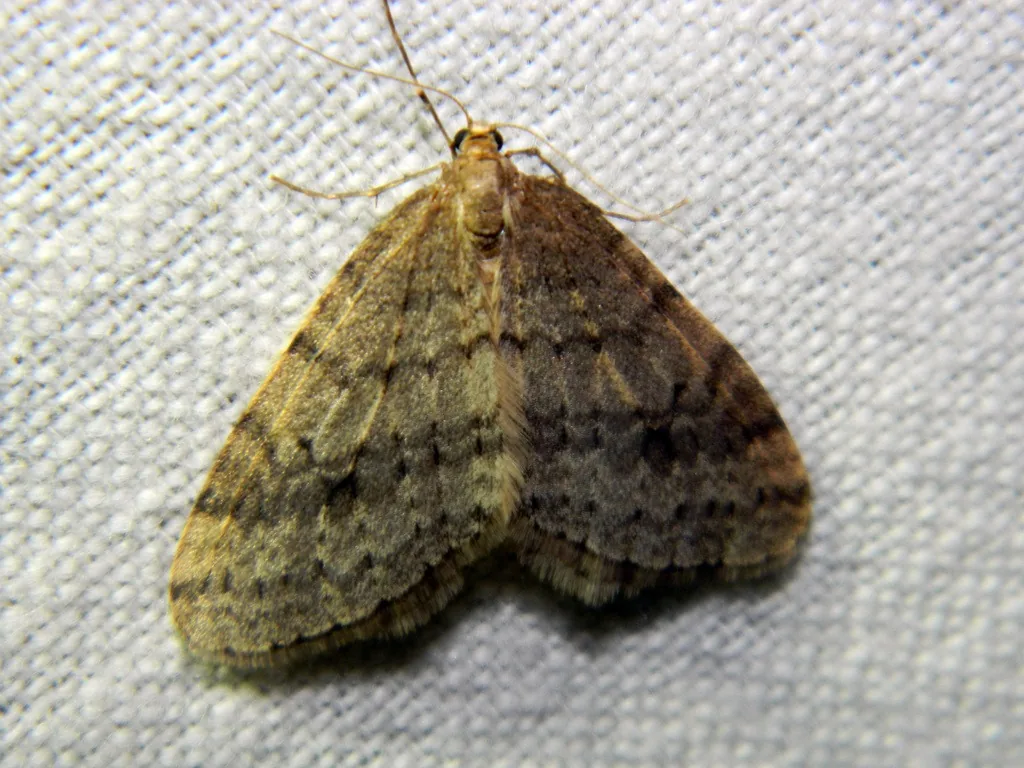
- Females are wingless. Males have thin, semitransparent wings banded with brown and gray; the USDA guide gives a male wingspan of about 2.9 cm, with forewings solid dark gray to pale cream crossed by fine dark lines.[1][2]
Look-alikes
| Look-alike | How to tell them apart |
|---|---|
| Winter moth | A USDA Forest Service guide says the Bruce spanworm is very similar in appearance to the exotic winter moth (Operophtera brumata); the sources read give no feature for telling the two apart.[2] |
Where it lives
The USDA Forest Service guide describes it as widely distributed in the West, and the British Columbia government covers it as a fruit-tree pest. GBIF holds about 5,800 records, about 2,800 each from Canada and the US; its US records since 1990 come from 32 states and the District of Columbia, most from Vermont, New York and Wisconsin.[2][1][4][5]
Biology and life cycle
The British Columbia fact sheet lists fruit trees and native trees and shrubs, including willow, poplar, maple and alder, as hosts. The USDA guide says the caterpillars are very common on big-leaf maple, oak, red alder, bitter cherry, hazel and willow.[1][2]
Eggs are laid singly on twigs and spend the winter there. They hatch at about the time apple buds reach the green tip stage, and the caterpillars feed on buds, blossoms and leaves.[1]
Most caterpillars are mature and drop to the ground by petal fall, then stay in the soil until they pupate in the fall. The wingless females crawl up the tree, mate and lay the overwintering eggs.[1]
The USDA guide says the species was previously known as Operophtera occidentalis and is found in low-elevation woodlands and wet forests.[2]
Damage and signs
Health risk
The British Columbia fact sheet and the USDA guide describe it only as a plant feeder; no cited source describes any risk to people or pets.[1][2]
Control
Prevention
Monitor in spring by examining fruit bud and blossom clusters for caterpillars and feeding damage; limb taps can also detect the caterpillars.[1]
Pesticides
The British Columbia fact sheet says heavy infestations require a spray at the pink bud stage, but only if the caterpillars are feeding on the buds, since they mainly feed on leaves. Insecticides applied at pink and petal fall for bud moth or two-generation leafrollers also control it.[1]
Where the sources disagree
Flight season: the British Columbia fact sheet gives adults in October and November; the USDA guide says its flight period is restricted to November and December.[1][2]
Caterpillar season: the British Columbia fact sheet ties hatching to apple green tip and says most caterpillars have dropped to the soil by petal fall; the USDA guide says caterpillars feed from March to June.[1][2]
Range: the USDA guide describes it as widely distributed in the West, but most of GBIF's US records since 1990 come from Vermont, New York and Wisconsin.[2][5]
Common questions
- What are the moths flying around late in the fall?
- Where the Bruce spanworm occurs, they may be male Bruce spanworm moths. The British Columbia fact sheet says adults appear in October and November, and the USDA guide says its flight is restricted to November and December; the females have no wings.[1][2]
- Do I need to spray for Bruce spanworm?
- The British Columbia fact sheet calls for a spray at pink bud only for heavy infestations where caterpillars are feeding on the buds, and notes that sprays for bud moth or leafrollers at pink and petal fall also control it.[1]
Sources
- Government of British Columbia, “Bruce Spanworm (Operophtera bruceata), plant health fact sheet (August 2020).” www2.gov.bc.ca/assets/gov/farming-natural-resources-and-industry/agriculture-and-seafood/animal-and-crops/plant-health/phu-bruce-spanworm.pdf (accessed 2026-11-13)
- USDA Forest Service, Forest Health Technology Enterprise Team, “Lepidoptera of the Pacific Northwest: Caterpillars and Adults, FHTET-03-11 (J. C. Miller and P. C. Hammond, 2003).” www.fs.usda.gov/foresthealth/technology/pdfs/FHTET_03_11.pdf (accessed 2026-11-13)
- Global Biodiversity Information Facility (GBIF), “Operophtera bruceata (Hulst, 1886) (GBIF Backbone Taxonomy).” api.gbif.org/v1/species/1972447 (accessed 2026-11-13)
- Global Biodiversity Information Facility (GBIF), “Operophtera bruceata: occurrence records by country (GBIF occurrence search).” api.gbif.org/v1/occurrence/search?taxonKey=1972447&facet=country&facetLimit=20&limit=0 (accessed 2026-11-13)
- Global Biodiversity Information Facility (GBIF), “Operophtera bruceata: U.S. occurrence records since 1990 by state (GBIF occurrence search).” api.gbif.org/v1/occurrence/search?taxonKey=1972447&country=US&hasGeospatialIssue=false&occurrenceStatus=PRESENT&year=1990%2C2026&facet=stateProvince&facetLimit=400&limit=0 (accessed 2026-11-13)