On this page
How to identify it
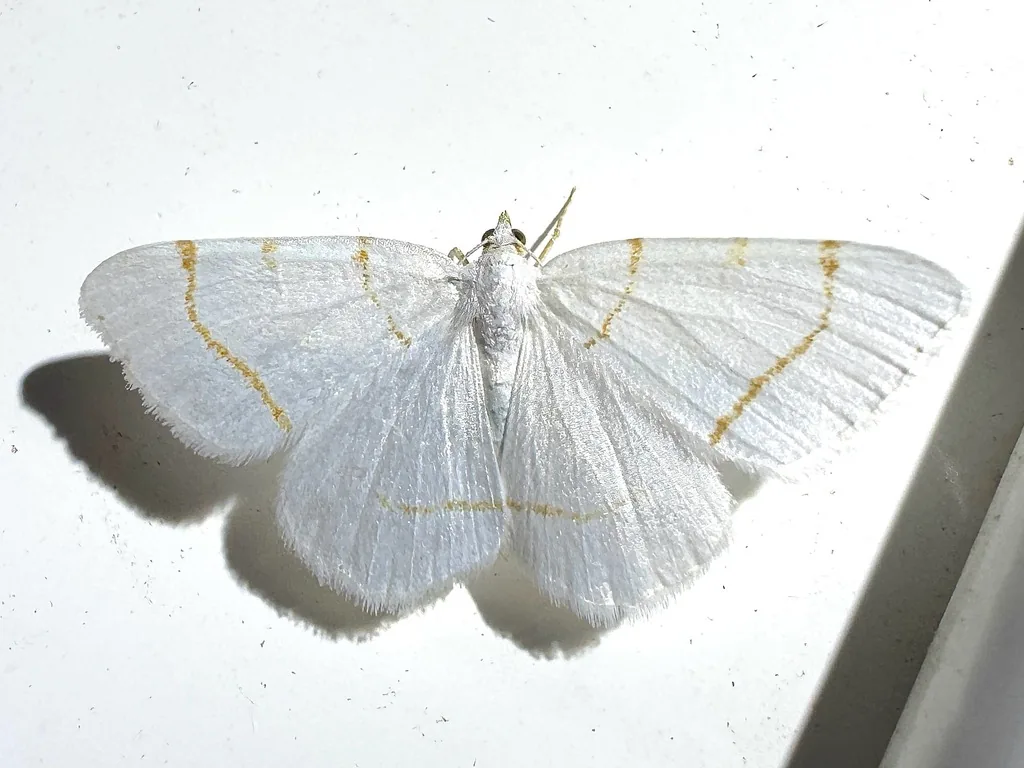
- The moth is white with a wingspan of about 25 mm (1 inch). Natural Resources Canada describes 3 or 4 golden brown spots along the front edge of each forewing and 2 or 3 very thin, often faint, cross lines of the same color.[1]
- The caterpillar is a green-headed inchworm (looper) with a green body and contrasting narrow white, cream or yellowish lines.[1]
- Fully grown caterpillars average 20 mm long.[1]
- Damage on shade trees shows as many holes in the leaves and large notches along the edges.[1]
Look-alikes
| Look-alike | How to tell them apart |
|---|---|
| Fall cankerworm | Natural Resources Canada says the fall cankerworm fed alongside the lesser maple spanworm during the 1970s New Brunswick outbreak on red maple. The source read gives no feature for telling the two caterpillars apart.[1] |
Where it lives
Natural Resources Canada says it is widely distributed in the Maritime Provinces, southern Quebec and southern Ontario, wherever red maple grows. GBIF holds about 20,900 records, about 14,200 from the US and about 6,500 from Canada; its roughly 13,400 US records since 1990 come mostly from New York, Massachusetts, Michigan and Vermont.[1][5][2]
Biology and life cycle
Red maple is the principal host. Sugar maple is also attacked but appears less prone to injury.[1]
The eggs, gray to pink, are laid one at a time on the branches and trunks of host maples and spend the winter there. They hatch in late May and early June.[1]
The caterpillars feed mostly during June.[1]
Pupation starts in late June or early July and usually takes about 10 days. Moths first appear about July 9 and peak in mid-July; they mainly rest by day and fly in the evening.[1]
Damage and signs
- The caterpillars are heavy feeders and can eat all the green tissue of a leaf, leaving only the main veins.[1]
- Outbreaks are unusual. In the mid-1970s an eruption in central and southern New Brunswick, often together with fall cankerworm and a common leaf roller, caused moderate to severe defoliation of red maple, mostly in forest stands but also on ornamental trees.[1]
Health risk
Natural Resources Canada describes it only as a maple-feeding caterpillar; no cited source describes any risk to people or pets.[1]
Control
Prevention
Inspect red and sugar maples during the first 10 days of June for small green caterpillars feeding on the leaves.[1]
Food for birds
Abundant native caterpillars like this one feed wildlife. In a Pennsylvania study that used DNA from droppings to work out what Louisiana waterthrushes eat, the lesser maple spanworm (listed as Speranza pustularia) was among the moth prey detected.[3]
The waterthrush is a streamside songbird; the study found it ate a wider range of land insects along acidified streams, where its preferred aquatic prey was scarce.[3]
Where the sources disagree
Name: Natural Resources Canada uses Itame pustularia, the 2018 songbird diet study lists it as Speranza pustularia, and GBIF's backbone lists Macaria pustularia (Guenée, 1857) as the accepted name.[1][3][4]
Range: Natural Resources Canada describes it from the Maritime Provinces, southern Quebec and southern Ontario; GBIF's records are mostly from the US, where its records since 1990 come from many states, led by New York, Massachusetts, Michigan and Vermont.[1][5][2]
Common questions
- What are the small white moths with brown spots on the forewings in July?
- In eastern Canada and the Northeast, one candidate is the lesser maple spanworm. Natural Resources Canada says the moths are white with golden brown spots along the front edge of the forewings, first appear about July 9, peak in mid-July and fly in the evening.[1]
- Do lesser maple spanworms hurt maple trees?
- Usually not, because numbers normally stay low. In rare outbreaks, like one in New Brunswick in the 1970s, the caterpillars have caused moderate to severe defoliation of red maple.[1]
Sources
- Natural Resources Canada, Canadian Forest Service, “Lesser maple spanworm, Trees, insects and diseases of Canada's forests.” tidcf.nrcan.gc.ca/en/insects/factsheet/8840 (accessed 2026-11-13)
- Global Biodiversity Information Facility (GBIF), “Macaria pustularia: U.S. occurrence records since 1990 by state (GBIF occurrence search).” api.gbif.org/v1/occurrence/search?taxonKey=9368398&country=US&hasGeospatialIssue=false&occurrenceStatus=PRESENT&year=1990%2C2026&facet=stateProvince&facetLimit=400&limit=0 (accessed 2026-11-13)
- PeerJ, via PubMed Central, “Stream acidification and reduced aquatic prey availability are associated with dietary shifts in an obligate riparian Neotropical migratory songbird (Trevelline et al. 2018).” pmc.ncbi.nlm.nih.gov/articles/PMC6037135/ (accessed 2026-11-13). PMID 30002974
- Global Biodiversity Information Facility (GBIF), “Macaria pustularia (Guenée, 1857) (GBIF Backbone Taxonomy).” api.gbif.org/v1/species/9368398 (accessed 2026-11-13)
- Global Biodiversity Information Facility (GBIF), “Macaria pustularia: occurrence records by country (GBIF occurrence search).” api.gbif.org/v1/occurrence/search?taxonKey=9368398&facet=country&facetLimit=20&limit=0 (accessed 2026-11-13)