On this page
How to identify it
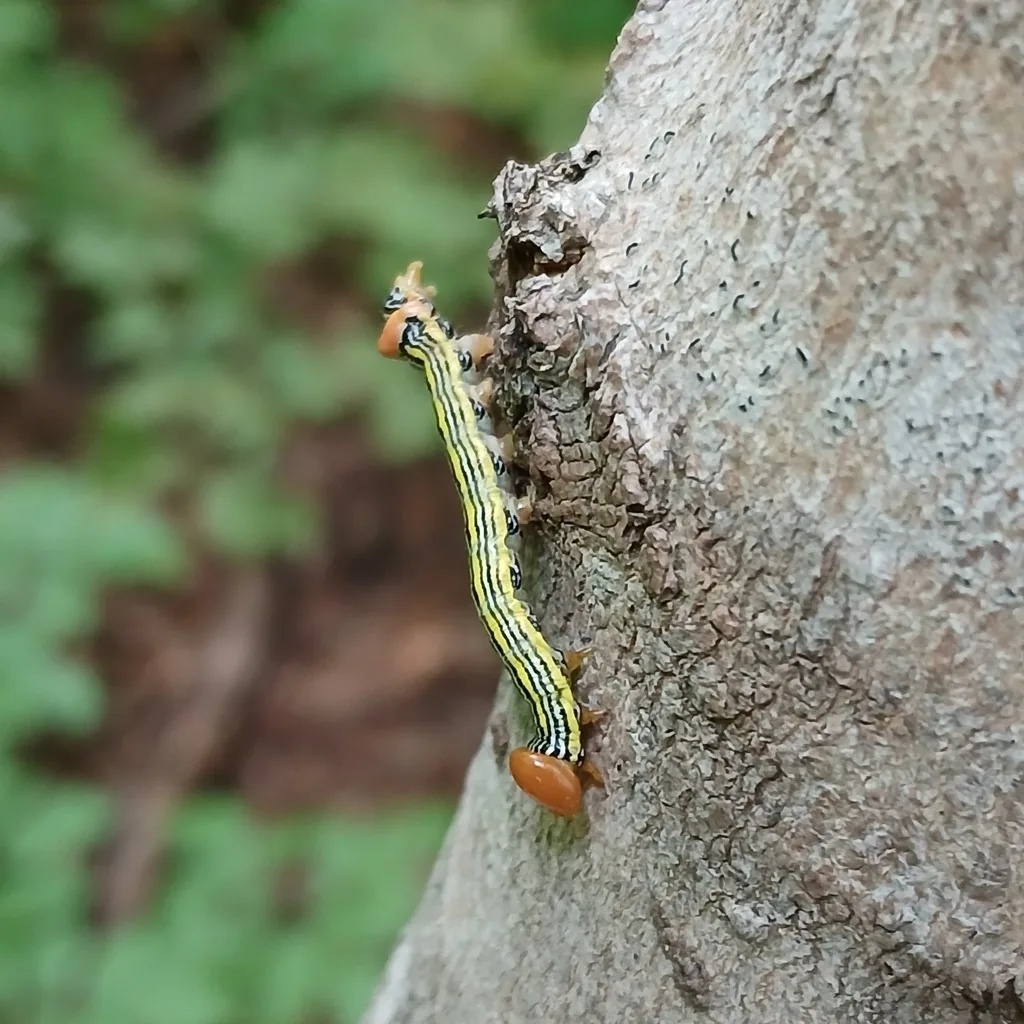
- Middle and late instar Symmerista caterpillars are easily recognized by a bright head, a thick stripe along each side of the back and a large, contrasting tubercle on the eighth abdominal segment. Only the last instar can be identified to species.[2]
- In the last instar, the back between the two yellow stripes is marked with only 3 black and 2 white stripes. The caterpillar is similar to the red-humped oakworm but has more yellow; earlier instars of other Symmerista may also show only 3 black stripes.[1][2]
- All Symmerista caterpillars feed in groups when young and alone in the last instar.[1]
Look-alikes
| Look-alike | How to tell them apart |
|---|---|
| Red-humped oakworm (Symmerista canicosta) | Its back between the yellow or orange stripes has 5 black and 4 white stripes, and it feeds especially on oaks, beeches and chestnuts. The orangehumped mapleworm has 3 black and 2 white stripes in the last instar and more yellow.[1][2] |
| White-headed prominent (Symmerista albifrons) | Also has five dorsal stripes, with the middle ones thicker and wavier; it prefers white and bur oak, though maple and birch are recorded hosts.[2][1] |
Where it lives
The Missouri oak guide cites Wagner (2005) for a range from Nova Scotia to Manitoba and south to North Carolina and Missouri, where it has been recorded. GBIF holds about 560 records, about 290 from the US and 250 from Canada; its roughly 180 US records since 1990 come mostly from Vermont, Massachusetts, Pennsylvania and Maine.[2][4][5]
Biology and life cycle
It feeds on many forest trees but especially maples. Host records compiled in the Missouri oak guide include maple, birch, beech, red oak, basswood and elm, and it feeds mostly on sugar maple, more rarely on oak and other trees.[1][2]
Caterpillars are found from July to September, with two generations a year in the South and one in the North.[1]
Damage and signs
Health risk
The USDA Forest Service guides describe it only as a leaf-feeding caterpillar of forest trees; no cited source describes any risk to people or pets.[1][2]
Control
Prevention
Neither USDA Forest Service guide recommends any control; they cover identification, hosts and seasonal timing.[1][2]
Where the sources disagree
Head color: the Caterpillars of Eastern Forests guide describes Symmerista heads and humps as bright orange; the Missouri oak guide calls the head bright red and the tubercle on A8 red.[1][2]
Hosts: the Caterpillars of Eastern Forests guide lists many forest trees, especially maples; host records in the Missouri oak guide add birch, beech, red oak, basswood and elm, while noting that hosts other than oak in this genus still need confirming from reared adults.[1][2]
Common questions
- What are the striped caterpillars with a bright head on my maple in August?
- If the last-stage caterpillar has a hump on the eighth abdominal segment and 3 black and 2 white stripes between the yellow stripes on its back, it matches the orangehumped mapleworm, which feeds especially on maples from July to September.[1][2]
- How is it different from the red-humped oakworm?
- The red-humped oakworm has 5 black and 4 white stripes on its back and favors oaks, beeches and chestnuts; the orangehumped mapleworm has 3 black and 2 white stripes and favors maples.[1]
Sources
- USDA Forest Service, Forest Health Technology Enterprise Team, “Caterpillars of Eastern Forests, FHTET-96-34 (D. L. Wagner, V. Giles, R. C. Reardon and M. L. McManus, 1997).” www.fs.usda.gov/foresthealth/technology/pdfs/Caterpillars_of_Eastern_Forests.pdf (accessed 2026-11-13)
- USDA Forest Service, Forest Health Assessment and Applied Sciences Team, “Illustrated Guide to the Immature Lepidoptera on Oaks in Missouri, FHAAST-2018-05 (R. J. Marquis and others, 2019).” www.fs.usda.gov/foresthealth/technology/pdfs/FHAAST-2018-05_Immature_Lepidoptera_Oaks.pdf (accessed 2026-11-13)
- Global Biodiversity Information Facility (GBIF), “Symmerista leucitys Franclemont, 1946 (GBIF Backbone Taxonomy).” api.gbif.org/v1/species/1826220 (accessed 2026-11-13)
- Global Biodiversity Information Facility (GBIF), “Symmerista leucitys: occurrence records by country (GBIF occurrence search).” api.gbif.org/v1/occurrence/search?taxonKey=1826220&facet=country&facetLimit=20&limit=0 (accessed 2026-11-13)
- Global Biodiversity Information Facility (GBIF), “Symmerista leucitys: U.S. occurrence records since 1990 by state (GBIF occurrence search).” api.gbif.org/v1/occurrence/search?taxonKey=1826220&country=US&hasGeospatialIssue=false&occurrenceStatus=PRESENT&year=1990%2C2026&facet=stateProvince&facetLimit=400&limit=0 (accessed 2026-11-13)