On this page
How to identify it
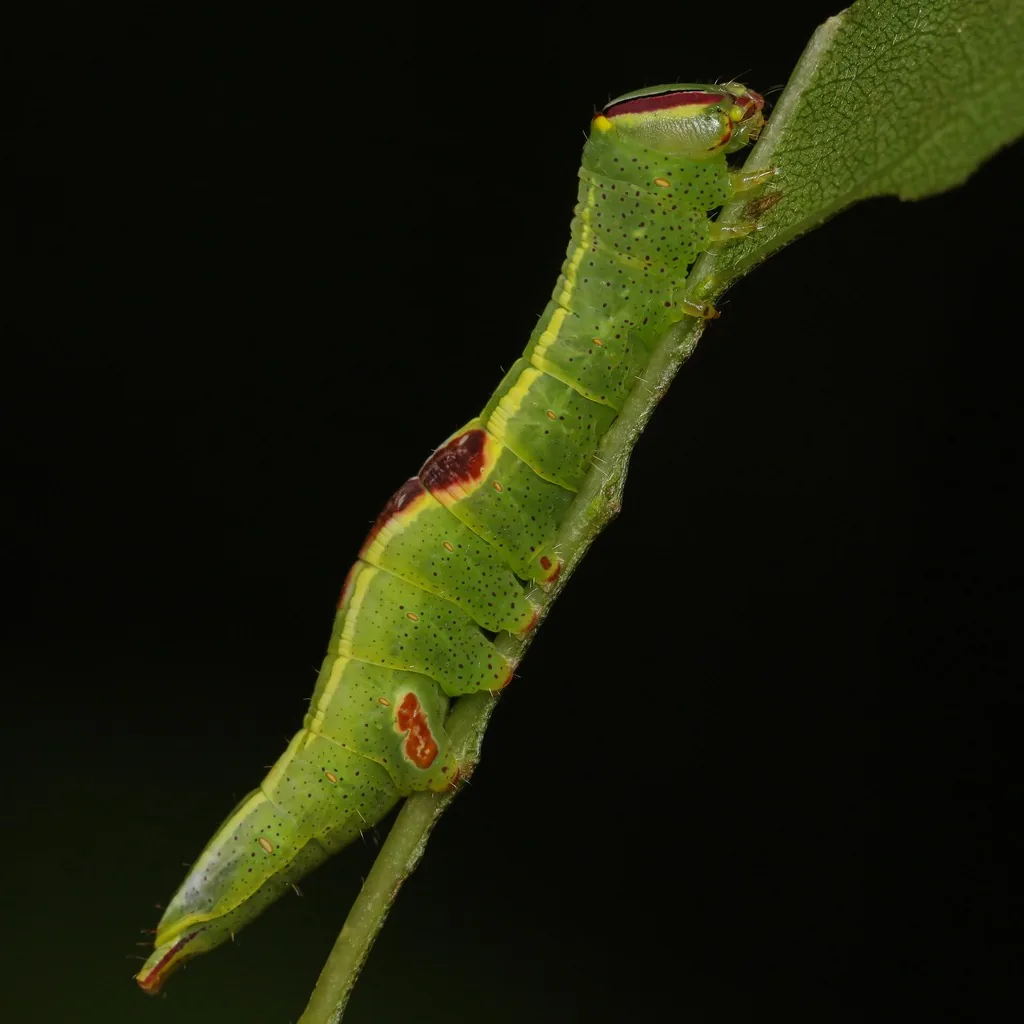
- Grown caterpillars are smooth and usually green, sometimes reddish brown, with a red to purplish saddle-shaped mark on the back and a cream stripe along each side. UMass gives about 1.5 inches; the Forest Service gives about 28 mm (about 1.1 inches) for the last stage. The Forest Service's 1972 manual Eastern Forest Insects gives about 30 mm and describes purple, gold and brown markings on the back.[1][2][3]
- Newly hatched caterpillars are reddish maroon to black, with a pair of antler-like horns behind the head and eight pairs of black spikes on the back. UMass says these are lost after the first molt; the Forest Service says they shrink over the next stages, with the spikes gone by the third and the horns by the fifth.[1][2]
- Adults are inconspicuous greenish gray, brownish gray or olive moths with white and black markings, about 3/4 inch long, that rest camouflaged on tree bark by day. Females have a wingspan of 40 to 52 mm, slightly larger than males. The 1972 manual describes the moth as greenish gray or brownish gray with splotches of creamy white and a wingspread of about 50 mm.[1][2][3]
- Eggs are round, about 1 mm across, pale green at first and reddish as they develop. Parasitized eggs turn gray with black spots.[1][2]
Look-alikes
| Look-alike | How to tell them apart |
|---|---|
| Variable oakleaf caterpillar, orangehumped mapleworm and greenstriped mapleworm | The Forest Service says these late-summer defoliators often feed alongside saddled prominent and can add to the damage as a group.[2] |
| Other Heterocampa caterpillars | The 1972 Forest Service manual names H. umbrata on oak and maple, H. biundata on beech, paper birch, wild black cherry and maple, and H. bilineata on elm and birch as other Heterocampa species likely to be met in eastern forests.[3] |
Where it lives
Native to the northeastern United States and southeastern Canada. The Forest Service says the most widespread U.S. outbreaks have been in the Northeast, with smaller areas of severe defoliation in Michigan and Wisconsin.[1][2]
Biology and life cycle
Pupae overwinter in the leaf litter, 1 to 3 inches down according to the Forest Service. It says moths emerge from late May to early July, peaking in mid-June; UMass says most emerge by the last week of May over about two weeks.[2][1]
Young caterpillars skeletonize leaf undersides, leaving translucent lacy patches; older ones eat leaves from the edges and shred them, littering the ground below. The 1972 manual says older caterpillars eat the entire leaf except the main veins, often move from tree to tree, and where abundant may gather in large numbers around the bases of stripped trees.[1][2][3]
The Northeast has one generation a year. UMass cites another source saying two are possible over much of the East, with mature caterpillars from late May to November in some places.[1][2]
Females lay eggs singly on leaf undersides, most densely in the upper crown. Each lays 200 to 250 on average; the Forest Service says the total can top 300, and UMass says up to 500. Larvae hatch about 9 days later, in late June or early July.[2][1]
Feeding ends in late August or early September, when the caterpillars crawl down into the leaf litter and spin cocoons. The 1972 manual puts pupation in the leaf mold from mid-July until late August.[2][3]
Damage and signs
- Favorite hosts are American beech, sugar maple, yellow birch and paper birch. The Forest Service says nearly any broadleaf tree mixed into such stands may be eaten, except red maple, striped maple and white ash, which are rarely attacked. UMass also lists apple as a preferred host. The 1972 manual adds that in heavily infested stands practically all other deciduous trees are eaten, particularly the oaks and poplar.[2][1][3]
- Most feeding falls between late July and early September, so healthy trees usually cope. Several seasons of feeding can cause branch dieback, and repeated severe defoliation, especially in drought, has killed 10 to 15 percent of trees in parts of New York, Pennsylvania and New England.[1][2]
- Outbreaks come about every 10 years and last 1 to 3 years. One from 1968 to 1971 defoliated nearly 1.5 million acres in six northeastern states, and Maine had further outbreaks covering more than 500,000 acres in 1976-78 and 1981.[1][2]
- Defoliated sugar maples produce less sap for maple syrup, and wandering caterpillars and falling frass can spoil recreation areas.[2]
- Severely defoliated trees may grow new leaves even in late summer, but these are often killed by frost and few normal buds form. Weakened trees are open to secondary pests such as an ambrosia beetle and Armillaria root disease.[2]
- In areas defoliated two years in a row, the 1972 manual says considerable tree mortality occurred, and many surviving trees lost some large branches and large parts of their tops.[3]
Health risk
It feeds on tree leaves. The Forest Service mentions falling frass and wandering caterpillars only as a nuisance in recreation areas, and no cited source describes any risk to people or pets.[2][1]
Control
Prevention
Pheromone traps are available. In New York trials, wing-style traps caught far more moths than green bucket traps and the lures drew only this species; trap catch tracked egg numbers in one year but not the next.[4][1]
Keep them out
During an outbreak, UMass suggests fine netting such as cheesecloth could protect small ornamental plants near forests.[1]
Biological control
Natural enemies help end outbreaks but don't prevent them: two egg parasitoid wasps (together 40 to 78% of egg deaths in the 1968-71 outbreak), a pupal parasitoid, shrews, birds such as grackles, a ground beetle, a stink bug, fungi and a virus, plus starvation.[1][2]
Pesticides
Chemical control isn't recommended routinely because outbreaks collapse on their own, though the Forest Service says it may help in special areas such as recreation sites or maple syrup stands. Bacillus thuringiensis spares the natural enemies, and UMass advises reduced-risk choices if a spray is needed.[1][2]
Common questions
- What is eating my beech and maple leaves in August?
- In the Northeast, saddled prominent caterpillars are a late-summer defoliator of beech and sugar maple, and the Forest Service says related caterpillars such as the variable oakleaf caterpillar often feed alongside them.[1][2]
- How long do saddled prominent outbreaks last?
- Usually 1 to 3 years before they collapse.[1][2]
- Why do some lists call it Cecrita guttivitta?
- GBIF's backbone taxonomy has a record for Cecrita guttivitta but marks it as doubtful, and accepts Heterocampa guttivitta, the name UMass and the Forest Service use.[5][6][1][2]
Sources
- UMass Extension Landscape, Nursery and Urban Forestry Program (Landscape Insect & Mite Guide), “Heterocampa guttivitta (Saddled Prominent).” www.umass.edu/agriculture-food-environment/landscape/publications-resources/insect-mite-guide/heterocampa-guttivitta (accessed 2026-11-13)
- USDA Forest Service (Forest Insect & Disease Leaflets), “Saddled Prominent (FIDL 167, Sept. 1987).” www.fs.usda.gov/foresthealth/docs/fidls/FIDL-167-SaddledProminent.pdf (accessed 2026-11-13)
- USDA Forest Service, “Eastern Forest Insects, Miscellaneous Publication 1175 (W. L. Baker, February 1972; scanned copy).” archive.org/details/easternforestins1175bake (accessed 2026-11-14). Scanned copy of the USDA Forest Service publication on the Internet Archive; text read from the archive.org full-text (djvu.txt) file.
- Journal of Economic Entomology (via PubMed), “Monitoring populations of saddled prominent (Lepidoptera: Notodontidae) with pheromone-baited traps. Spear-O'Mara & Allen 2007 (abstract).” pubmed.ncbi.nlm.nih.gov/17461055/ (accessed 2026-11-13)
- Global Biodiversity Information Facility (GBIF), “Heterocampa guttivitta Walker, 1855 (GBIF Backbone Taxonomy).” api.gbif.org/v1/species/5119026 (accessed 2026-11-13)
- Global Biodiversity Information Facility (GBIF), “Cecrita guttivitta Walker, 1855 (status: doubtful) (GBIF Backbone Taxonomy).” api.gbif.org/v1/species/9807789 (accessed 2026-11-13)