On this page
How to identify it
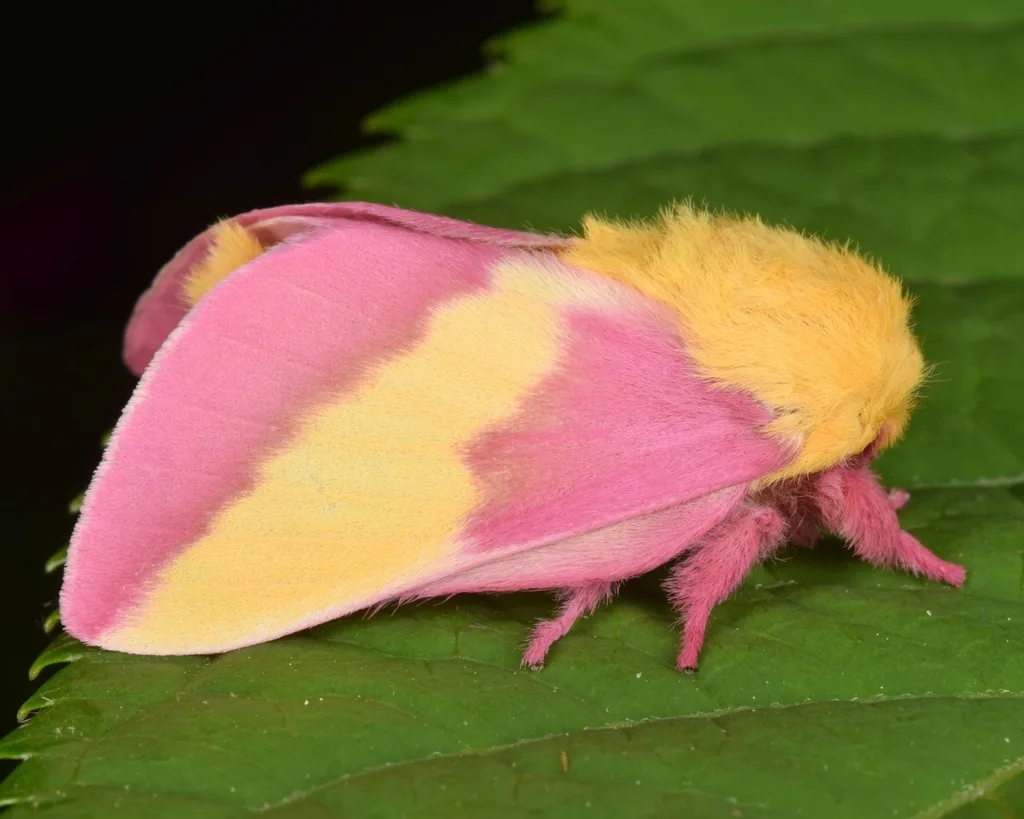
- Adults are thick, fuzzy moths, most often pink and yellow, though cream, white and purple forms occur. Males have comblike antennae and are smaller than females.[1][3]
- It is the smallest of the silk moths. Clemson gives a spread of up to 2 inches; the Missouri Department of Conservation gives a wingspan of 1 1/4 to 2 1/4 inches.[1][3]
- In Missouri a dark pink form is most common in the Ozarks, a lighter form in central and northeastern Missouri, and an almost all-white form (alba) in the west and north.[3]
- The caterpillar is green with lengthwise stripes, a red, orange or orangish-brown head, two black horns behind the head and rings of tiny black spines, and often a red or pinkish patch near the rear.[1][2][3]
Look-alikes
| Look-alike | How to tell them apart |
|---|---|
| Pink prominent (Hyparpax aurora) | An unrelated moth with similar pink-and-yellow coloring; the wing patterns differ, so compare photos.[3] |
Where it lives
Clemson says it is found throughout North America, and Mississippi State calls it a native insect of the eastern United States. GBIF holds about 21,000 US records since 1990 from 33 states, most from North Carolina, Massachusetts and Vermont.[1][2][5]
Biology and life cycle
Females lay eggs in clusters on the undersides of host leaves, 10 to 30 eggs per cluster in Missouri, and the eggs hatch about 2 weeks later. Young caterpillars feed together and become solitary as they grow.[1][3]
Full-grown caterpillars crawl down to the ground and pupate in a shallow hole or burrow in the soil. The pupal stage can last as little as two weeks or several months over winter.[1][3]
Adults have no working mouthparts and don't feed. They emerge in the late afternoon, mate that evening and come to lights at night.[3][2]
Mississippi State reports two to three generations a year in the Deep South and one farther north. Missouri has at least two, with adults from late April into September, and in South Carolina mating runs from as early as March to October.[2][3][1]
Damage and signs
- Hundreds of caterpillars can feed on a single tree and leave it partly or entirely bare. Clemson calls this mainly an aesthetic problem that may harm saplings or stressed trees; the Missouri Department of Conservation says trees already stressed by drought or disease might not survive the added stress.[1][3]
- Mississippi State notes that completely defoliated trees may look bad for a while but will usually leaf out and recover.[2]
- In a two-year Auburn University field study of planted red maples, rosy maple moth caterpillars caused most of the damage, and in the second year red maples surrounded by crape myrtles had more defoliation and more caterpillars than other plantings.[4]
Health risk
Clemson, Mississippi State and the Missouri Department of Conservation describe only leaf feeding by the caterpillars and report no harm to people. The adults don't feed at all.[1][2][3]
Control
Prevention
Healthy trees can withstand occasional outbreaks and grow new leaves, so a defoliated maple usually doesn't need treatment.[3][2]
Traps and physical control
Wipe egg clusters off the undersides of leaves to stop caterpillars before they hatch.[1]
Biological control
Birds such as tufted titmice, blue jays and black-capped chickadees, along with parasitic flies and wasps and predatory beetles, feed on them.[1]
Pesticides
Clemson says insecticides work on the larvae but are very rarely advised or worthwhile, and suggests talking to an arborist or Extension agent first. For heavy infestations on young trees small enough to spray, Mississippi State suggests spinosad and warns that broad insecticides such as carbaryl or bifenthrin are more likely to set off outbreaks of other insects or mites.[1][2]
Where sources disagree
Where it lives: Clemson says it is found throughout North America, while Mississippi State describes it as native to the eastern United States.[1][2]
Size: Clemson gives up to 2 inches across; the Missouri Department of Conservation gives a wingspan of 1 1/4 to 2 1/4 inches.[1][3]
Caterpillar color: Clemson describes bright neon green with faded white stripes, Mississippi State light-colored with green stripes, and the Missouri Department of Conservation greenish white, with stripes only in some stages.[1][2][3]
Host trees: Clemson names sugar, silver and red maples and sometimes turkey oak; Mississippi State says maples and occasionally oaks; the Missouri Department of Conservation adds sycamore and beech.[1][2][3]
Common questions
- What is the pink and yellow fuzzy moth on my porch?
- Most likely a rosy maple moth. It is a small silk moth, usually pink and yellow, and it comes to lights at night.[1][3]
- Will greenstriped mapleworms kill my maple?
- Usually not. Defoliated trees generally leaf out again, though saplings and trees already stressed by drought or disease can be harmed.[1][2][3]
- Should I spray?
- Rarely. Clemson says spraying is very rarely advised or worthwhile; Mississippi State suggests spinosad only for heavy infestations on young trees small enough to spray.[1][2]
Sources
- Clemson Cooperative Extension, Home & Garden Information Center, “Rosy Maple Moth (Dryocampa rubicunda) (HGIC 2022).” hgic.clemson.edu/factsheet/rosy-maple-moth-dryocampa-rubicunda/ (accessed 2026-11-11)
- Mississippi State University Extension, “Rosy Maple Moth, Vol. 4, No. 10.” extension.msstate.edu/newsletters/bugs-eye-view/2018/rosy-maple-moth-vol-4-no-10 (accessed 2026-11-11)
- Missouri Department of Conservation, “Rosy Maple Moth (field guide).” mdc.mo.gov/discover-nature/field-guide/rosy-maple-moth (accessed 2026-11-11)
- Environmental Entomology, via PubMed, “Associational interactions between urban trees: are native neighbors better than non-natives? (Clem and Held 2018).” pubmed.ncbi.nlm.nih.gov/29771321/ (accessed 2026-11-11). Cited from the PubMed abstract.
- Global Biodiversity Information Facility (GBIF), “Dryocampa rubicunda: US occurrence records since 1990 by state (GBIF occurrence search API).” api.gbif.org/v1/occurrence/search?taxonKey=1865862&country=US&hasGeospatialIssue=false&occurrenceStatus=PRESENT&year=1990%2C2026&facet=stateProvince&facetLimit=400&limit=0 (accessed 2026-11-11). State counts are records reported (iNaturalist research-grade, museum specimens, surveys), not abundance.
- iNaturalist, “Dryocampa rubicunda taxon page (order and family).” www.inaturalist.org/taxa/48094 (accessed 2026-11-11)