On this page
How to identify it
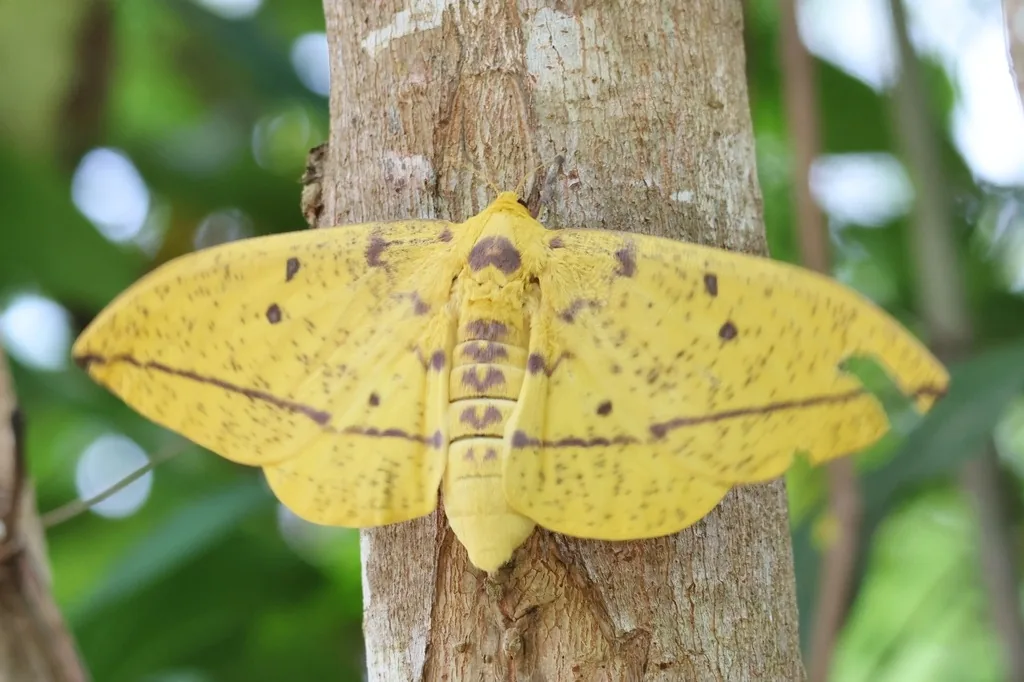
- Adults are large, mostly yellow moths with spots, lines and blotches of light to dark brown; the Missouri Department of Conservation describes the speckling as pink, orange or rusty pale purple. They usually fly at night and come to lights.[1][3]
- Males have more feathery antennae and are more heavily marked; females are larger, with broader wings and less brown above.[1][3][4]
- Mature caterpillars are fat, green to brown or nearly black, 3 to 5 inches long, with fine hair, two pairs of spiny horns behind the head, and pale spiracles (breathing holes) down each side.[1][3]
- Newly hatched caterpillars are orange, almost half an inch long, with conspicuous black spines.[1]
Where it lives
UW-Milwaukee describes it in woodlands east of the Great Plains from Canada to Florida and Texas and south to Argentina, with a historic range that once reached farther north; the Missouri Department of Conservation calls it widespread in the eastern United States. GBIF holds about 20,000 US records since 1990 from 31 states, counting the District of Columbia, most from North Carolina, Virginia and Florida.[4][3][6]
Biology and life cycle
Moths emerge from the soil in late spring. Adults have no working mouthparts and don't feed; they mate the evening after emerging, usually between 11 p.m. and 1 a.m.[1][3]
Females lay several hundred eggs, singly or in small groups, on leaves of many kinds of trees. The eggs are flattened spheres almost 1/8 inch across and hatch a few weeks later.[1][3][4]
Caterpillars feed alone. Full-grown caterpillars climb down, burrow into the soil and pupate, and the pupae spend the winter there; in spring the pupa works its way up to the surface before the moth emerges.[1][2][4]
Few survive: caterpillars feeding in the open are eaten by birds and mammals, armadillos dig pupae out of the soil, bats eat the moths, and parasitic flies and diseases take more.[1][4]
Imperial moths have no chemical defenses or stinging hairs; young caterpillars wave their front ends back and forth to bluff predators.[4]
Damage and signs
Health risk
The caterpillars have no stinging hairs or chemical defenses, and NC State, Clemson and UW-Milwaukee describe them only as leaf feeders; none reports harm to people.[4][1][2]
Control
Prevention
NC State says it seems a pity to use an insecticide on such usually rare caterpillars, though they are susceptible to most insecticides labeled for home landscapes should the need arise.[1]
Why it has disappeared from New England
The species has disappeared from almost all of New England except a population on Martha's Vineyard. Suggested causes include habitat fragmentation, pesticides, street lights that disrupt night-time navigation and mating, and introduced parasitic insects released against spongy moth.[3][4]
A University of Massachusetts study found that Compsilura concinnata, a parasitic fly released repeatedly from 1906 to 1986 against 13 pest species, caused 81% of the early caterpillar deaths in a native silk moth, and concluded the fly may explain reported silk moth declines in New England.[5]
Where sources disagree
Generations: NC State says it is unclear whether North Carolina has one generation or two and that only one occurs farther north; the Missouri Department of Conservation reports 2 broods in Missouri, with adults from early May through August.[1][3]
Size: the Missouri Department of Conservation gives a wingspan of 3 3/4 to 5 1/2 inches and UW-Milwaukee 4 to 5 inches. NC State gives caterpillars 3 to 5 inches and notes reports of 5.5 inches, while UW-Milwaukee says up to four inches.[3][4][1]
Favorite hosts: NC State lists pines, oaks, maples, sassafras and sweetgum; in Missouri the caterpillars most often eat maples, sycamores and sassafras; UW-Milwaukee's list leads with oak, hickory, walnut, sycamore and basswood.[1][3][4]
Common questions
- What is the huge yellow moth on my wall?
- Likely an imperial moth, one of the largest moths in the Southeast.[1][2]
- What is the giant green caterpillar walking across the driveway?
- Possibly a full-grown imperial moth caterpillar climbing down to burrow into the soil and pupate.[1][2]
- Do I need to kill imperial moth caterpillars?
- Usually not; they are rare and seldom do noticeable damage.[1]
- Do imperial moth caterpillars sting?
- No. Unlike some of their relatives, they have no stinging hairs or chemical defenses.[4]
Sources
- NC State Extension, “Imperial Moth (PDIC Factsheet).” content.ces.ncsu.edu/imperial-moth (accessed 2026-11-11)
- Clemson Cooperative Extension, Home & Garden Information Center, “What Is It? Wednesday – Imperial Moth Caterpillar (Nov. 9, 2022).” hgic.clemson.edu/what-is-it-wednesday-imperial-moth-caterpillar/ (accessed 2026-11-11)
- Missouri Department of Conservation, “Imperial Moth (field guide).” mdc.mo.gov/discover-nature/field-guide/imperial-moth (accessed 2026-11-11)
- University of Wisconsin-Milwaukee Field Station, “Imperial Moth, Bug of the Week (K. Redmond, 'the BugLady').” uwm.edu/field-station/bug-of-the-week/imperial-moth/ (accessed 2026-11-11). University field station's natural-history column
- Conservation Biology, via PubMed, “Effects of a biological control introduction on three nontarget native species of saturniid moths (Boettner et al. 2000).” pubmed.ncbi.nlm.nih.gov/35701905/ (accessed 2026-11-11). Cited from the PubMed abstract.
- Global Biodiversity Information Facility (GBIF), “Eacles imperialis: US occurrence records since 1990 by state (GBIF occurrence search API).” api.gbif.org/v1/occurrence/search?taxonKey=1865107&country=US&hasGeospatialIssue=false&occurrenceStatus=PRESENT&year=1990%2C2026&facet=stateProvince&facetLimit=400&limit=0 (accessed 2026-11-11). State counts are records reported (iNaturalist research-grade, museum specimens, surveys), not abundance.
- iNaturalist, “Eacles imperialis taxon page (order and family).” www.inaturalist.org/taxa/81590 (accessed 2026-11-11)