On this page
How to identify it
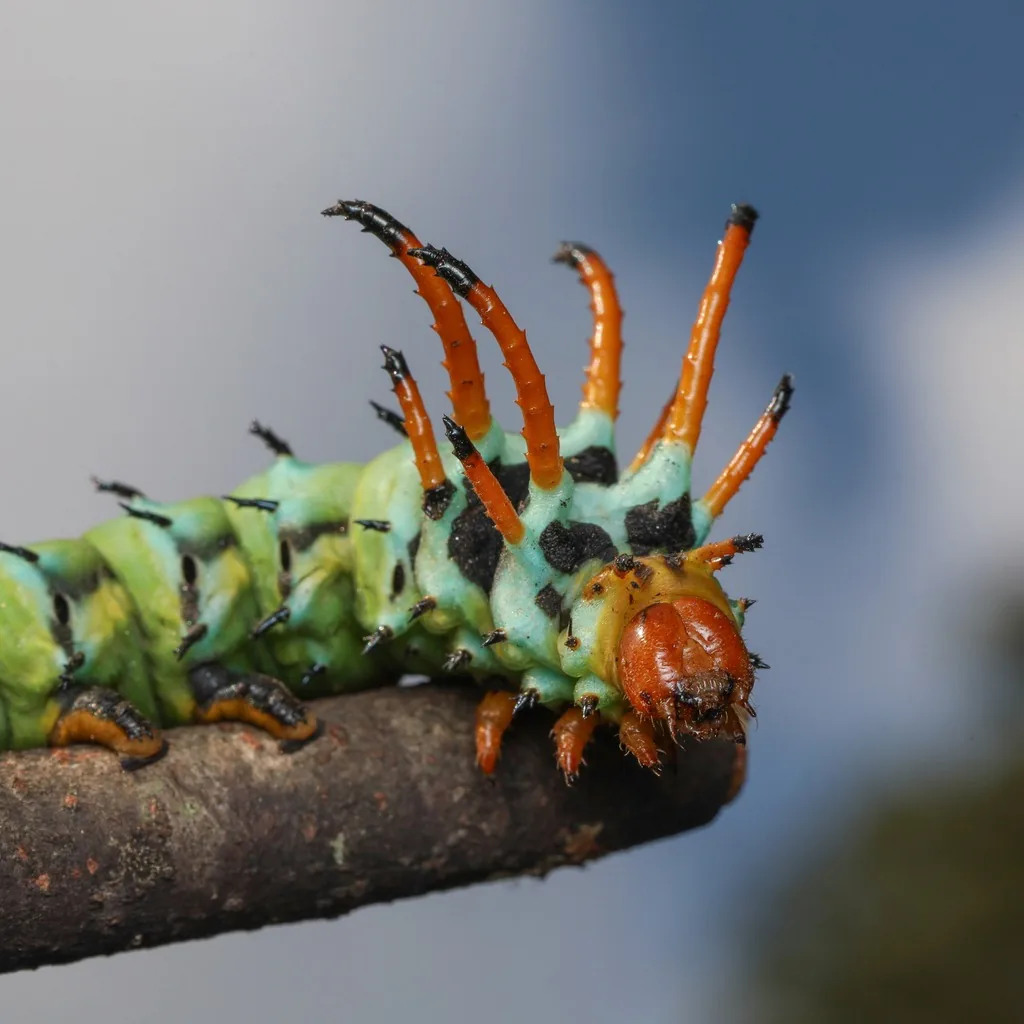
- A full-grown caterpillar is up to 5 1/2 inches long (Missouri) or almost 6 inches (NC State), usually green, with long curved horns behind the head that are orange with bluish-black tips. Rows of smaller spines run down the rest of the body. UF/IFAS gives 12.5 to 14 cm (5 to 5 1/2 inches), about the size of a large hot dog, and says the caterpillars are commonly blue-green. The second and third segments behind the head each carry two long and two shorter orange, black-tipped horns; each abdominal segment has four short black spines, and segments 2 through 8 have a pale slanting stripe on each side.[2][1][4]
- NC State describes a brown head, dark green body and black prolegs, with four or more short black spines around each body segment; the horns can be 3/4 inch long.[1]
- Color varies. Small caterpillars are spinier and mostly black, middle stages orangish or reddish, and the youngest rest on top of leaves looking like bird droppings.[2][5]
- It becomes the regal moth, also called the royal walnut moth: gray to olive forewings with orange veins and pale yellow spots and more orange hindwings, with a wingspan of about 3 15/16 to 6 1/4 inches. UF/IFAS gives a wingspan of 9.5 to 15.5 cm (3 3/4 to 6 1/8 inches), with females larger than males, a row of seven to nine yellow spots near the forewing edge, a mostly orange hind wing that may have one or two rows of gray-green spots, and an orange body with narrow yellow bands.[2][5][4]
Where it lives
Deciduous woods from New York west through southern Michigan and Illinois to eastern Kansas, and south to central Florida, the Gulf states and east Texas. It may be quite rare at the edges of its range; in Missouri it is found statewide but is best established in the wooded Ozarks and eastern part of the state. UF/IFAS describes it in eastern deciduous forests from New Jersey to Missouri and south to eastern Texas and central Florida, more common in the south. It was historically found north to Massachusetts and seems to be declining in other parts of its range.[5][2][4]
Biology and life cycle
There is one generation a year. Adults fly from May into August or mid-September, live only a week or two and do not feed. UF/IFAS says a few late records suggest a small second brood in the Deep South. In Florida adults have been collected in May but are more common in summer, and adults have vestigial mouthparts.[2][5][4]
Females lay eggs one to three at a time on host leaves; caterpillars hatch in about a week (6 to 10 days in BAMONA's account) and feed alone.[2][5]
After about 35 days of feeding, full-grown caterpillars climb down from the tree and dig into the soil to pupate in an underground cell. That is when people usually see them, mostly July to October. In central Florida, UF/IFAS says wandering caterpillars are usually seen from late July to mid-August.[2][1][3][4]
They spend the winter as pupae, and some stay underground an extra year before emerging. UF/IFAS notes a report that a small number of pupae stayed dormant through two winters.[2][4]
Few survive: birds eat them, and parasites and diseases kill others, so very few of the many eggs a female lays become adults. UF/IFAS lists at least six species of tachinid flies, one flesh fly and one braconid wasp reported as parasites of the regal moth.[1][4]
UF/IFAS says adults mate on the second evening after emerging and start laying eggs at dusk on the third. Eggs hatch in six to 10 days, and the caterpillar stage lasts about 35 days.[4]
Damage and signs
- Caterpillars feed on hickories including pecan, black walnut and butternut, sumac, persimmon and sweetgum; sycamore, ash, lilac and cotton are also eaten. UF/IFAS cites studies in which caterpillars grew faster and larger on persimmon than on sweetgum or sumac.[2][5][3][1][4]
- Small caterpillars eat very little; the last stages eat a lot of leaves, but the caterpillars are scattered and relatively rare.[1]
Health risk
Although it looks fierce, the caterpillar is harmless to people.[1][2][3]
Control
Prevention
No control is needed: the caterpillar is harmless and relatively rare. One found crawling on the ground is most likely a full-grown caterpillar looking for soil to burrow into. UF/IFAS calls the regal moth a beautiful native species whose caterpillars should not be killed. If you find one on pavement or thick lawn where it would struggle to dig, move it to soft soil or a mulched bed where it can burrow.[1][3][2][4]
Where sources disagree
Size: Missouri gives a maximum of 5 1/2 inches; NC State says almost 6 inches.[2][1]
Horn color: Missouri describes the horns as orange with bluish-black tips; NC State as brown at the base and black at the tip.[2][1]
Caterpillar color: UF/IFAS says commonly blue-green, while NC State describes a dark green body and Missouri says usually green.[4][1][2]
Range: UF/IFAS gives New Jersey to Missouri, south to eastern Texas and central Florida, while BAMONA extends it north and west to New York, southern Michigan, Illinois and eastern Kansas.[4][5]
Wingspan: UF/IFAS gives 3 3/4 to 6 1/8 inches; BAMONA and Missouri give about 3 15/16 to 6 1/4 inches.[4][5][2]
Common questions
- Is the giant horned caterpillar dangerous?
- No. NC State, the Missouri Department of Conservation and Clemson all call the hickory horned devil harmless despite its look.[1][2][3]
- What does it turn into?
- The regal moth, or royal walnut moth, a large gray-and-orange moth that flies at night and does not eat.[2][5]
- Why was it crawling on the ground?
- Full-grown caterpillars leave the tree to find soil to burrow into and pupate, and that is when they are most often seen.[3][2]
- What should I do if I find one on my driveway?
- Leave it be or move it. UF/IFAS says a caterpillar found on pavement or thick turf should be moved to soft soil or mulch where it can burrow to pupate.[4]
Sources
- NC State Extension, “Hickory Horned Devil \ Regal Moth.” content.ces.ncsu.edu/hickory-horned-devil (accessed 2026-11-11)
- Missouri Department of Conservation, “Regal Moth (Royal Walnut Moth; Hickory Horned Devil), Field Guide.” mdc.mo.gov/discover-nature/field-guide/regal-moth-royal-walnut-moth-hickory-horned-devil (accessed 2026-11-11)
- Clemson Cooperative Extension, Home & Garden Information Center, “What Is It? Wednesday: Hickory Horned Devil Caterpillar.” hgic.clemson.edu/what-is-it-wednesday-hickory-horned-devil-caterpillar/ (accessed 2026-11-11)
- University of Florida IFAS Extension (EDIS), “Hickory Horned Devil (Larva), Regal Moth or Royal Walnut Moth (Adult), Citheronia regalis (Fabricius), EENY-052/IN209 (D. W. Hall; Featured Creatures).” ask.ifas.ufl.edu/publication/IN209 (accessed 2026-11-14)
- Butterflies and Moths of North America (BAMONA), “Royal Walnut Moth, Citheronia regalis (species account).” www.butterfliesandmoths.org/species/Citheronia-regalis (accessed 2026-11-11)
- iNaturalist, “Citheronia regalis taxon page (order and family).” www.inaturalist.org/taxa/81586 (accessed 2026-11-11)