On this page
How to identify it
- The full-grown caterpillar is pale green, 3.3 to 3.8 cm long. Most have red bands across the back between yellow stripes, but a less common light form has no red bands. The USDA Forest Service describes prominent yellow stripes along each side of the back, with the back itself plain pale green or marked with wine-red and yellow spots.[1][4]
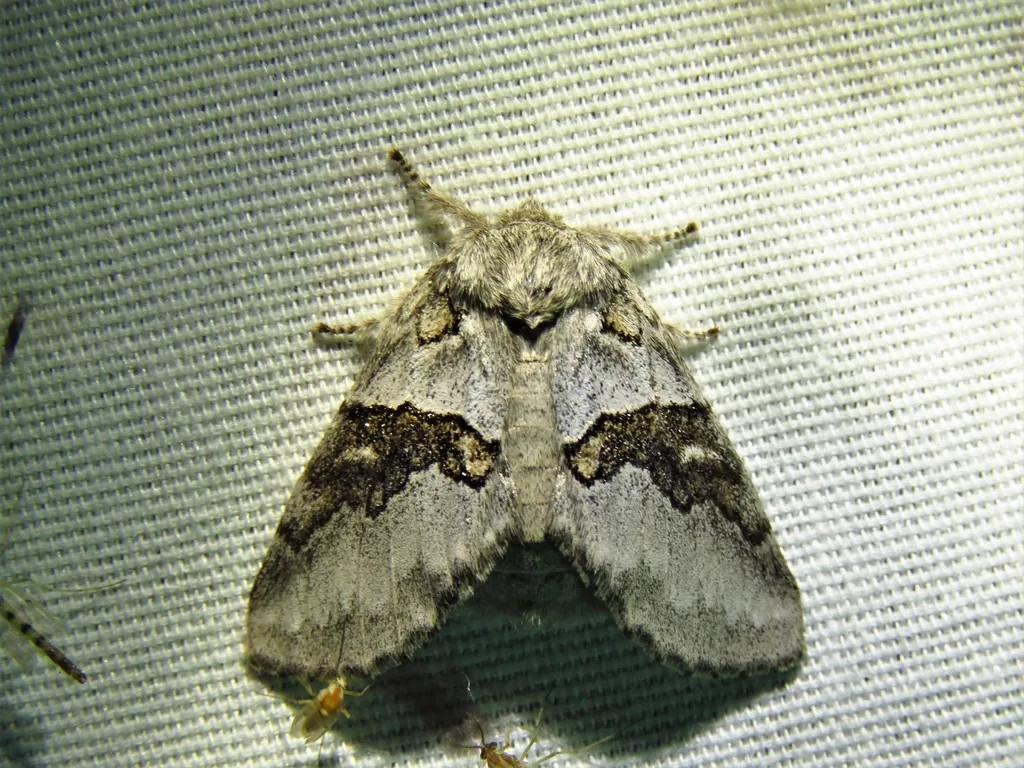
- Adults are small, dark grayish moths with a wingspan of 2.5 to 3.3 cm: rounded gray forewings with irregular beige and dark gray bands, and light gray hindwings. The resting moth looks like a pebble, hence the name common pebble moth.[1]
- Male moths have a wide mouth slit and a greatly enlarged gut lining, which the Science study describes as specializations for puddling.[2]
- The caterpillar's head is flattened, with conspicuous antennae and often black lines on its sides; the abdomen tapers toward the rear and the last segment is compressed.[4]
Where it lives
Washington State University Extension says it has been collected from Maine west to Washington, south to California and east to Mississippi, though in the mid-1900s it was reported only from southeastern Canada and the northeastern U.S. Idaho Fish and Game lists it as native and regularly occurring in Idaho. The USDA Forest Service includes it in its guide to the caterpillars of eastern forests.[1][5][4]
Biology and life cycle
The caterpillars feed on poplars and aspens, including black cottonwood and hybrid poplars; WSU also lists alder, birch, butternut, sweetgum, elm, willow and basswood as hosts. The USDA Forest Service lists poplars as its food and finds caterpillars from June to October, with 2 generations a year.[1][4]
It can go from egg to adult in 28 to 37 days, allowing two generations a year; moths fly from early May through June and again from July through August in parts of Canada and the Pacific Northwest. The second generation pupates in September and October and spends the winter as a pupa.[1]
Males puddle routinely and for hours, drinking hundreds of gut-loads of water and squirting the fluid back out from the rear end in repeated jets. They come away with a net gain of sodium, which the caterpillars' poplar diet supplies very little of.[2][3][1]
At mating a male passes the female about 10 micrograms of sodium, more than half of the sodium in his body, probably in the sperm packet. She puts much of it into her eggs: eggs fathered by puddling males held two to four times as much sodium as eggs from the study's control males, starting with eggs laid the night after mating.[3]
The authors note that a father supplying his offspring with sodium had not been shown before in an insect, as far as they knew, and that getting sodium may be the main reason butterflies and moths puddle.[3][2]
Male moths lived only about 6 days in the lab and could mate at least three times.[1]
It belongs to the prominent family, whose caterpillars tend to stay on the foliage by day; most prominents are specialized in diet, so the host plant helps with identification.[4]
Damage and signs
- Young caterpillars skeletonize the leaf surface, spinning a silk anchor on the leaf underside so wind does not blow them off; later they strip leaves down to the midrib. A late-stage caterpillar can eat up to 95% of a 36 square cm poplar leaf in 24 hours.[1]
- Outbreaks matter in hybrid poplar plantations: first noticed in eastern Oregon in 2004, it defoliated 80% of 350 acres near Boardman three years later, and within five years that tree farm had 8,000 acres a year defoliated.[1]
Health risk
None of the sources (WSU Extension, Idaho Fish and Game, the USDA Forest Service and the two Cornell studies) mentions any bite, sting or other risk to people.[1][5][4][2][3]
Control
Prevention
WSU's guidance is written for hybrid poplar plantations: monitor eggs and young larvae on foliage after the adult flight peak, or use light traps for adults.[1]
Biological control
Natural enemies help: the parasitic wasp Eulophus orgyiae attacks the caterpillars, Trichogramma wasps parasitize the eggs, tachinid flies parasitize pupae and predators such as stink bugs eat larvae. Minimal or careful insecticide use lets these build up.[1]
Pesticides
For plantation outbreaks, WSU recommends targeting young larvae with the insect growth regulator diflubenzuron to spare beneficial insects; for late larvae on FSC-certified poplars it names indoxacarb, spinosad and chlorantraniliprole, always used according to the label.[1]
Where the sources disagree
Food plants: the USDA Forest Service lists only poplars, while WSU Extension adds aspens, alder, birch, butternut, sweetgum, elm, willow and basswood.[4][1]
Caterpillar pattern: the USDA Forest Service describes yellow stripes with a plain back or wine-red and yellow spots; WSU describes red bands across the back between yellow stripes, with a less common form lacking the red.[4][1]
Common questions
- Why do some moths sit at mud puddles?
- Males of this moth drink from puddles to collect sodium. They swallow water for hours, squirt it back out, and keep the sodium, which they later pass to the female at mating.[2][3]
- Why would a moth need extra sodium?
- Its caterpillars eat poplar leaves, which are extremely low in sodium. The sodium a male gathers ends up largely in the eggs, so the next generation starts with more of it.[3][2][1]
- What does the common gluphisia caterpillar look like?
- A pale green caterpillar up to about 3.8 cm long, usually with red bands across the back between yellow stripes (some lack the red). Look for it on poplars and aspens. The USDA Forest Service adds a flattened head and a body that tapers to the rear, and finds caterpillars from June to October.[1][4]
- Can it hurt my poplar trees?
- It can strip leaves when numbers are high; outbreaks have defoliated thousands of acres of hybrid poplar plantations in Oregon, and populations can reach damaging levels after one or two years.[1]
Sources
- Washington State University Extension, “Gluphisia septentrionis Walker (FS271E, Insect Pest Management in Hybrid Poplars Series).” wpcdn.web.wsu.edu/wp-ecommerce/uploads/sites/2/product-3668-sku-FS271E.pdf (accessed 2026-11-14)
- Science (via NCBI PubMed), “Sodium uptake by puddling in a moth (S. R. Smedley and T. Eisner; Science 270(5243): 1816-1818, 1995; abstract).” pubmed.ncbi.nlm.nih.gov/8525374/ (accessed 2026-11-14)
- Proceedings of the National Academy of Sciences (via NCBI PubMed), “Sodium: a male moth's gift to its offspring (S. R. Smedley and T. Eisner; Proceedings of the National Academy of Sciences 93(2): 809-813, 1996; abstract).” pubmed.ncbi.nlm.nih.gov/11607627/ (accessed 2026-11-14)
- USDA Forest Service, Forest Health Technology Enterprise Team (scan at Internet Archive), “Caterpillars of Eastern Forests, FHTET-96-34 (D. L. Wagner, V. Giles, R. C. Reardon and M. L. McManus, 1997).” archive.org/details/caterpillarsofea001997 (accessed 2026-11-14). Read from the Internet Archive's scan and full text of the USDA Forest Service publication.
- Idaho Department of Fish and Game, Species Catalog, “Gluphisia septentrionis (Common Gluphisia Moth).” idfg.idaho.gov/species/taxa/23263 (accessed 2026-11-14)
- iNaturalist, “Gluphisia septentrionis taxon page (order and family).” www.inaturalist.org/taxa/143274 (accessed 2026-11-14)