On this page
How to identify it
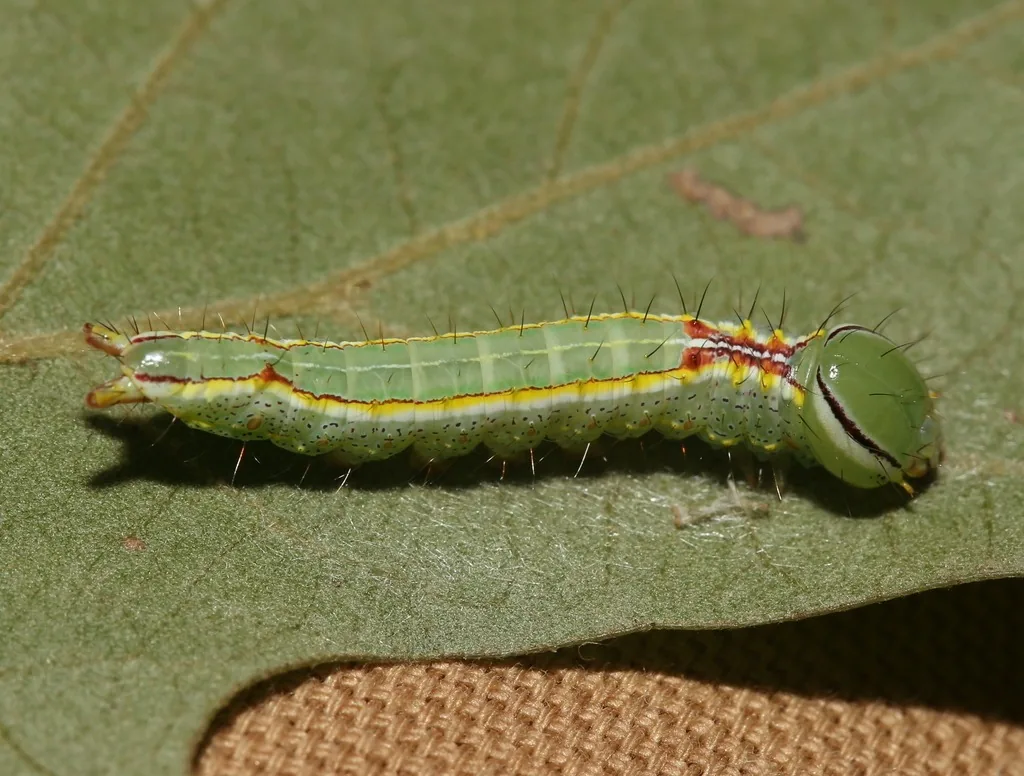
- Grown caterpillars are about 1.5 inches long and green to yellow, often with a pink to dark red stripe on the back that varies widely in shape.[1][2]
- The head ranges from amber brown to yellow or green, with two curved bands on each side: an outer creamy white band and an inner reddish-brown to black one.[1]
- Moths have a wing expanse of 1.5 to 1.75 inches. Each forewing is light or dark ashy gray with three darker wavy lines and one faint black spot, and the hindwings are light brown.[1]
- Eggs are pale cream, glossy and round, about 0.8 mm across, laid on the lower leaf surface.[1]
Look-alikes
| Look-alike | How to tell them apart |
|---|---|
| Saddled prominent | A close relative with similar habits that often feeds alongside it.[1] |
Where it lives
Eastern North America, west to North Dakota and south to eastern Texas, Louisiana and Mississippi; southwestern Arkansas had a heavy outbreak in 2017.[1][2]
Biology and life cycle
It overwinters as a prepupa in a cocoon under the leaf litter, and in heavy outbreaks the Forest Service says more than half may stay prepupae for another year. The North has one generation a year; south of a line from Virginia to Missouri, two have been reported.[1][2]
In the North, moths fly from late June to late July. Females lay clusters of 30 to 300 eggs under leaves, which hatch in 5 to 7 days. Young caterpillars feed in groups and skeletonize leaves, older ones eat everything between the main veins, and the last stage does about 85% of the defoliation.[1]
When disturbed, larvae defend themselves by secreting formic acid.[1]
Damage and signs
- All oaks are attacked, with white oak generally preferred. Beech, basswood, paper birch and American elm are also hosts, and the Forest Service says walnut, black birch, hawthorn, eastern hophornbeam, apple, boxelder and persimmon are fed on occasionally.[1]
- Most feeding comes in August or later, so trees can withstand 2 or 3 years of heavy defoliation, and outbreaks seldom last more than 2 years. Sources differ on tree loss: the Forest Service says an occasional tree may be killed, while Arkansas says the caterpillars don't harm the tree itself.[1][2]
- In outbreaks the droppings stain sidewalks, porches and cars, and the sound of falling frass can be mistaken for rain.[2]
Health risk
No cited source describes a health risk specific to this caterpillar. MedlinePlus says most caterpillars are harmless, but some cause allergic reactions through contact with their hairs, and brightly colored caterpillars with spines, bristles or a fuzzy look might be venomous and shouldn't be touched. For an exposure, the Poison Help line is 1-800-222-1222.[3]
Control
Sanitation
Arkansas suggests sweeping up and disposing of fallen leaves in fall, since the insects overwinter under the leaf litter.[2]
Biological control
After large outbreaks, the Forest Service says the egg parasites Trichogramma and Telenomus may kill 90% of the eggs and larval parasites may kill 90% of the larvae. Ground beetles and stink bugs also prey on them.[1][2]
Sources disagree about birds. Arkansas says pileated woodpeckers and blue jays rely on these caterpillars for food, while the Forest Service says most birds don't prey on active larvae, though prepupae have been found in the crops of ruffed grouse and wild turkeys.[2][1]
Pesticides
Arkansas says spraying large oaks is unnecessary and impractical. The Forest Service says chemical control is generally neither necessary nor recommended over large areas, though local treatment may be needed in residential or recreation areas.[2][1]
Common questions
- Why does it sound like rain under my oak trees in late summer?
- Heavy feeding by variable oakleaf caterpillars drops so much frass that it can sound like rainfall.[2]
- Will variable oakleaf caterpillars kill my oaks?
- Rarely. The Forest Service says most outbreaks subside before trees die, though an occasional tree may be killed; Arkansas says the caterpillars don't harm the tree itself.[1][2]
- Are the caterpillars dangerous to touch?
- No cited source describes a health risk from this species specifically. MedlinePlus says most caterpillars are harmless but some cause allergic reactions through their hairs, and advises not touching brightly colored caterpillars with spines, bristles or a fuzzy look.[3]
Sources
- USDA Forest Service (Forest Insect & Disease Leaflets), “Variable Oakleaf Caterpillar (FIDL 67, revised May 1979).” www.fs.usda.gov/foresthealth/docs/fidls/FIDL-67-VariableOakleafCaterpillar.pdf (accessed 2026-11-13)
- University of Arkansas System Division of Agriculture (Cooperative Extension Service), “The variable oakleaf caterpillar returns: noisy, messy but harmless (Sept. 20, 2017).” www.uaex.uada.edu/media-resources/news/2017/september2017/09-20-2017-Ark-variable-oakleaf-caterpillar.aspx (accessed 2026-11-13)
- U.S. National Library of Medicine (MedlinePlus), “Caterpillars (MedlinePlus Medical Encyclopedia).” medlineplus.gov/ency/article/002860.htm (accessed 2026-11-13)
- Global Biodiversity Information Facility (GBIF), “Lochmaeus manteo Doubleday, 1841 (GBIF Backbone Taxonomy).” api.gbif.org/v1/species/1825428 (accessed 2026-11-13)