On this page
How to identify it
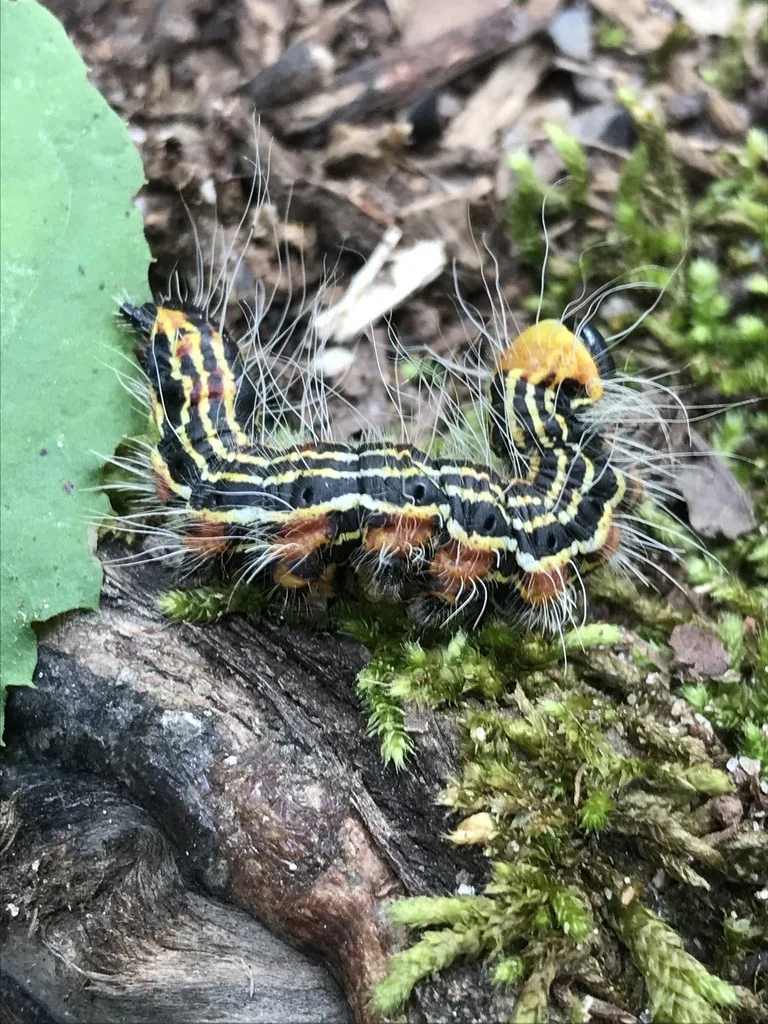
- Full-grown caterpillars are about 2 inches long, black with yellow to white stripes, with a black head and a bright yellow-orange patch behind it. Young ones look different: NC State and Clemson describe them as small and green, Iowa State as purplish with white stripes.[1][2][3]
- The body is covered in long, fine white hairs.[1][3]
- When disturbed, the whole group raises both ends of the body into a U shape, and Clemson says they can spit up a ball of brown fluid.[1][3]
Look-alikes
| Look-alike | How to tell them apart |
|---|---|
| Other Datana caterpillars | Clemson says ten Datana species occur in South Carolina and all look similar; the yellownecked caterpillar is the most common.[3] |
Where it lives
NC State calls it one of the most frequently reported pests of oaks, birches and other hardwoods, Clemson the most common Datana species in South Carolina, and Iowa State covers it in Iowa landscapes.[1][3][2]
Biology and life cycle
Moths emerge from the soil in early summer; NC State says June and July. They are reddish to cinnamon brown with fine darker wavy lines, about a 2-inch wingspread, and at rest look like the end of a broken stick. Males sometimes come to lights.[1][3]
Females lay masses of 100 or more eggs on the undersides of leaves; Iowa State says in July. Young caterpillars feed in clusters and skeletonize leaves, then eat whole leaves; Iowa State says the larger ones scatter through the tree.[1][3][2]
In August and September mature caterpillars drop to the ground and pupate for the winter in the soil (NC State says 2 to 4 inches deep) or leaf litter; there is one generation a year.[1][3]
Damage and signs
- Hosts include oak, maple, birch, elm, walnut, basswood, honeylocust, mountain-ash and witchhazel, plus apple, pear, cherry, blueberry and other fruit trees and shrubs.[1][3]
- Sources differ on severity. Iowa State says defoliation is usually mild, while Clemson says small trees can be stripped completely; most plants regrow leaves or have already stored enough for the year, but heavy or repeated defoliation may contribute to their death.[2][3]
Health risk
Clemson warns that the brown fluid they spit when disturbed stains skin and clothes, so be careful handling them. NC State, Iowa State and Clemson don't describe them as stinging.[3][1][2]
Control
Traps and physical control
Young caterpillars still in clusters can be removed by pulling off a leaf or pruning a branch tip in mid to late July. Larger ones can be shaken or knocked from low branches and stepped on, or hosed off with a strong stream of water.[2][1][3]
Biological control
Birds, tachinid flies and parasitic wasps, stink bugs and assassin bugs feed on the caterpillars, and Clemson says field mice eat the pupae in the soil.[1][3]
Pesticides
Control is usually not needed on landscape trees; Iowa State says small, newly planted or stressed trees benefit most, and Clemson says treatment is typically warranted on fruit trees and shrubs. If you spray, NC State and Clemson name Sevin or other home-use insecticides. Spray while caterpillars are small, since mature ones are much less susceptible.[2][3][1]
Common questions
- What are the striped caterpillars in a group on my oak?
- In mid to late summer, a cluster of black-and-yellow striped caterpillars with an orange-yellow neck patch is likely yellownecked caterpillars, though Clemson notes several related Datana species look similar.[1][2][3]
- Do I need to treat yellownecked caterpillars?
- Usually not on shade trees; most recover. Small, newly planted or stressed trees and fruit trees benefit most from protection.[2][3]
- Why do they lift their heads and tails?
- The whole group raises both ends of the body when disturbed, behavior NC State says may intimidate predators; Clemson adds they spit brown fluid to scare predators off.[1][3]
Sources
- NC State Extension, “Yellownecked Caterpillar in the Landscape (PDIC Factsheet).” content.ces.ncsu.edu/yellownecked-caterpillar (accessed 2026-11-13)
- Iowa State University Extension and Outreach (Yard and Garden), “Yellownecked Caterpillar.” yardandgarden.extension.iastate.edu/encyclopedia/yellownecked-caterpillar (accessed 2026-11-13)
- Clemson Cooperative Extension, Home & Garden Information Center, “Yellownecked Caterpillar (Datana ministra) in South Carolina: Identification, Host Plants, and Management (HGIC 2030; Caleb Davis and David Coyle).” hgic.clemson.edu/factsheet/yellownecked-caterpillar-datana-ministra-in-south-carolina-identification-host-plants-and-management/ (accessed 2026-11-13)
- Global Biodiversity Information Facility (GBIF), “Datana ministra Drury, 1773 (GBIF Backbone Taxonomy).” api.gbif.org/v1/species/1826164 (accessed 2026-11-13)
- iNaturalist, “Datana ministra taxon page (order and family).” www.inaturalist.org/taxa/47719 (accessed 2026-10-06)