On this page
How to identify it
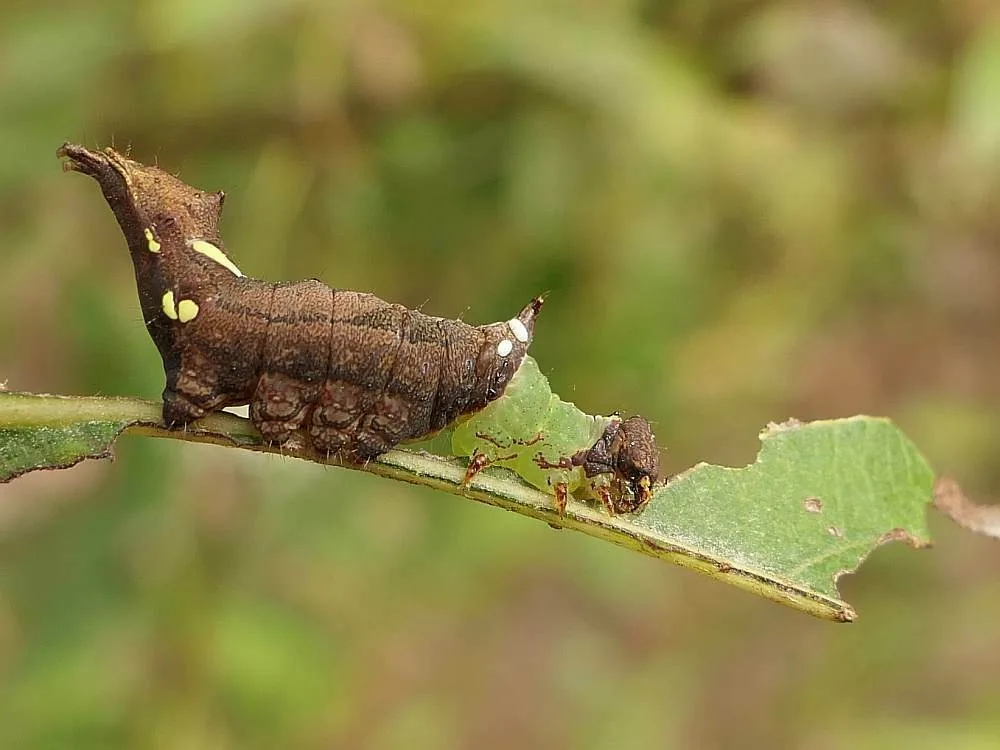
- MU Extension describes a mottled brown head and tan-brown body except for the second and third segments behind the head, which are bright green; see where the sources disagree on color.[1][3]
- A prominent horn-like hump rises from the first abdominal segment, with a smaller one on the eighth; the Forest Service guide also notes a hump on the fifth segment and an oblique white band on the seventh.[1][3]
- The moth is medium-sized, maroon to purplish gray with pale greenish patches when fresh and a thin black bar in the middle of the forewing; see where the sources disagree on wingspan.[2][3]
Look-alikes
| Look-alike | How to tell them apart |
|---|---|
| Other prominent moths | Related species in the same genus look similar as adults; the University of Alberta museum points to Schizura leptinoides and S. ipomoeae.[2] |
Where it lives
The University of Alberta museum gives its range as Nova Scotia to British Columbia, south to Florida, Texas and Utah, and calls it the most common and widespread member of its genus; the USDA Forest Service says it is widely distributed in North America.[2][3]
Biology and life cycle
MU Extension reports one generation a year, with caterpillars from summer to fall. In Alberta adults fly from late May to August and larvae appear in late June, some into September; it overwinters as a pupa.[1][2]
The caterpillars feed alone rather than in groups. When physically disturbed they spray a defensive secretion from a gland behind the head, aimed toward whatever disturbed them.[2][4]
Damage and signs
- Hosts include apple, elm, aspen, willow, hickory, cherry, hawthorn, oak and dogwood, among other broadleaf trees and shrubs; Canadian records cited by the Alberta museum show a strong preference for white birch and willows.[1][3][2]
- MU Extension says most caterpillars in its yard-and-garden guide, which includes this one, are not considered pests, though some species can seriously damage trees, shrubs and other plants.[5][1]
Health risk
MU Extension says some caterpillars in this family, when disturbed, expose glands that produce irritating acidic chemicals to ward off attackers. A 1993 study found the unicorn caterpillar's gland secretion contains formic acid, acetic acid and other compounds. None of these sources describe effects on people or pets.[1][4]
Control
Prevention
MU Extension's caterpillar guide gives no management steps for the unicorn caterpillar.[1][5]
Where the sources disagree
Color: MU Extension describes a mottled brown head and tan-brown body; the USDA Forest Service guide describes the head and body as dark to gray-black. Both note the bright green patch behind the head.[1][3]
Wingspan: the University of Alberta museum gives 2.4 to 3.5 cm; the Forest Service guide gives 3.5 cm.[2][3]
Season: MU Extension and the Alberta museum put caterpillars in summer into fall; the Forest Service guide (Pacific Northwest) says they feed during spring.[1][2][3]
Common questions
- What is the brown caterpillar with a green patch and a horn on its back?
- A small caterpillar with a horn-like hump just behind a bright green patch, mottled brown elsewhere, is likely a unicorn caterpillar.[1][3]
- Is the unicorn caterpillar harmful?
- MU Extension says most caterpillars in its guide aren't considered pests. When disturbed, unicorn caterpillars spray an acidic defensive secretion; the sources don't describe effects on people or pets.[5][1][4]
Sources
- University of Missouri Extension, “Caterpillars in Your Yard and Garden (IPM1019), page 47: unicorn caterpillar.” extension.missouri.edu/publications/ipm1019/47 (accessed 2026-11-13)
- University of Alberta Museums, “Schizura unicornis species details (E. H. Strickland Entomological Museum).” search.museums.ualberta.ca/g/2-461 (accessed 2026-11-13)
- USDA Forest Service, Forest Health Technology Enterprise Team, “Lepidoptera of the Pacific Northwest: Caterpillars and Adults (FHTET-03-11, December 2003), unicorn caterpillar entry, p. 254.” www.fs.usda.gov/foresthealth/technology/pdfs/FHTET_03_11.pdf (accessed 2026-11-13)
- Journal of Chemical Ecology (PubMed 24248561), “Attygalle AB, Smedley SR, Meinwald J, Eisner T. Defensive secretion of two notodontid caterpillars (Schizura unicornis, S. badia). J Chem Ecol. 1993;19(10):2089-2104.” pubmed.ncbi.nlm.nih.gov/24248561/ (accessed 2026-11-13). Abstract read via NCBI E-utilities on 2026-11-13.
- University of Missouri Extension, “Caterpillars in Your Yard and Garden (IPM1019): introduction (B. A. Barrett and M. Kroening; reviewed April 2022).” extension.missouri.edu/publications/ipm1019 (accessed 2026-11-13)
- Global Biodiversity Information Facility (GBIF), “Schizura unicornis J.E.Smith, 1797 (GBIF Backbone Taxonomy).” api.gbif.org/v1/species/5118934 (accessed 2026-11-13)
- iNaturalist, “Coelodasys unicornis taxon page (order and family).” www.inaturalist.org/taxa/1373714 (accessed 2026-10-06)