On this page
How to identify it
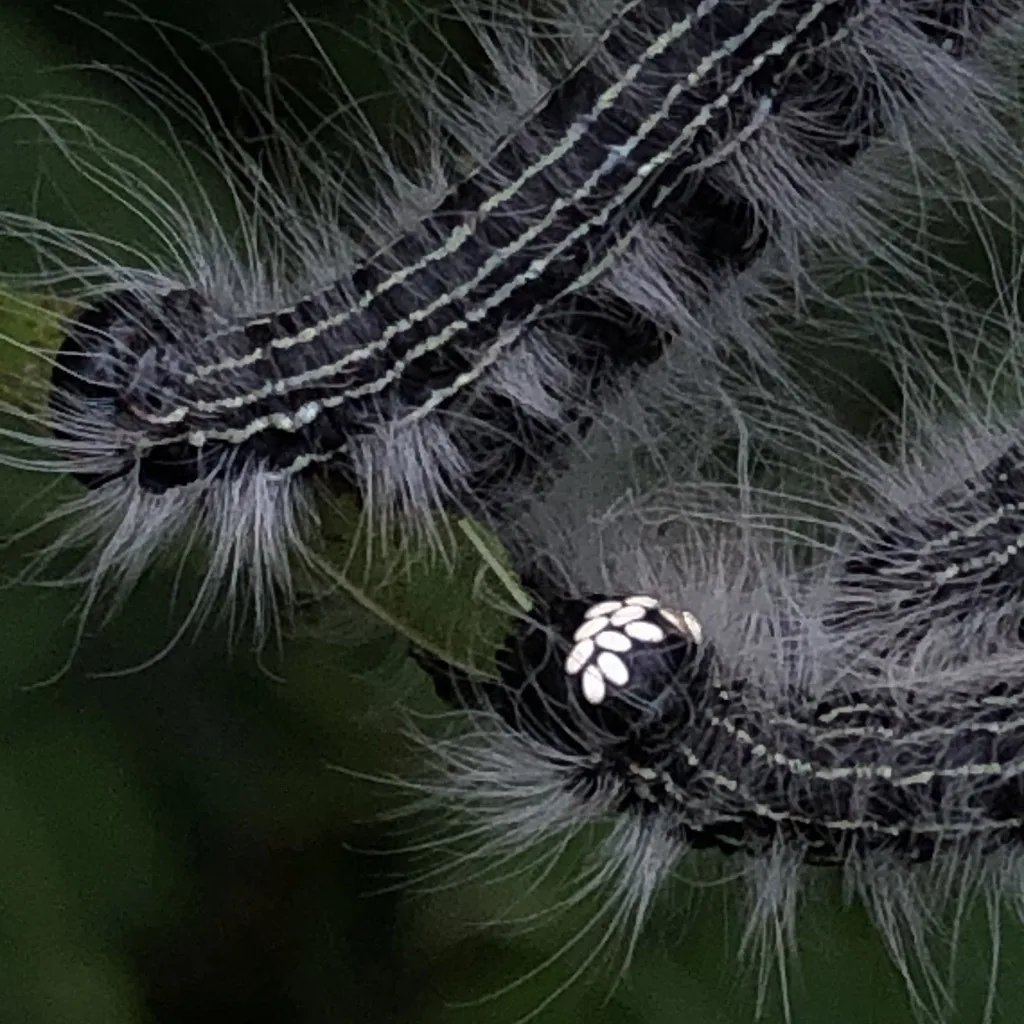
- Full-grown caterpillars are black with long whitish-gray hairs. Iowa State says they're about 2 inches long and the Forest Service 1 to 2 inches; it adds that the head is black at every stage.[1][2][3]
- Newly hatched larvae are pale green (Iowa State says light yellow-green and about 1/4 inch), then turn reddish brown with white lines; Iowa State describes middle-sized larvae as dark red with four white stripes along each side.[1][2][3]
- When disturbed, younger larvae arch their head and tail into the air; the Forest Service says last-stage larvae just drop to the ground instead.[2][3]
- Moths are tan to cinnamon brown. NC State gives a wingspan of almost 2 inches, and the Forest Service gives 1.6 to 1.9 inches, with dark tan forewings crossed by four rust-colored lines.[1][3]
Where it lives
The Forest Service gives its range as Ontario and most eastern states, west to Minnesota and south into northern Mexico. Iowa State says it's moderately common on walnut in Iowa.[3][2]
Biology and life cycle
Moths emerge from the soil in late spring or early summer and lay pale green eggs in a tight mass under the leaves. NC State and the Forest Service give 120 to 880 eggs per mass and Iowa State 300 or more; the Forest Service says they hatch in 8 to 10 days.[1][2][3]
Caterpillars feed in clusters and crawl down to the trunk or a large limb in a group to molt, leaving a hairball of shed skins.[1][2]
NC State says there are two generations a year in North Carolina. The Forest Service ties it to latitude: one generation north of about 40°N, two between 30° and 40°N and three farther south, with the second generation the most destructive. Pupae spend the winter in the soil, and the Forest Service says no cocoon is spun.[1][3]
Damage and signs
- Sources disagree on hosts. NC State says it feeds on many kinds of trees and shrubs but mostly walnuts, pecans and hickories; the Forest Service says larvae feed only on the walnut family (black and English walnut, butternut, pecan and hickories) and that, though reported on other trees, it doesn't feed on them. Young larvae skeletonize leaves and older ones eat all but the leaf stalk.[1][3][2]
- Iowa State and the Forest Service say isolated trees are hit hardest. NC State says two years of complete defoliation can stunt trees, and the Forest Service says trees can withstand 2 or 3 years of defoliation and outbreaks seldom last more than 2 years; Iowa State says late-season defoliation does little harm to healthy, established trees.[2][3][1]
Health risk
No cited source describes a health risk specific to this caterpillar. MedlinePlus says most caterpillars are harmless, but some cause allergic reactions through contact with their hairs, and brightly colored caterpillars with spines, bristles or a fuzzy look might be venomous and shouldn't be touched. For an exposure, the Poison Help line is 1-800-222-1222.[4]
Control
Traps and physical control
On small trees, prune off leaves or twigs with egg masses or young clusters in early summer, and scrape molting masses off the trunk into a bucket or bag. Iowa State says to put them in the trash or at least 25 feet from walnut trees.[1][2][3]
The Forest Service also suggests a sticky barrier around the trunk below the branches to trap larvae coming down to molt, shallow disking around and between rows to destroy pupae, and resistant trees with hairy leaves where available.[3]
Biological control
NC State says birds and other predators rarely let it become abundant, and Iowa State says natural enemies usually keep it in check. The Forest Service lists egg parasites, at least 13 other parasite species, predators such as the spined soldier bug, wheel bug, eastern yellowjacket and Calosoma beetles that may kill half a colony, mice that eat pupae, and diseases that kill many grown larvae and pupae.[1][2][3]
Pesticides
Iowa State says spraying the whole tree is usually not warranted except on small or newly transplanted trees, and the Forest Service says chemical control is usually unnecessary and may harm parasites and predators. Sprays work best on small caterpillars; NC State names carbaryl (e.g. Sevin) and pyrethroids and says to keep pyrethroids away from pools, ponds and streams. Follow the label.[2][3][1]
Common questions
- What is the hairy gray mass on my walnut tree trunk?
- Likely a group of walnut caterpillars that crawled down together to molt.[1][2]
- Will walnut caterpillars kill my tree?
- Rarely. Late-season defoliation does little harm to healthy trees, though two years of complete defoliation can stunt a tree, and the Forest Service says outbreaks seldom last more than 2 years.[1][2][3]
- How do I get rid of them without spraying?
- Remove egg masses and young clusters on small trees, or scrape the molting mass off the trunk. The Forest Service also suggests a sticky trunk barrier to catch larvae coming down to molt.[1][2][3]
- Does it feed on trees other than walnut?
- Sources disagree. NC State says it feeds on many kinds of trees and shrubs, mostly walnuts, pecans and hickories; the Forest Service says it feeds only on the walnut family, which includes butternut, pecan and hickories.[1][3]
Sources
- NC State Extension, “Walnut Caterpillar (PDIC Factsheet).” content.ces.ncsu.edu/walnut-caterpillar (accessed 2026-11-13)
- Iowa State University Extension and Outreach (Yard and Garden), “Walnut caterpillar.” yardandgarden.extension.iastate.edu/encyclopedia/walnut-caterpillar (accessed 2026-11-13)
- USDA Forest Service (Forest Insect & Disease Leaflets), “Walnut Caterpillar (FIDL 41, August 1982).” www.fs.usda.gov/foresthealth/docs/fidls/FIDL-41-WalnutCaterpillar.pdf (accessed 2026-11-13)
- U.S. National Library of Medicine (MedlinePlus), “Caterpillars (MedlinePlus Medical Encyclopedia).” medlineplus.gov/ency/article/002860.htm (accessed 2026-11-13)
- Global Biodiversity Information Facility (GBIF), “Datana integerrima Grote & Robinson, 1866 (GBIF Backbone Taxonomy).” api.gbif.org/v1/species/1826156 (accessed 2026-11-13)