On this page
How to identify it
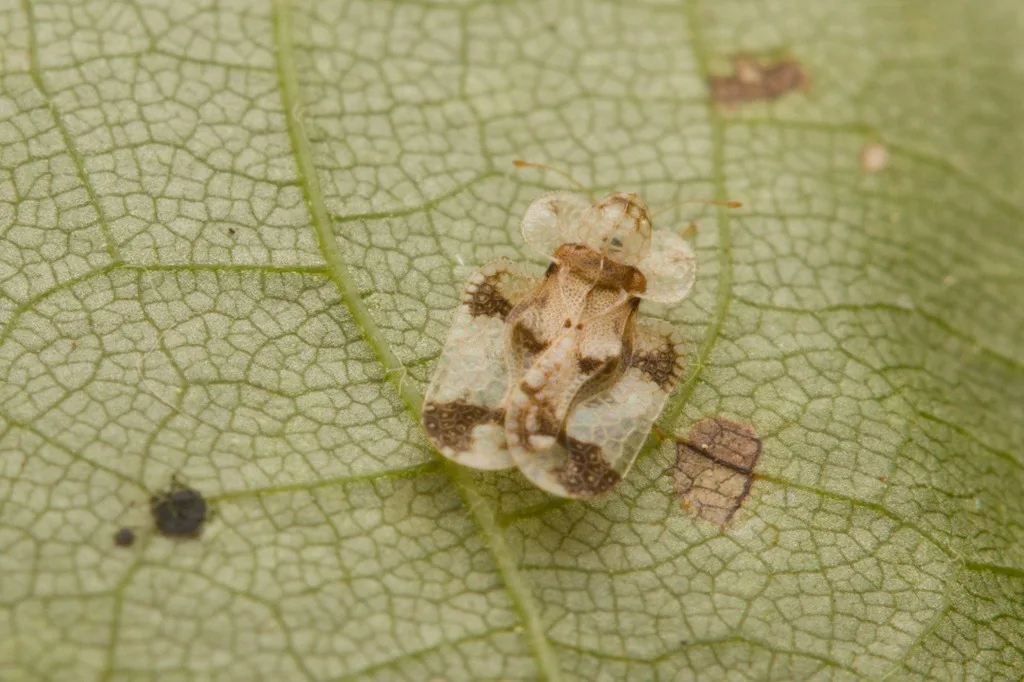
- Like other lace bugs, adults have highly ornamented wings and a hood-like structure over the head, with the whole surface veined like lace; Ohio State gives lace bug adults as about 1/8 inch long and somewhat rectangular.[2]
- The USDA manual describes lace bugs as small, usually whitish, flat bugs about 5 or 6 mm long with gauzy, lacelike wing covers that hide the abdomen and a large hood that often hides the head.[7]
- Nymphs are black and often covered with long spines, according to the USDA manual; Ohio State describes lace bug nymphs in general as oval and often spiny.[7][2]
- Look on the leaf underside, where lace bugs feed among their eggs, cast skins and dark excrement; in heavy infestations some move to the upper side of the leaflet.[1][7]
Look-alikes
| Look-alike | How to tell them apart |
|---|---|
| Hawthorn lace bug | A Corythucha relative that Ohio State says attacks hawthorn, cotoneaster, pyracantha, flowering quince, crabapple, mountain ash and shadbush, and the USDA manual records on hawthorn and pyracantha, rather than walnut or butternut.[2][7] |
| Sycamore lace bug | Same genus and the same kind of damage; Ohio State says it is fairly well restricted to sycamore, though UMass and the 1972 USDA manual also list ash, hickory and mulberry as occasional hosts.[2][3][7] |
Where it lives
It was studied on butternut in northeastern Massachusetts. GBIF holds about 270 records, about 200 from the US and 64 from Canada; its roughly 155 US records since 1990 come mostly from Pennsylvania, Maryland and Ohio.[1][5][6]
Biology and life cycle
The 1972 USDA manual lists black walnut, butternut and linden as hosts. In the Massachusetts study the host was butternut (Juglans cinerea), and the bugs fed on the lower leaf surface.[7][1]
Adults spend the winter in hiding and come out in early or mid-May, timed to the host's leaf-out. A paint-marked bug in the Massachusetts study survived the winter and was found again the next season.[1]
Two broods a year are usual in northeastern Massachusetts. The first matures by late June or early July and the second by mid-August or early September. In good years the bugs stay active into early October.[1]
Weather can cut the season short: in 1960 a storm followed by a light frost sent most of them into hibernation about a month early.[1]
Populations can differ a lot between trees. Of two butternuts only about 60 feet apart, one was heavily infested every year and the other carried few bugs.[1]
Damage and signs
- Lace bug feeding produces yellow or whitish spots on the upper leaf surface; heavy feeding can yellow whole leaves and cause early leaf drop, and dark varnish-like spots of excrement collect underneath.[2]
- In the Massachusetts study the heavily infested butternut was stunted, which the author put down partly to old fire injury and partly to the yearly lace bug infestation.[1]
- The USDA manual says the upper surfaces of leaves infested by lace bugs may look whitened, brownish or dead, and the leaves of heavily infested trees may turn entirely brown and fall off.[7]
Health risk
The USDA manual, the Massachusetts study and Ohio State describe only sap feeding on leaves; no cited source describes any risk to people or pets.[7][1][2]
Control
Prevention
Check leaf undersides early in the season if the tree had lace bugs before; Ohio State's general lace bug advice is to stop the first generation, because spotting already on the leaves will not go away.[2]
Traps and physical control
On small trees, a hard jet of water knocks young nymphs off the leaves, and many die before getting back.[2]
Biological control
Green lacewings, mites and assassin bugs attack lace bugs; soaps and water sprays spare them better than standard insecticides.[2]
Pesticides
Insecticidal soap or horticultural oil works only if it hits the bugs, so spray the leaf undersides. Not every lace bug or host plant is on every label, so check before using any product.[2]
Where the sources disagree
Name: the 1964 Massachusetts study spells the genus Corythuca; GBIF accepts Corythucha juglandis (Fitch, 1857).[1][4]
Range: the Massachusetts study is the only field account read for this page, and the 1972 USDA manual gives hosts but no range for this species; GBIF's US records since 1990 come mostly from Pennsylvania, Maryland and Ohio, and it also holds 64 records from Canada.[1][6][5][7]
Size: the 1972 USDA manual gives lace bugs as about 5 or 6 mm long, while Ohio State gives lace bug adults as about 1/8 inch; neither gives a size for this species.[7][2]
Hosts: the USDA manual lists black walnut, butternut and linden; the Massachusetts study looked only at butternut.[7][1]
Common questions
- What are the tiny lacy bugs under my butternut or walnut leaves?
- In the Massachusetts study, the lace bugs on butternut were walnut lace bugs feeding on the leaf undersides. The 1972 USDA manual lists black walnut, butternut and linden as this species' hosts, and Ohio State notes that most lace bugs are fairly well restricted to their namesake hosts.[1][7][2]
- When are walnut lace bugs active?
- In Massachusetts, from early or mid-May into early October, with two broods a year.[1]
Sources
- Psyche (Cambridge Entomological Club), “Bailey (1964), Further Studies of the Bioecology of the New England Tingidae (Heteroptera), Part III: Seasonal population trends of the walnut lace bug, Psyche 71:65-72.” groups.csail.mit.edu/mac/projects/psyche/71/71-065.html (accessed 2026-11-13)
- Ohio State University Extension, Ohioline, “HYG-2150: Lace Bugs (D. J. Shetlar, 2011).” ohioline.osu.edu/factsheet/HYG-2150-10 (accessed 2026-11-13)
- UMass Extension Landscape, Nursery and Urban Forestry Program (Landscape Insect & Mite Guide), “Corythucha ciliata, Sycamore Lace Bug (Landscape Insect & Mite Guide).” www.umass.edu/agriculture-food-environment/landscape/publications-resources/insect-mite-guide/corythucha-ciliata (accessed 2026-11-13)
- Global Biodiversity Information Facility (GBIF), “Corythucha juglandis (Fitch, 1857) (GBIF Backbone Taxonomy).” api.gbif.org/v1/species/2020662 (accessed 2026-11-13)
- Global Biodiversity Information Facility (GBIF), “Corythucha juglandis: occurrence records by country (GBIF occurrence search).” api.gbif.org/v1/occurrence/search?taxonKey=2020662&facet=country&facetLimit=20&limit=0 (accessed 2026-11-13)
- Global Biodiversity Information Facility (GBIF), “Corythucha juglandis: U.S. occurrence records since 1990 by state (GBIF occurrence search).” api.gbif.org/v1/occurrence/search?taxonKey=2020662&country=US&hasGeospatialIssue=false&occurrenceStatus=PRESENT&year=1990%2C2026&facet=stateProvince&facetLimit=400&limit=0 (accessed 2026-11-13)
- USDA Forest Service, “Eastern Forest Insects, Miscellaneous Publication 1175 (W. L. Baker, 1972; scanned copy).” archive.org/details/easternforestins1175bake (accessed 2026-11-14)