On this page
How to identify it
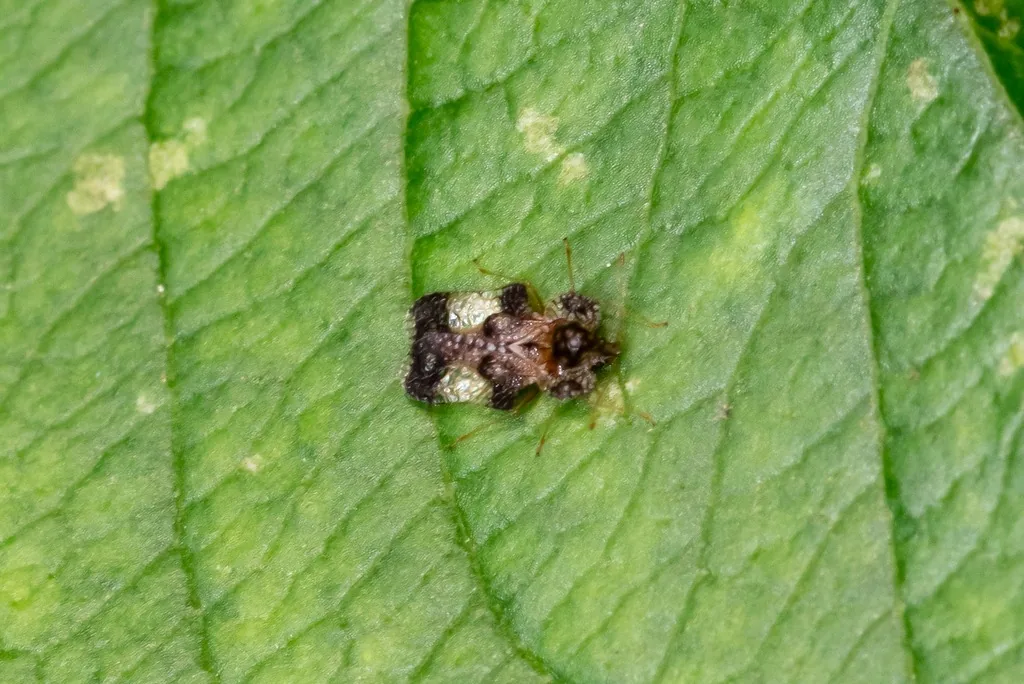
- Adults are about 1/8 inch long, with lacy wings marked by large brown spots and yellowish legs and antennae.[1]
- Nymphs are spiny and dirty brown; older nymphs become flat and oval.[1][3]
- Eggs are cone-shaped and fastened to the underside of the leaf, often covered by a hard brown 'varnish' the female secretes.[1]
- Cast nymph skins stay stuck to the leaves, along with tiny dark droppings.[3][1]
Look-alikes
| Look-alike | How to tell them apart |
|---|---|
| Spider mites and thrips | Their injury looks similar, but lace bug spotting is coarser and lace bugs leave noticeable specks of excrement under the leaf, which spider mites do not.[1] |
| Other Corythucha lace bugs | Many Corythucha species are named for and limited to their host plants, so the plant helps with ID. Hawthorn has more than one: the USDA Forest Service lists C. bellula on hawthorn as well as the hawthorn lace bug on hawthorn and pyracantha.[4][11] |
Where it lives
NC State says it occurs throughout the United States and in parts of Canada and Mexico, and reports it on North Carolina landscape shrubs. GBIF holds 148 U.S. records since 1990 from 25 states, from Vermont and Massachusetts to Minnesota, North Dakota, Texas and California. The USDA Forest Service's Eastern Forest Insects also lists it among eastern lace bugs.[2][1][5][11]
Biology and life cycle
Adults spend the winter in fallen leaves or other sheltered spots near their host plants.[1][3]
Females lay eggs in small groups on the leaves; nymphs pass through five stages before becoming adults.[1]
At least four generations a year can occur in North Carolina. Minnesota Extension says lace bugs there have two generations a season, and Ohio State says only one generation occurs per year in Ohio, with adults active from early to mid-May, nymphs reaching adulthood in three to four weeks and peak numbers in July.[1][3][6]
Nymphs are not defenseless. USDA researchers found hawthorn lace bugs carry alarm pheromones in glands on the back of the abdomen, and the nymphs' spines give off an exudate whose main chemicals they identified.[7][8]
Damage and signs
- Feeding from below causes yellow or pale spots on the upper leaf surface; heavy feeding nearly bleaches the leaves. The Forest Service adds that lace bug leaf undersides are speckled with eggs, excrement and cast nymph skins, and heavily infested leaves may turn brown and fall.[1][11]
- Main hosts are pyracantha (firethorn), cotoneaster and hawthorn. NC State also reports it on apple, button bush, juneberry (serviceberry), loquat, oak, pear and quince, and Ohio State adds flowering quince, crabapple and mountain ash.[1][2][6]
Health risk
NC State and Minnesota Extension describe it only as a sap-feeding plant pest; neither mentions bites or any effect on people or pets. A 2015 JAMA Dermatology report did describe skin disease caused by a relative, the sycamore lace bug (Corythucha ciliata), which its title calls blood-sucking.[1][3][12][11]
Control
Prevention
Treatment is usually not needed for lace bugs.[3]
Pesticides
If numbers build up, hawthorn lace bugs are sluggish and slow to fly, so most insecticides labeled for landscape use give adequate control.[1][3]
How lace bug nymphs signal danger
In hawthorn lace bugs the alarm signal comes from two glands on the back of the abdomen and works only when both secretions mix. Unlike eggplant lace bug nymphs, hawthorn lace bug nymphs apparently cannot release it at will: both glands have to be ruptured.[7]
Separately, USDA chemists identified three main compounds in the droplets exuded from the nymphs' spines, plus ten minor ones.[8]
Where the sources disagree
Generations: NC State says at least four a year can occur in North Carolina, Minnesota Extension gives two a season, and Ohio State says only one occurs per year in Ohio. The USDA Forest Service says most eastern lace bugs have two generations a year.[1][3][6][11]
Hosts: NC State and Ohio State agree on pyracantha, cotoneaster, hawthorn and quince; NC State adds loquat, oak, pear and button bush, and Ohio State adds crabapple and mountain ash.[2][1][6]
Common questions
- What makes pyracantha leaves pale and speckled?
- Often hawthorn lace bugs feeding underneath. Check the undersides for small lacy bugs, spiny nymphs and dark specks.[1]
- Are they hard to control?
- No. They are sluggish, and landscape insecticides labeled for lace bugs work; light infestations usually need no treatment.[1][3]
- Do hawthorn lace bugs bite people?
- It is a plant feeder, and the extension sources describe it only as a plant pest. The only bite report found involves a different species, the sycamore lace bug.[1][12][11]
Sources
- NC State Extension, “Hawthorn Lace Bug (PDIC Factsheet).” content.ces.ncsu.edu/hawthorn-lace-bug (accessed 2026-11-13)
- NC State Extension, “Pests of Pyracantha.” content.ces.ncsu.edu/pests-of-pyracantha (accessed 2026-11-13)
- University of Minnesota Extension, “Lace bugs.” extension.umn.edu/yard-and-garden-insects/lace-bugs (accessed 2026-11-13)
- Missouri Department of Conservation, “Lace Bugs (Field Guide).” mdc.mo.gov/discover-nature/field-guide/lace-bugs (accessed 2026-11-13)
- Global Biodiversity Information Facility (GBIF), “Corythucha cydoniae: US occurrence records by state, 1990-2026 (GBIF occurrence search).” api.gbif.org/v1/occurrence/search?taxonKey=2020683&country=US&hasGeospatialIssue=false&occurrenceStatus=PRESENT&year=1990%2C2026&facet=stateProvince&facetLimit=400&limit=0 (accessed 2026-11-13). State counts are records reported (iNaturalist research-grade, museum specimens, surveys), not abundance.
- Ohio State University Extension, Ohioline, “HYG-2150: Lace Bugs (D. J. Shetlar, 2011).” ohioline.osu.edu/factsheet/HYG-2150-10 (accessed 2026-11-13)
- Journal of Chemical Ecology, via PubMed, “Aldrich JR, Neal JW Jr, Oliver JE, Lusby WR (1991), Chemistry vis-a-vis maternalism in lace bugs (Heteroptera: Tingidae): alarm pheromones and exudate defense in Corythucha and Gargaphia species, Journal of Chemical Ecology 17(11):2307-2322.” pubmed.ncbi.nlm.nih.gov/24258608/ (accessed 2026-11-13). Cited from the PubMed abstract.
- Journal of Chemical Ecology, via PubMed, “Lusby WR, Oliver JE, Neal JW Jr, Heath RR (1989), Acyclohexanediones from setal exudate of hawthorn lace bug nymph Corythucha cydoniae (Hemiptera: Tingidae), Journal of Chemical Ecology 15(9):2369-2378.” pubmed.ncbi.nlm.nih.gov/24272424/ (accessed 2026-11-13). Cited from the PubMed abstract.
- Global Biodiversity Information Facility (GBIF), “Corythucha cydoniae (Fitch, 1861) (GBIF Backbone Taxonomy).” api.gbif.org/v1/species/2020683 (accessed 2026-11-13)
- iNaturalist, “Corythucha cydoniae taxon page (order and family).” www.inaturalist.org/taxa/51151 (accessed 2026-11-11)
- USDA Forest Service, “Eastern Forest Insects, Miscellaneous Publication 1175 (W. L. Baker, 1972; scanned copy).” archive.org/details/easternforestins1175bake (accessed 2026-11-14). Scanned USDA publication; read via archive.org's full-text (djvu.txt) copy.
- JAMA Dermatology, via PubMed, “Izri A, Andriantsoanirina V, Chosidow O, Durand R (2015), Dermatosis caused by blood-sucking Corythucha ciliata, JAMA Dermatology 151(8):909-910.” pubmed.ncbi.nlm.nih.gov/25970727/ (accessed 2026-11-14). Cited by title only; PubMed has no abstract.