On this page
How to identify it
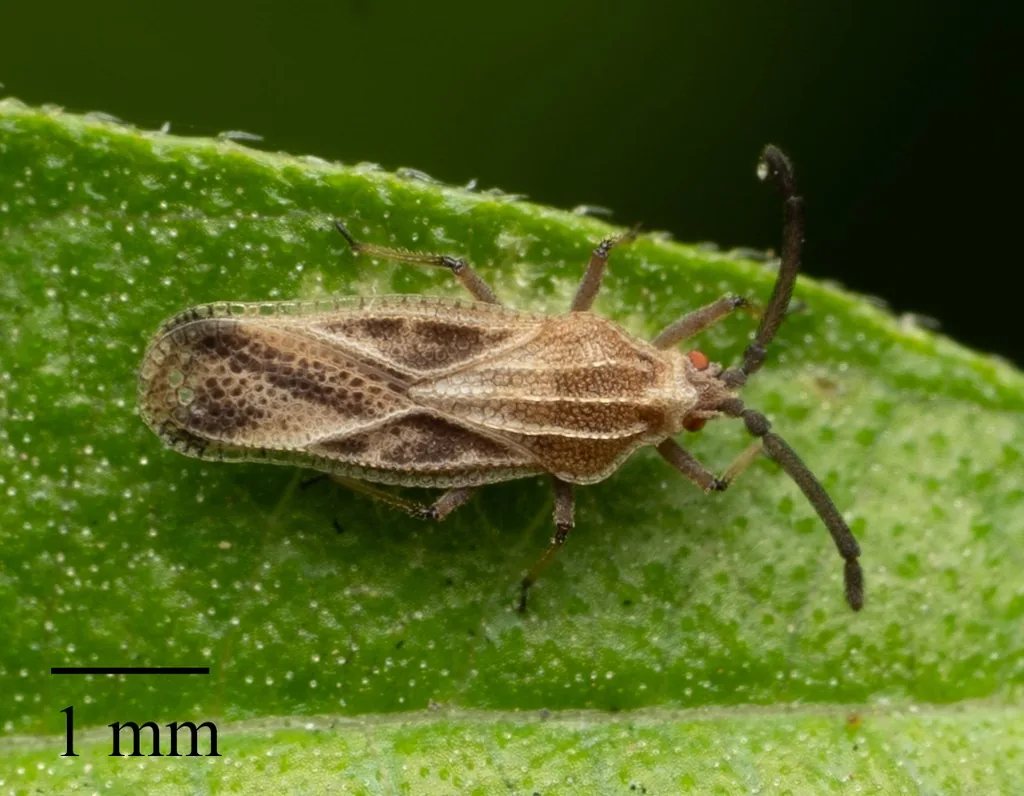
- Adults are about 1/8 inch (3 mm) long and brown. NC State describes them as relatively slender and grayish-brown with conspicuous dark antennae; Georgia Extension calls them fat, about 3 mm long and 1 mm wide. UF/IFAS gives 3 to 4 mm long and 1.1 to 1.3 mm wide, elongate-oval, often with an obscure dark brown X on the forewings flanked by brown spots, and, unlike many lace bugs, no hood extending over the head.[1][3][8]
- At rest, the wing folds form an X on the back, and the thorax has three ridges.[1][3]
- Nymphs are small, dark and spiny; the last two nymphal stages have noticeable wing pads. UF/IFAS adds that nymphs look very different from adults, dull-colored with spines especially around the abdomen.[1][3][8]
- Under the leaves look for dark spots of excrement and cast nymph skins. Females insert their eggs into the leaf tissue along the midrib and larger veins, and Georgia Extension says they usually cover them with tar-like excrement.[1][3]
Look-alikes
| Look-alike | How to tell them apart |
|---|---|
| Azalea lace bug and other lace bugs | Many lace bugs stick to one kind of host plant, so the plant is a strong clue. The lantana lace bug feeds mainly on lantana; NC State notes it occasionally infests other plants such as sesame and purple sage.[7][1] |
| Leafhopper or mite damage | Lace bug feeding looks much like leafhopper damage, but lace bugs leave varnish-like spots and black excrement droplets under the leaves. Mite feeding makes much finer pale flecks; where lace bugs fed, large patches of neighboring cells turn pale.[8] |
| Other Teleonemia lace bugs | Florida has three Teleonemia species. T. belfragii, pale brownish yellow with darker markings, lives on beauty berry over most of the state; T. sacchari, dark brown, is found in coastal areas from Palm Beach County south.[8] |
Where it lives
NC State gives its native range as the Gulf Coast south into South America; it only occasionally reaches North Carolina. It has also been deliberately introduced to several countries to control lantana as a weed, and in South Africa it heavily attacked uncaged lantana in a field study. GBIF holds U.S. records from 11 states, most from Texas, California and Florida. UF/IFAS gives its natural range as Florida and Texas south through Mexico and Central America to southern Brazil, Paraguay and northern Chile, lists deliberate introductions to Fiji, Australia, India, Kenya, Tanzania, Uganda, South Africa and many Pacific and Indian Ocean islands, and says it probably occurs throughout most of Florida. It was first confirmed in Georgia in June 1999.[1][3][5][6][8]
Biology and life cycle
Females start laying eggs 5 or 6 days after their last molt. NC State says they insert them in bunches of 10 to 30; Georgia Extension describes single eggs set into the leaf tissue.[1][3]
Nymphs hatch about a week later and pass through five stages over 12 to 18 days. At 80°F an egg can reach adulthood in 3 to 4 weeks.[1][3]
Generations overlap. NC State says at least two are possible in North Carolina; Georgia Extension says several overlapping generations occur in Georgia.[1][3]
Winter survival depends on climate. NC State says it cannot overwinter successfully in North Carolina. In Georgia, early observations suggest adults spend the winter in leaf litter around the plant; eggs do not survive because the leaves dry up below freezing, and nymphs show up again in April on new shoots.[1][3]
Adults fly readily in summer, and when a heavy infestation uses up a plant, adults leave to find another lantana.[1][3]
UF/IFAS, citing Australian work, gives nymph development of 15 to 18 days at 70 to 77°F and 12 to 15 days at 77 to 85°F. Eggs hatch in seven to eight days, and the new nymphs gather in colonies.[8]
About 15 plant species, mostly Lantana and Leucophyllum, are recorded hosts, but UF/IFAS says damage to plants other than lantana has been slight and short-lived, with one exception: in East Africa, lace bugs that had stripped lantana moved onto sesame and caused crop losses.[8]
Damage and signs
- The bugs suck out leaf cells from below. Pale spots appear on the upper surface, leaves bleach almost white, then wilt and die starting at the tips, and heavily infested leaves drop. UF/IFAS adds that it attacks newly opened buds and flowers, and that on purple sage it feeds on both leaf surfaces, leaving black excrement spots visible on top.[1][3][8]
- Feeding on flower buds can stop blooming entirely, and severe infestations can kill the whole plant. In a South African field plot, heavily attacked lantana produced no flowers or fruit.[3][5]
- In nurseries it lowers the market value of container lantana, and in landscapes it spoils the plants' looks.[4]
Health risk
It feeds only on plants, piercing leaf cells with needle-like mouthparts; the extension sources describe it only as a plant pest.[3][1]
Control
Prevention
Check lantana for lace bugs from April on, and keep checking new plants set out in summer. In spring look for nymphs under the leaves with a hand lens, and pick off and destroy yellowed or blanched leaves.[3]
Traps and physical control
Repeated sprays of high-pressure water reduce lace bug numbers.[3]
Biological control
Mild infestations don't need insecticides. Assassin bugs, mirid bugs, bigeyed bugs, minute pirate bugs, green lacewings and spiders eat the eggs and nymphs, and tiny wasps parasitize lace bug eggs. UF/IFAS also lists predatory mites among its natural enemies.[3][1][8]
Pesticides
Insecticidal soap or horticultural oil is the mild option. NC State notes soaps leave no toxic residue that would kill the egg-parasitizing wasps.[3][1]
Lantana flowers draw many pollinators, so use stronger insecticides only when numbers become unacceptable, and read the whole label first. NC State warns that a systemic neonicotinoid applied to lantana can move into the flowers and nectar.[3][1]
Research on gentler options
Lantana lace bug has typically been managed with neonicotinoids, and concern about their effects on pollinators has growers looking for alternatives. In a University of Georgia study, adults sprayed with the insect growth regulators novaluron or pyriproxyfen produced significantly fewer nymphs than untreated adults, even at an eighth of the top label dose of novaluron.[4]
Where the sources disagree
Egg laying: NC State and UF/IFAS say females insert eggs in clusters of 10 to 30 along the midrib or larger veins, while Georgia Extension describes single eggs set into the leaf tissue.[1][8][3]
Size: Georgia Extension gives about 3 mm long and 1 mm wide; UF/IFAS gives 3 to 4 mm long and 1.1 to 1.3 mm wide.[3][8]
Native range: NC State gives the Gulf Coast south into South America, and UF/IFAS gives Florida and Texas south to southern Brazil, Paraguay and northern Chile.[1][8]
Common questions
- Why are my lantana leaves speckled and brown?
- Lantana lace bugs feeding under the leaves are a common cause. Turn a leaf over and look for small brown bugs, spiny nymphs and dark specks of excrement.[1][3]
- Can lantana lace bugs kill my plant?
- A severe infestation can, and bud feeding can stop flowering. Light infestations are usually handled by predators, leaf removal and water or soap sprays.[3]
- Will they come back next year?
- In Georgia, adults appear to overwinter in leaf litter and nymphs show up in April. In North Carolina it cannot survive the winter and only occasionally arrives.[3][1]
- Is the lantana lace bug ever useful?
- Where lantana is a weed, yes. UF/IFAS notes lantana often forms spiny, dense thickets over large areas, and the lace bug has been released in many countries to fight it.[8]
Sources
- NC State Extension, “Lantana Lace Bug.” content.ces.ncsu.edu/lantana-lace-bug (accessed 2026-11-11)
- iNaturalist, “Teleonemia scrupulosa taxon page (order and family).” www.inaturalist.org/taxa/449919 (accessed 2026-11-11)
- University of Georgia Cooperative Extension, “Lantana Lace Bug Biology and Management (Circular 1262, Joseph and Hudson, 2023).” fieldreport.caes.uga.edu/publications/C1262/lantana-lace-bug-biology-and-management/ (accessed 2026-11-11)
- Pest Management Science, via PubMed, “Joseph SV (2022), Insect growth regulators elicit transovarial effects on Teleonemia scrupulosa (Hemiptera: Tingidae), Pest Management Science 78(5):1800-1805.” pubmed.ncbi.nlm.nih.gov/35019229/ (accessed 2026-11-11). Cited from the PubMed abstract.
- Neotropical Entomology, via PubMed, “April V, Simelane DO, Robertson MP (2021), Co-existence between two leaf-feeding biological control agents of Lantana camara alters their herbivory under semi-field conditions, Neotropical Entomology 50(6):959-965.” pubmed.ncbi.nlm.nih.gov/34669161/ (accessed 2026-11-11). Cited from the PubMed abstract.
- Global Biodiversity Information Facility (GBIF), “Teleonemia scrupulosa: US occurrence records by state, 1990-2026 (GBIF occurrence search).” api.gbif.org/v1/occurrence/search?taxonKey=2020580&country=US&hasGeospatialIssue=false&occurrenceStatus=PRESENT&year=1990%2C2026&facet=stateProvince&facetLimit=400&limit=0 (accessed 2026-11-11). State counts are records reported (iNaturalist research-grade, museum specimens, surveys), not abundance.
- Missouri Department of Conservation, “Lace Bugs (Field Guide).” mdc.mo.gov/discover-nature/field-guide/lace-bugs (accessed 2026-11-11)
- University of Florida IFAS Extension, EDIS (Featured Creatures), “Lantana Lace Bug, Teleonemia scrupulosa Stål, EENY-246/IN514 (Featured Creatures).” ask.ifas.ufl.edu/publication/IN514 (accessed 2026-11-14)