On this page
How to identify it
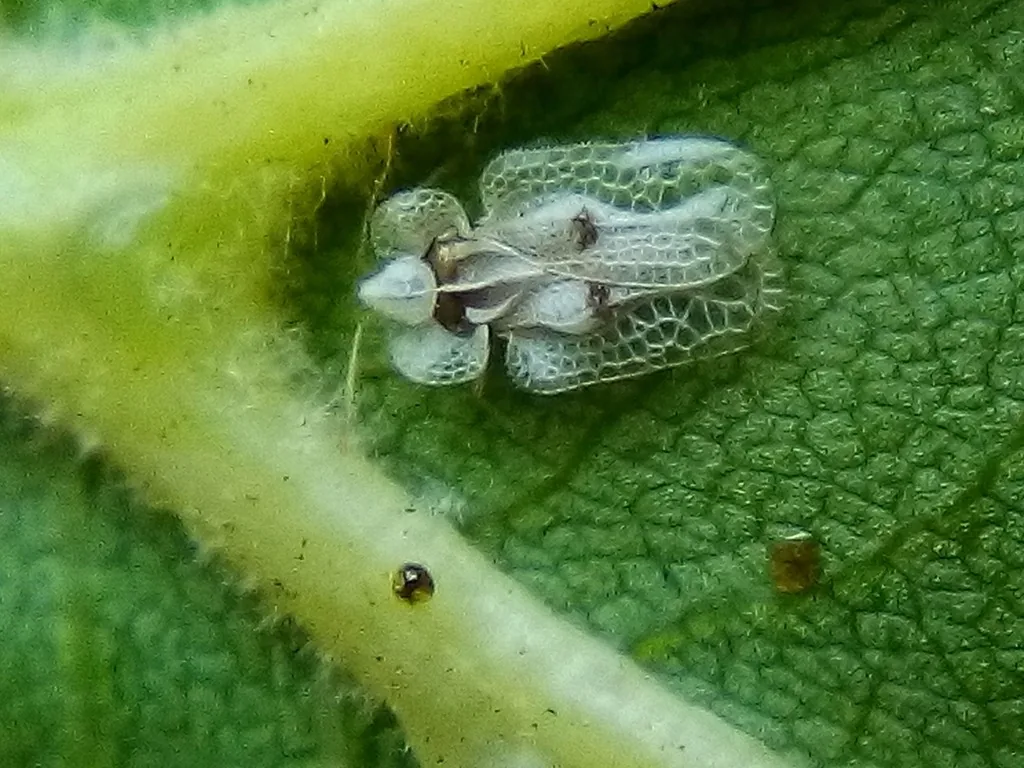
- Adults are about 1/8 inch (3 mm) long, whitish and roughly rectangular, with lace-covered wings and a hood over the head.[1][2]
- Nymphs are black, spiny and wingless and feed on the leaf underside; by late summer adults and nymphs feed together.[1][2]
- Look for shiny black tar-like spots of excrement on the undersides of damaged leaves.[1][2]
- Its host is a strong clue: Ohio State says sycamore, oak and hackberry lace bugs are fairly well restricted to their namesake trees, though UMass also lists ash, hickory and mulberry as hosts.[2][1]
Look-alikes
| Look-alike | How to tell them apart |
|---|---|
| Oak lace bug | A close relative (Corythucha arcuata) with a similar life cycle; it feeds on oaks rather than sycamore.[2] |
| Spider mites | Spider mites also leave leaves stippled with tiny white or yellow spots, but heavy infestations add fine webbing. Lace bugs leave black, varnish-like excrement spots under the leaves instead.[3][2][1] |
Where it lives
A native North American insect, it was found in Italy in 1964 and has since spread across the Northern Hemisphere, including Europe and China. GBIF holds about 14,600 records, most from France, Belgium, Germany, the Netherlands and Spain, with about 720 from the US; its roughly 470 US records since 1990 come mostly from Maryland, Virginia, Pennsylvania and New York.[1][5][4][8][9]
Biology and life cycle
Adults overwinter in sheltered spots, often under the flaking bark of the sycamore itself, and move to the new leaves in spring to lay eggs on the undersides, glued in place with a sticky brown substance.[1][2]
Each female may lay at least 284 eggs.[1]
Nymphs pass through five instars; fourth-instar nymphs are more likely than younger ones to move to new leaves.[6][1]
Damage and signs
- Feeding causes white or yellow stippling that can progress to bronzed leaves, early leaf drop and, with large populations, late-summer defoliation.[1][2]
- Damage is worse in dry weather and in urban trees on poor sites; several consecutive years of severe attack combined with other stresses may kill trees.[1]
- Trees on good sites often suffer only cosmetic damage that needs no management.[1]
- In Europe, where it was found in Italy in 1964, it is also associated with two fungi it may spread to its European host trees.[1]
Health risk
UMass and Ohio State describe it as a sap feeder on the undersides of leaves and do not discuss effects on people.[1][2]
Control
Prevention
Plant sycamores on suitable sites and avoid other stresses such as drought; UMass calls this the single most important step.[1]
Spotting and yellowing already on the leaves won't go away even after the lace bugs are controlled, and on large trees the canopy makes treatment hard.[2][1]
Traps and physical control
On small trees, a hard jet of water from a hose dislodges young nymphs, many of which die before they find their way back to a leaf.[2]
Biological control
Lacewings, assassin bugs, minute pirate bugs, spiders and predatory mites attack lace bugs; insecticidal soap or hosing spares them better than standard insecticides.[1][2]
Pesticides
Insecticidal soap and horticultural oil work only if they reach the bugs under the leaves. Systemic products applied as soil drenches or trunk injections are another option, but bugs can re-infest from surrounding trees.[2][1]
Spread beyond North America
Native to North America, it has spread across the Northern Hemisphere since the 1960s. In China it first invaded the east coast and then moved inland, and a 2026 study recommends strict quarantine and more varied street trees there.[1][5][4]
Where the sources disagree
Generations: Ohio State says two and occasionally three a year; UMass says two or more, and up to five in the warmer parts of its range.[2][1]
Development: UMass gives about 30 days from egg to adult with egg hatch in a few days; in a 2025 laboratory study in China, nymphs developed in about 15 days.[1][6]
Eggs: UMass cites at least 284 eggs per female from a 1917 study; in the 2025 laboratory study each pair averaged 17 eggs.[1][6]
Where it is recorded: the species is native to North America, yet most of GBIF's records come from Europe, with France alone holding several times as many as the US.[1][8]
Common questions
- Why are my sycamore leaves turning white?
- Often sycamore lace bug feeding; check the leaf undersides for lacy whitish bugs, black spiny nymphs and black varnish-like specks.[1][2]
- Will lace bugs kill my sycamore?
- Rarely. Trees on good sites usually suffer only cosmetic damage, though several years of severe attack plus other stress may kill a tree.[1]
- Should I spray my sycamore?
- Usually not on a big tree: damaged leaves won't recover, the canopy is hard to reach, and bugs come back from nearby trees. Reducing stress such as drought helps more.[2][1]
Sources
- UMass Extension Landscape, Nursery and Urban Forestry Program (Landscape Insect & Mite Guide), “Corythucha ciliata, Sycamore Lace Bug (Landscape Insect & Mite Guide).” www.umass.edu/agriculture-food-environment/landscape/publications-resources/insect-mite-guide/corythucha-ciliata (accessed 2026-11-13)
- Ohio State University Extension (Ohioline), “Lace Bugs (HYG-2150-10).” ohioline.osu.edu/factsheet/HYG-2150-10 (accessed 2026-11-13)
- University of Minnesota Extension, “Twospotted spider mites in home gardens.” extension.umn.edu/yard-and-garden-insects/spider-mites (accessed 2026-11-13)
- Scientific Reports, via PubMed, “The population genetic structure of Corythucha ciliata provides insights into its distribution and invasiveness (Yang et al. 2017).” pubmed.ncbi.nlm.nih.gov/28377573/ (accessed 2026-11-13)
- Journal of Environmental Management, via PubMed, “Invasion dynamics of Corythucha ciliata in China (Mao et al. 2026).” pubmed.ncbi.nlm.nih.gov/41863943/ (accessed 2026-11-13)
- Insects, via PubMed, “Biological Characteristics and Bacterial Community of Invasive Pest Corythucha ciliata (Li et al. 2025).” pubmed.ncbi.nlm.nih.gov/41148922/ (accessed 2026-11-13)
- Global Biodiversity Information Facility (GBIF), “Corythucha ciliata (Say, 1832) (GBIF Backbone Taxonomy).” api.gbif.org/v1/species/2020655 (accessed 2026-11-13)
- Global Biodiversity Information Facility (GBIF), “Corythucha ciliata: occurrence records by country (GBIF occurrence search).” api.gbif.org/v1/occurrence/search?taxonKey=2020655&facet=country&facetLimit=20&limit=0 (accessed 2026-11-13)
- Global Biodiversity Information Facility (GBIF), “Corythucha ciliata: U.S. occurrence records since 1990 by state (GBIF occurrence search).” api.gbif.org/v1/occurrence/search?taxonKey=2020655&country=US&hasGeospatialIssue=false&occurrenceStatus=PRESENT&year=1990%2C2026&facet=stateProvince&facetLimit=400&limit=0 (accessed 2026-11-13)