On this page
How to identify it
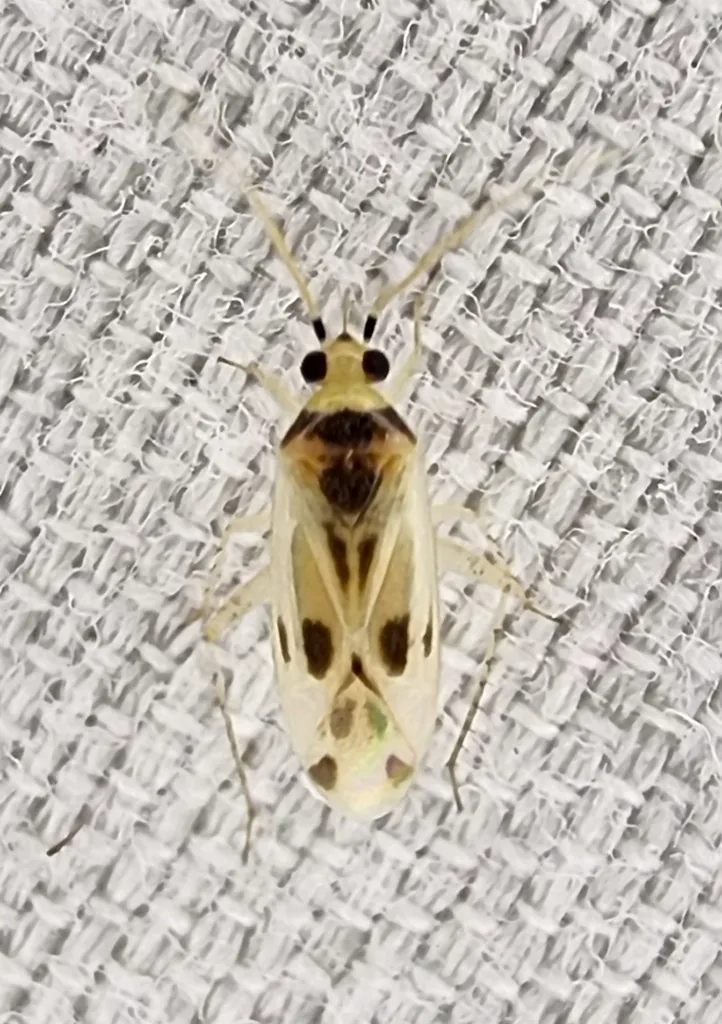
- Adults are about 1/4 inch long with whitish wings; nymphs are smaller and wingless. Sources differ on color: Utah State and UMass say yellowish brown, while the Connecticut Agricultural Experiment Station says yellowish green with dark eyes.[1][2][3]
- Look for the bugs on leaves as they expand in spring; feeding spots start yellow and later brown and fall out.[1][2][3]
Look-alikes
| Look-alike | How to tell them apart |
|---|---|
| Sycamore leaf beetle | Its adults and larvae chew larger, irregular holes in sycamore leaves than this bug's feeding spots.[2] |
| Sycamore lace bug | Sycamore lace bugs live on the undersides of leaves and leave small white marks on the upper surface. They overwinter as adults under bark and have two or more generations a year; the plant bug overwinters as eggs and has one.[3][2][1] |
Where it lives
UMass says it's known from the northeastern United States and parts of Canada, and the Connecticut Agricultural Experiment Station lists it among sycamore pests. Farther west, Utah State's diagnostic lab identified it on sycamore from Salt Lake County in July 2014.[2][3][4]
Biology and life cycle
It overwinters as eggs in bark or woody tissue near the buds. Eggs hatch in spring once leaves have expanded to about 1 1/2 inches (UMass says about 1.6 inches); in a Pennsylvania study hatch ran from late April to early May.[1][2][3]
Nymphs pass through at least five stages and feed on both leaf surfaces; older studies disagree on which side they prefer. They become adults by late May or early June, adults are present until about mid-July, and there's one generation a year.[2][1]
Damage and signs
- Feeding leaves yellow spots that turn brown and may drop out, giving leaves a ragged, tattered look; young leaves may be mottled and distorted.[1][2][3]
- UMass cites Pennsylvania work finding that as few as 1 to 15 bugs per foot of branch can noticeably damage London planetrees, yet on otherwise healthy trees the damage is only aesthetic.[2][1]
- UMass says the injury is unusual for this kind of insect, and some researchers have suggested it injects a toxic substance while feeding, though that hasn't been shown.[2]
Health risk
It feeds on sycamore leaves. Utah State, UMass and the Connecticut Agricultural Experiment Station describe leaf damage only and don't mention any risk to people or pets.[1][2][3]
Control
Prevention
Keep trees healthy and tolerate the mostly cosmetic damage; check leaves for nymphs as they expand in spring.[1][2]
Traps and physical control
On small trees, nymphs can be washed off with a strong jet of water.[2][1]
Pesticides
If treatment is warranted, Utah State lists insecticidal soap, horticultural oil and other insecticides about a week after budbreak, and Connecticut lists ultrafine horticultural oil and insecticidal soap against the nymphs. UMass says to apply after bloom to protect pollinators.[1][3][2]
Common questions
Sources
- Utah State University Extension (Integrated Pest Management), “Sycamore Plant Bug (Ornamental Pest Guide).” extension.usu.edu/planthealth/ipm/ornamental-pest-guide/arthopods/plant-lace-seed-bugs/sycamore-plant-bug.php (accessed 2026-11-13)
- UMass Extension Landscape, Nursery and Urban Forestry Program (Landscape Insect & Mite Guide), “Plagiognathus albatus (Sycamore Plantbug).” www.umass.edu/agriculture-food-environment/landscape/publications-resources/insect-mite-guide/plagiognathus-albatus (accessed 2026-11-13)
- Connecticut Agricultural Experiment Station, “Sycamore and London Plane Tree (Platanus), Plant Pest Handbook.” portal.ct.gov/CAES/Plant-Pest-Handbook/pphS/Sycamore-and-London-Plane-Tree-Platanus (accessed 2026-11-13)
- Utah State University Extension, “Arthropod Samples in July 2014 (Utah Plant Pest Diagnostic Lab).” extension.usu.edu/pests/uppdl/recent-pests/2014/arth-july-2014 (accessed 2026-11-13)
- Global Biodiversity Information Facility (GBIF), “Plagiognathus albatus (Van Duzee, 1915) (GBIF Backbone Taxonomy).” api.gbif.org/v1/species/5152937 (accessed 2026-11-13)
- iNaturalist, “Plagiognathus albatus taxon page (order and family).” www.inaturalist.org/taxa/495015 (accessed 2026-10-06)