On this page
How to identify it
Look-alikes
| Look-alike | How to tell them apart |
|---|---|
| Woolly whitefly nymphs | Waxy sycamore scale nymphs are sometimes mistaken for whitefly nymphs.[1] |
| Sycamore borer | UC IPM says rough bark on sycamores is more often caused by the sycamore borer, a clearwing moth whose larvae push granular excrement pellets out of their tunnels; sycamore scale leaves no pellets.[1] |
| Sycamore anthracnose | This fungal disease browns all or large parts of leaves, often starting along the veins, rather than the small spots sycamore scale causes.[1] |
Where it lives
It lives only on sycamores. UC IPM lists California sycamore, Oriental sycamore and London plane as hosts and says it reportedly isn't a pest on American sycamore. Utah State says it's common in warmer parts of Utah, such as southern Utah, and its diagnostic lab identified it from Utah County in July 2014.[1][2][3]
Biology and life cycle
It lives on foliage from leaf flush through fall and on tender bark all year.[1]
In late winter females lay masses of 50 to 100 eggs under white, cottony wax. Hatch coincides with bud break, and the crawlers move to buds, leaf stems and leaf undersides, then settle and swell into tiny football shapes.[1][2]
Sources differ on overwintering and generations. Utah State says nymphs overwinter under bark scales and there are three to five generations a year; UC IPM says most scales are first or second instars in midwinter, with several generations a year and more of the population moving to bark as fall approaches.[2][1]
Damage and signs
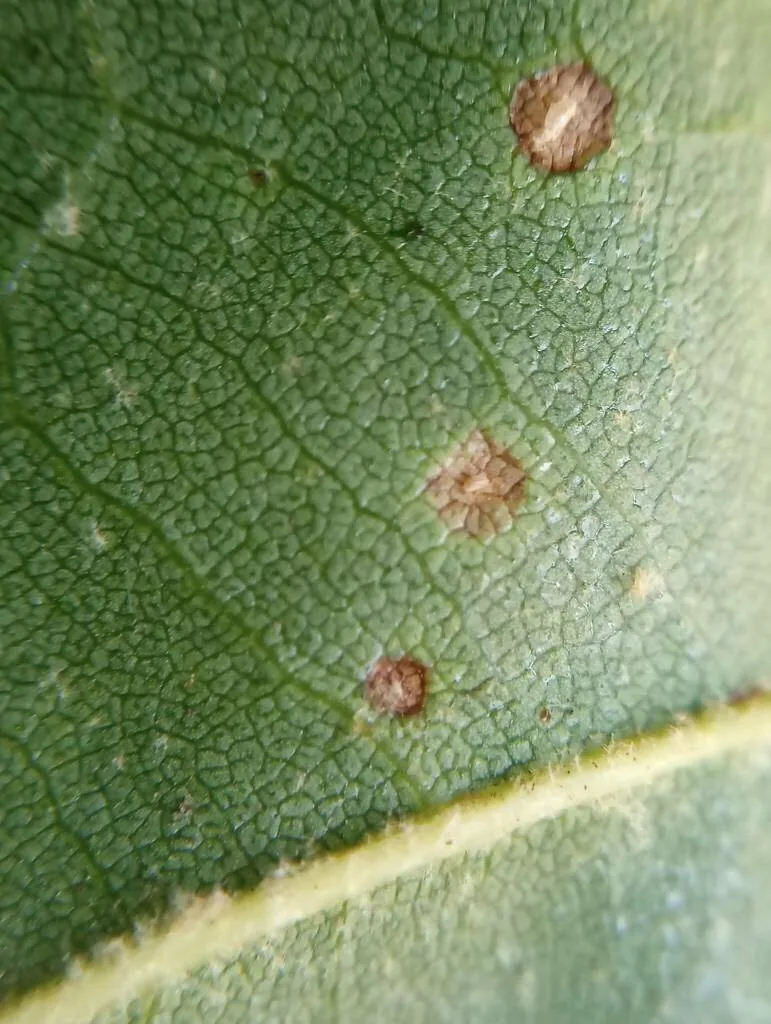
- Feeding causes small yellow, white or brown leaf spots that can look like disease, distorted and undersized leaves, premature leaf drop and, on young bark, rough texture and abnormal flaking. Utah State adds twig dieback.[1][2]
- UC IPM says its effect on tree health hasn't been measured. Landscape trees probably tolerate low to moderate infestations, but prolonged heavy feeding could stunt growth and kill twigs and small branches.[1]
Health risk
It feeds on sycamores. UC IPM and Utah State describe tree damage only and don't mention any risk to people or pets.[1][2]
Control
Prevention
Keep trees healthy with suitable growing conditions and protect them from injury. UC IPM notes American sycamore reportedly isn't damaged but may not suit most urban California landscapes.[1]
Biological control
Lady beetles, including the twicestabbed lady beetle, the pine ladybird and Axion plagiatum, feed on sycamore scale.[1]
Pesticides
Sources differ on timing. UC IPM recommends horticultural oil or insecticidal soap from bud break through early leaf-out, and advises against malathion because it can cause secondary pest outbreaks. Utah State says to time sprays to crawler activity, notes summer sprays work less well, and lists a systemic neonicotinoid in spring after leaves expand, while UC IPM says soil-applied imidacloprid has little efficacy data and is more likely to work in late winter or early spring.[1][2]
UC IPM advises against trunk injections or implants, which wound trees and can spread the sycamore canker stain fungus.[1]
When to call a professional
Treatment works best at bud break, before damage shows; by the time leaves are distorted or spotted it's too late to spray effectively. Spraying a large tree thoroughly usually takes a professional applicator with high-pressure equipment.[1]
More from Utah State University Extension
Feeding leaves small yellow to brown spots that look like a disease; eggs are laid in cottony masses in late winter and early spring, and insecticide applications are less effective in summer than at crawler time.[2]
Common questions
- Why are my London plane tree's leaves spotted?
- Sycamore scale feeding causes small yellow to whitish spots that look like disease.[1][2]
- When is treatment most effective?
- UC IPM says at bud break, before damage shows; Utah State says to time sprays to crawler activity. Both say sprays work less well once leaves are out in summer.[1][2]
Sources
- University of California Statewide IPM Program, “Pest Notes: Sycamore Scale (Publication 7409).” ipm.ucanr.edu/PMG/PESTNOTES/pn7409.html (accessed 2026-11-13)
- Utah State University Extension, “Sycamore Scale.” extension.usu.edu/planthealth/ipm/ornamental-pest-guide/arthopods/scales/sycamore-scale.php (accessed 2026-11-13)
- Utah State University Extension, “Arthropod Samples in July 2014 (Utah Plant Pest Diagnostic Lab).” extension.usu.edu/pests/uppdl/recent-pests/2014/arth-july-2014 (accessed 2026-11-13)
- Global Biodiversity Information Facility (GBIF), “Stomacoccus platani Ferris, 1917 (GBIF Backbone Taxonomy).” api.gbif.org/v1/species/2080069 (accessed 2026-11-13)
- iNaturalist, “Stomacoccus platani taxon page (order and family).” www.inaturalist.org/taxa/349754 (accessed 2026-10-06)