On this page
How to identify it
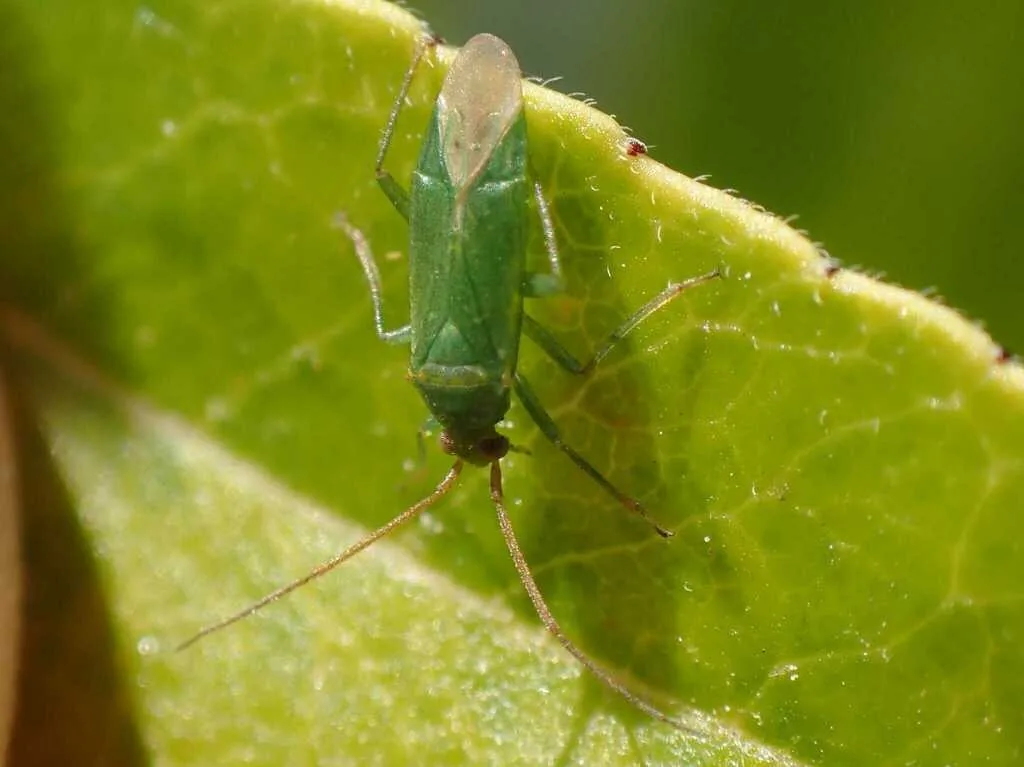
- Adults are pale green to yellowish and blend in with new leaves. Minnesota Extension gives up to 1/8 inch for nymphs and 1/4 inch for adults; Penn State puts adults at about 3/16 inch.[1][2]
- Nymphs are very active and look like large, fast aphids. Penn State says they have short wing buds and a distinct orange spot in the middle of the abdomen; adults fly when disturbed.[1][3][2]
- Small, shiny, dark, varnish-like droppings show under infested leaves.[1]
- The overwintering egg is pale and looks like a grain of rice.[2]
Look-alikes
| Look-alike | How to tell them apart |
|---|---|
| Herbicide injury | Plant bug damage shows on new leaves all over the tree; herbicide injury only on the side that was sprayed.[1] |
| Honeylocust pod gall midge | Midge larvae turn new leaflets into swollen, pod-like galls; plant bug feeding leaves leaflets stippled, twisted and dwarfed but not swollen.[3][4] |
Where it lives
Penn State says it occurs throughout the eastern United States wherever honeylocust grows, and Colorado State says it commonly infests honeylocust there in late spring. Trees in sunny, exposed spots, yellow-leaved varieties and recent transplants are hit hardest.[2][3][1]
Biology and life cycle
Eggs spend the winter just under the bark of 2- to 3-year-old twigs and hatch as the leaf buds open, in late April in Pennsylvania. The nymphs go through five stages in about 30 days and become adults in early June.[1][2]
There is one generation a year. Sources differ on how long adults last: Penn State says they disappear by early July, and Minnesota Extension says they are rarely seen after late July.[1][2][3]
Damage and signs
- Feeding injects saliva that kills cells, leaving yellow spots that turn brown. Leaves stay small, twisted and dwarfed for the rest of the season, and heavy infestations can drop leaves, especially on young trees. Penn State says tree death is rare.[1][2][3]
- Colorado State says damage peaks in late May or early June and that leaves produced after that grow normally. Penn State adds that repeated damage may weaken a tree and leave it open to other insects and diseases.[3][2]
- UF/IFAS's thornless honeylocust fact sheet says plant bug and leafhopper feeding together causes the leaves to drop, and that both insects are green, so they're hard to spot.[5]
Health risk
It feeds on honeylocust leaves. Minnesota, Penn State and Colorado State Extension describe tree damage only and don't mention any risk to people or pets.[1][2][3]
Control
Prevention
Keep trees healthy and tolerate the damage when you can; Penn State says large established trees can withstand several years of it without serious harm. Where you plant, green-leaved cultivars such as 'Shademaster' and 'Skyline' are less susceptible than yellow-leaved ones such as 'Sunburst'.[1][2]
Traps and physical control
On small trees, a strong spray of water can knock nymphs off the leaves.[2]
Pesticides
Where damage has been heavy before, target the young nymphs around bud break, spraying the undersides of the leaves. Insecticidal soap works only on nymphs it touches and may need repeating. Colorado State recommends sprays only when spring growth is seriously threatened, and Penn State notes that bugs from untreated trees can move in.[1][2][3]
Honeylocust flowers draw bees, so Minnesota Extension says to avoid the bee-toxic neonicotinoids imidacloprid and dinotefuran. It also warns that broad-spectrum sprays can kill spider mite predators and set off a mite outbreak.[1]
When to call a professional
For large trees, consider hiring a tree care professional.[1]
Background
It became a problem in the 1950s and 1960s, after thornless honeylocust cultivars became popular in nurseries and landscapes.[2]
Colorado State notes that by destroying new growth the plant bug can indirectly limit the honeylocust pod gall midge, which needs that growth to lay eggs.[3]
UF/IFAS warns that honeylocust has been overplanted in some areas and that insect problems are beginning to catch up with it, cultivars included, so it recommends planting it in moderation.[5]
Common questions
- Why are my honeylocust leaves small and twisted?
- Probably honeylocust plant bugs feeding on the new leaves; the twisting looks like herbicide injury but shows all over the tree.[1][4]
- When should I check?
- In early spring, before or as the leaf buds open. Penn State suggests tapping branches over a black tray to spot the small green nymphs.[1][2]
- Will honeylocust plant bugs kill my tree?
- Rarely. Most damage is cosmetic, and Penn State says large trees can take several years of it without serious harm.[1][2]
- Are some honeylocust varieties more likely to get plant bugs?
- Yes. UF/IFAS says plant bugs may be more common on the yellow-leaved cultivar 'Sunburst' than on green-leaved types, and describes 'Sunburst' as favored by plant bugs and leafhoppers.[5]
Sources
- University of Minnesota Extension, “Honeylocust plant bugs (Yard and garden insects).” extension.umn.edu/garden-and-home/yard-and-garden/yard-and-garden-insects/honeylocust-plant-bugs (accessed 2026-11-13)
- Penn State Extension, “Honeylocust Plant Bug.” extension.psu.edu/honeylocust-plant-bug (accessed 2026-11-13)
- Colorado State University Extension, “Insect and Mite Pests of Honeylocust (Fact Sheet 5.571).” extension.colostate.edu/resource/insect-and-mite-pests-of-honeylocust/ (accessed 2026-11-13)
- University of Minnesota Extension, “Honeylocust: small, distorted leaflets (What's wrong with my plant?).” apps.extension.umn.edu/garden/diagnose/plant/deciduous/honeylocust/leavesdistorted.html (accessed 2026-11-13)
- University of Florida IFAS Extension (EDIS), “Gleditsia triacanthos var. inermis: Thornless Honeylocust, ENH438/ST279 (E. F. Gilman and D. G. Watson; reviewed February 2014).” journals.flvc.org/edis/article/view/141310 (accessed 2026-11-14). Archived EDIS fact sheet; the Ask IFAS page (ask.ifas.ufl.edu/publication/ST279) returns 410, so the journals.flvc.org EDIS copy was read.
- Global Biodiversity Information Facility (GBIF), “Blepharidopterus chlorionis (Say, 1832) (GBIF Backbone Taxonomy).” api.gbif.org/v1/species/2009601 (accessed 2026-11-13)
- iNaturalist, “Blepharidopterus chlorionis taxon page (order and family).” www.inaturalist.org/taxa/900581 (accessed 2026-10-06)