On this page
How to identify it
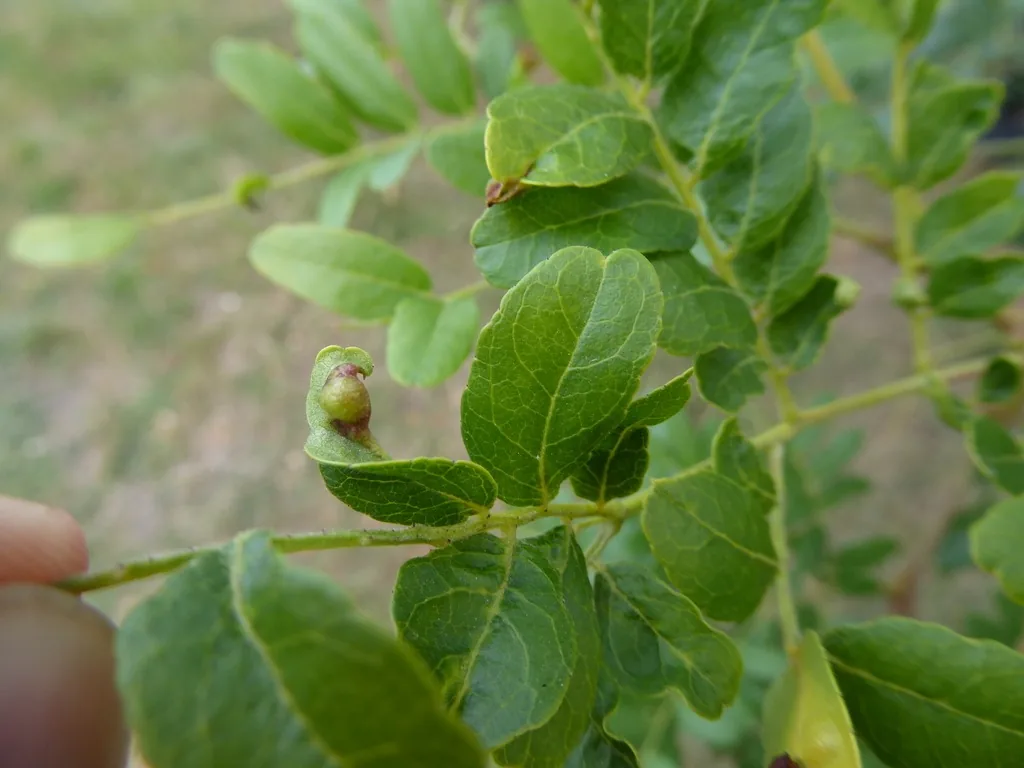
- Infested leaflets form pod-shaped galls instead of expanding normally, and may turn brown and drop early.[1][3][2]
- Each gall holds one to several larvae; Colorado State counts two to eight cream-colored larvae or pupae. After the adults emerge the galls drop, leaving bare leaf stalks.[1][2]
- Adults are delicate flies about 3 mm long. Males are black; females are similar but have a red abdomen.[2][3]
Look-alikes
| Look-alike | How to tell them apart |
|---|---|
| Honeylocust plant bug | Plant bug feeding leaves leaflets stippled, twisted and dwarfed, but not swollen into pods.[1][3] |
Where it lives
Colorado State says it commonly distorts new honeylocust growth in Colorado, and UMass covers it in Massachusetts. A 2009 study called it the main pest of ornamental honeylocust in North America and a growing concern in Europe.[1][2][4]
Biology and life cycle
Adults appear when new spring growth forms, and females lay tiny, lemon-colored eggs in the young leaflets; larvae hatch within a couple of days. Colorado State says new generations follow every three to four weeks through midsummer, while UMass notes 5 to 7 generations a year recorded in Connecticut.[2][1]
Sources disagree on how it spends the winter. Colorado State says adults apparently go dormant once new growth stops, and UMass says it is thought to overwinter as an adult, though sources farther south say pupae overwinter in the soil.[1][2]
Females release a sex pheromone that Hungarian researchers identified in 2009; synthetic lures caught males in sticky traps and can be used to track their flights.[4]
Damage and signs
Health risk
It feeds on honeylocust leaflets. Colorado State, UMass and Minnesota Extension describe tree damage only and don't mention any risk to people or pets.[1][2][3]
Control
Prevention
Watch for black midges on the buds at bud break, or use sticky traps, and check expanding leaflets for pods.[2]
UMass says the cultivar 'Sunburst' may be especially susceptible, while Colorado State finds all common honeylocust varieties susceptible.[2][1]
Biological control
Severe weather, predatory bugs and small parasitic wasps attack the midge, and outbreaks often collapse once new growth stops. UMass notes that how well these natural enemies work in landscapes isn't well understood.[1][2]
Pesticides
Chemical controls are only moderately effective. If used, sprays should protect the first flushes of growth, while adults are laying eggs, and UMass advises waiting until after bloom to protect pollinators. Massachusetts made neonicotinoids state restricted-use for trees and shrubs in 2022.[1][2]
Timing by degree days
UMass, citing Cornell, puts the first adults at about 192 to 299 growing degree days (base 50°F, counted from March 1), which lines up with new spring growth.[2]
Common questions
- Why do my honeylocust leaflets look like little pods?
- Honeylocust pod gall midge larvae curl and swell new leaflets into pod galls.[1][2]
- Will my honeylocust recover from pod galls?
- Usually. Outbreaks often collapse when new growth stops, Colorado State says lasting harm is extremely rare, and UMass says trees are typically not killed.[1][2]
Sources
- Colorado State University Extension, “Insect and Mite Pests of Honeylocust (Fact Sheet 5.571).” extension.colostate.edu/resource/insect-and-mite-pests-of-honeylocust/ (accessed 2026-11-13)
- UMass Extension, “Dasineura gleditchiae (UMass Insect & Mite Guide).” www.umass.edu/agriculture-food-environment/landscape/publications-resources/insect-mite-guide/dasineura-gleditchiae (accessed 2026-11-13)
- University of Minnesota Extension, “Honeylocust: small, distorted leaflets (What's wrong with my plant?).” apps.extension.umn.edu/garden/diagnose/plant/deciduous/honeylocust/leavesdistorted.html (accessed 2026-11-13)
- J Chem Ecol 2009;35(6):706-14, via PubMed, “Identification of female-produced sex pheromone of the honey locust gall midge, Dasineura gleditchiae (Molnar et al., 2009).” pubmed.ncbi.nlm.nih.gov/19459010/ (accessed 2026-11-13)
- Global Biodiversity Information Facility (GBIF), “Dasineura gleditchiae (Osten Sacken, 1866) (GBIF Backbone Taxonomy).” api.gbif.org/v1/species/1595142 (accessed 2026-11-13)
- iNaturalist, “Dasineura gleditchiae taxon page (order and family).” www.inaturalist.org/taxa/367311 (accessed 2026-10-06)