On this page
How to identify it
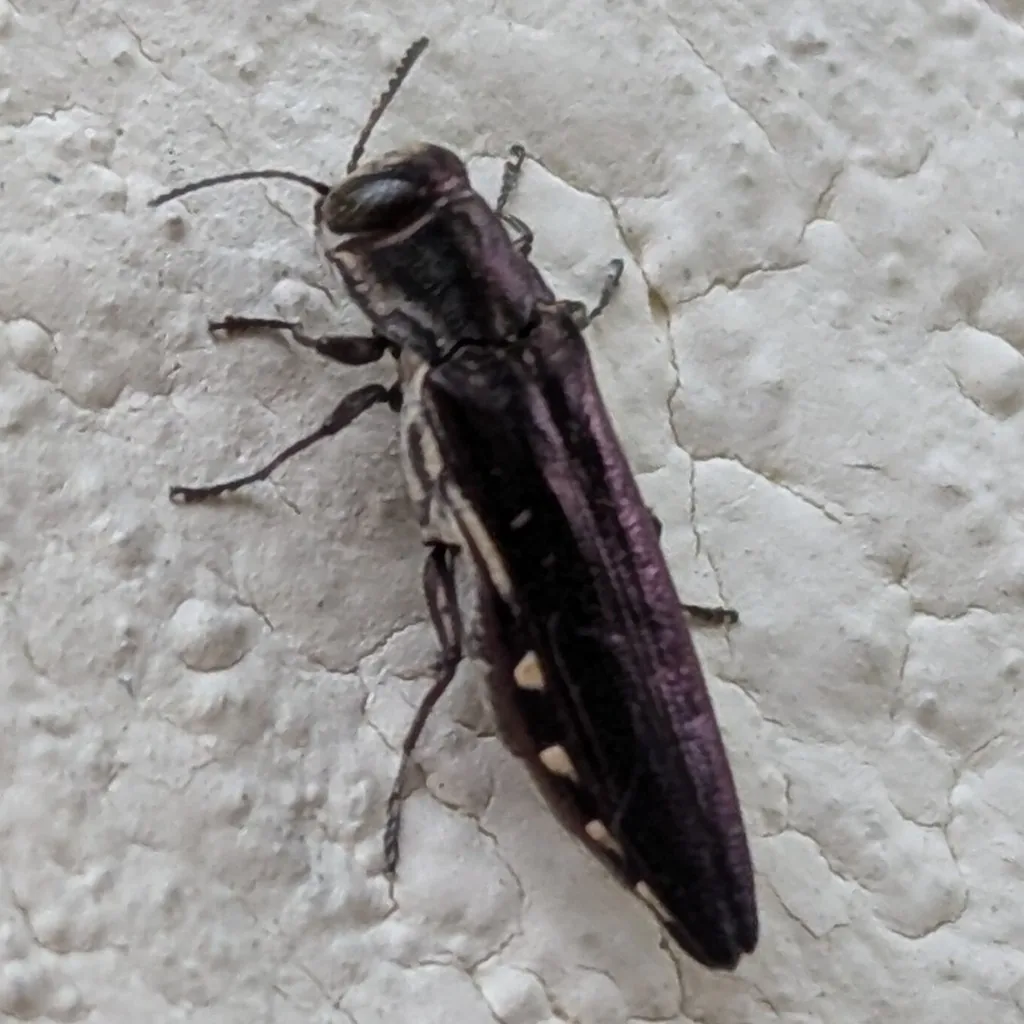
- Adults are slender, bullet-shaped beetles; Utah State calls them black with greenish-purple reflections, and Colorado State metallic green. All three sources note yellow or whitish spots or bands on the abdomen under the wing covers. Size estimates differ: 1/4 to 3/4 inch (Utah State), about 1/4 to 1/2 inch (Colorado State) or 5/16 to 1/2 inch (Minnesota).[1][3][4]
- Larvae are creamy white and flattened with an enlarged front end, which gives them a tapeworm-like look.[1][3]
- Adults leave small D-shaped or oval exit holes in the bark as they emerge.[1][2][3][4]
- Adults chew notches along leaf edges while they feed.[3][4]
Look-alikes
| Look-alike | How to tell them apart |
|---|---|
| Emerald ash borer | Utah State notes that emerald ash borer larvae look similar to honeylocust borer larvae. Emerald ash borer attacks ash, not honeylocust.[1] |
Where it lives
Found where honeylocust grows. Utah State, Colorado State and Minnesota Extension all cover it, and Colorado State says honeylocust is its main host.[1][3][4]
Biology and life cycle
It spends the winter as a larva under the bark or in the sapwood, and there is one generation a year.[1][3]
Adults are present from late May through September. Colorado State says they feed for a couple of weeks before laying eggs, mostly in June.[1][3][2]
Eggs go singly or in groups under bark flaps or in bark crevices, and the larvae are the damaging stage.[1][3]
Damage and signs
- Larvae feed on the inner bark and etch winding, frass-filled galleries into the sapwood, especially in sunscalded or damaged bark and around existing cankers.[1][2][3][4]
- Signs include wet, weeping spots where sap oozes from holes and then hardens. Branches thicker than about 1/2 inch can die back, and heavy infestations thin the canopy; Utah State says the tree is rarely killed.[1][3][4]
- It succeeds only in trees already stressed by drought, root pruning, disease, poor sites or injury, so Colorado State says borers are rarely the root cause of decline. Canker diseases matter far more to honeylocust health.[1][2]
Health risk
It feeds under the bark of honeylocust. Utah State, Colorado State and Minnesota Extension describe tree damage only and don't mention any risk to people or pets.[1][2][4]
Control
Prevention
Tree care is the main control: water during dry spells, plant honeylocust where it won't be stressed, and avoid mechanical and other injury to the bark. Colorado State also recommends good pruning and drainage and prompt removal of dead limbs, dead trees and bark from felled trees.[1][2][3]
Pesticides
On stressed or injured trees, a protective insecticide can be kept on the trunk bark through egg laying and egg hatch in early summer. Colorado State adds that a systemic soil drench in spring can protect trees not already badly damaged.[1][2][3]
Other honeylocust borers
Colorado State notes that several borers attack honeylocust, some metallic wood borers and some longhorned beetles; Agrilus difficilis is the main one.[2]
Common questions
- What are the D-shaped holes in my honeylocust bark?
- Most likely exit holes left by adult honeylocust borers. Peeling back bark nearby will show frass-filled galleries if they are there.[1][3][4]
- Will spraying save my tree?
- Tree care comes first. The borer attacks trees that are already stressed, so watering and preventing wounds matter most; sprays only supplement that.[1][2]
Sources
- Utah State University Extension (Integrated Pest Management), “Honeylocust Borer (Ornamental Pest Guide).” extension.usu.edu/planthealth/ipm/ornamental-pest-guide/arthopods/wood-borers/honeylocust-borer.php (accessed 2026-11-13)
- Colorado State University Extension, “Insect and Mite Pests of Honeylocust (Fact Sheet 5.571).” extension.colostate.edu/resource/insect-and-mite-pests-of-honeylocust/ (accessed 2026-11-13)
- Colorado State University, Department of Agricultural Biology, “Beetle pests of honeylocust.” agsci.colostate.edu/agbio/ipm-pests/beetle-pests-of-honeylocust/ (accessed 2026-11-13)
- University of Minnesota Extension, “Honeylocust: holes in bark (What's wrong with my plant?).” apps.extension.umn.edu/garden/diagnose/plant/deciduous/honeylocust/branchesholes.html (accessed 2026-11-13)
- Global Biodiversity Information Facility (GBIF), “Agrilus difficilis Gory, 1841 (GBIF Backbone Taxonomy).” api.gbif.org/v1/species/6004142 (accessed 2026-11-13)
- iNaturalist, “Agrilus difficilis taxon page (order and family).” www.inaturalist.org/taxa/492654 (accessed 2026-10-06)