On this page
How to identify it
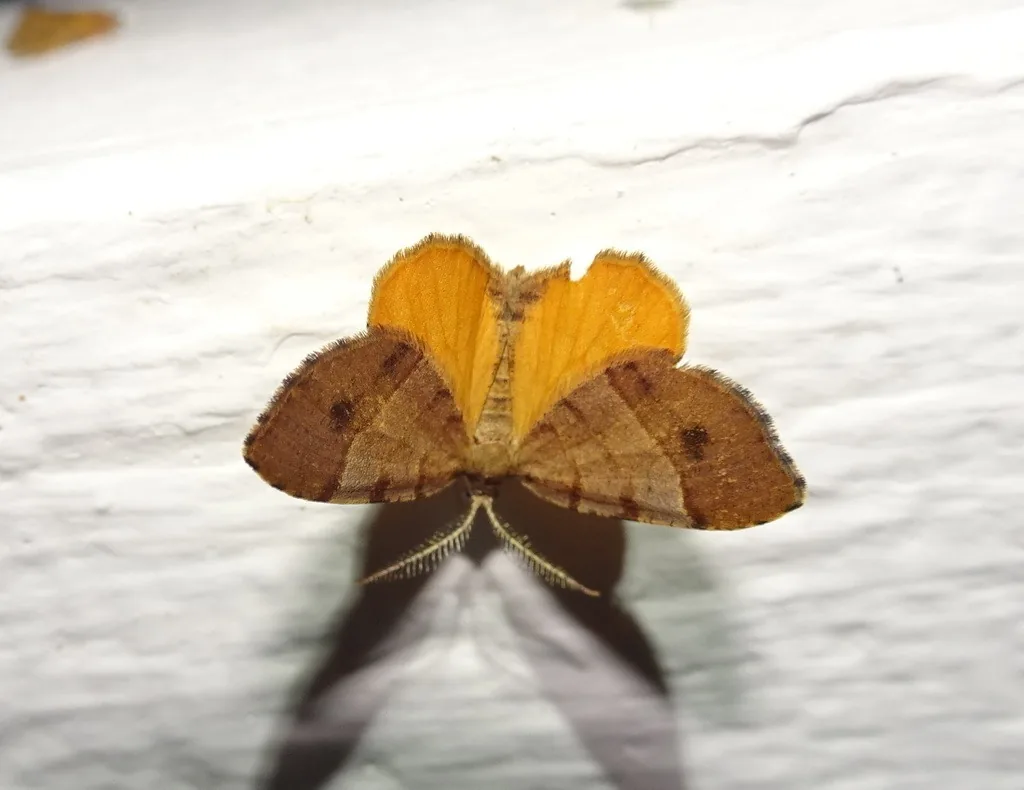
- The hindwings are bright orange in males and usually more yellowish and less bright in females; Butterflies and Moths of North America calls it the only geometer moth with a bright orange hindwing. The forewings are gray, tan or brown with variable markings, usually nearly straight lines and often a single dark spot.[1][2]
- The wingspan is 1/2 to 1 inch according to the Missouri Department of Conservation, or 1.6 to 2.1 cm according to Butterflies and Moths of North America. Like other geometrid moths it has a slender body and rests with its wings held flat.[1][2]
- The caterpillar is a green inchworm with a brownish-orange head. The Forest Service guide describes green and brown forms, both with many fine lengthwise pinstripes: the stripes along the back tend to be tawny, while those lower on the sides are whiter and often broken into a row of spots. Mature caterpillars are under 2 cm (about 3/4 inch) long.[1][7]
Look-alikes
| Look-alike | How to tell them apart |
|---|---|
| Other geometrid moths | Most geometrids have markings that run smoothly from the forewings onto the hindwings. The orange wing stands out because its orange hindwings contrast with its bark-colored forewings, and it is the only species in its genus in North America.[1] |
Where it lives
Butterflies and Moths of North America gives its range as New Jersey to South Carolina, west to Nebraska and Texas; in Missouri it is found statewide, as widespread as honey locust. GBIF holds 6409 U.S. records since 1990 from 30 state-level areas, the most from Illinois (1281), Ohio (1049) and Missouri (598). The University of Alberta's Strickland Entomological Museum holds a specimen collected in Delta National Forest, Mississippi, in July 2008. The Forest Service guide gives extreme southern Ontario to New Jersey and Florida, west to Illinois and Texas, calls it particularly common in the Midwest and South, and lists it as absent from Connecticut.[2][1][4][6][7]
Biology and life cycle
Honey locust is the host. The Missouri Department of Conservation says the caterpillars may possibly feed on other woody legumes; Butterflies and Moths of North America lists the hosts as locust trees. The Forest Service guide adds that the caterpillars refuse black locust.[1][2][7]
Adults are active both day and night and there are several broods a year. In Missouri they fly from early April into September; Butterflies and Moths of North America gives a flight period of April to October. In Maryland and Ohio the Forest Service guide reports at least three generations, with mature caterpillars from late June through November.[1][2][7]
By day the moths are easily flushed from foliage and often fly some distance before settling again.[1]
Fun fact: scientists in Illinois sequenced a high-quality genome of the orange wing from moths collected in central Illinois prairies and savannas, as one of nine native insects in the project.[3]
It spends the winter as a pupa. The Forest Service guide notes that the caterpillars are readily collected by beating branches over a sheet.[7]
Damage and signs
- The caterpillars eat honey locust leaves. The Missouri Department of Conservation describes them as a natural pruning mechanism on the tree, and every stage of the insect is food for predators.[1]
Health risk
Neither the Missouri Department of Conservation nor Butterflies and Moths of North America mentions any bite, sting or other risk to people.[1][2]
Control
Prevention
No control is recommended; the Missouri Department of Conservation calls the orange wing an abundant resident whose caterpillars act as natural pruners on honey locust.[1]
Where the sources disagree
Range: Butterflies and Moths of North America gives New Jersey to South Carolina, west to Nebraska and Texas, while the USDA Forest Service guide gives extreme southern Ontario to New Jersey and Florida, west to Illinois and Texas.[2][7]
Other hosts: the Missouri Department of Conservation says the caterpillars may possibly feed on other woody legumes, while the USDA Forest Service guide says they refuse black locust.[1][7]
Common questions
- What is the little orange moth that flies up from my honey locust?
- Most likely an orange wing. It is active by day and night, is easily flushed in the daytime, and shows its bright orange hindwings even in flight.[1][2]
- Will orange wing caterpillars hurt my honey locust?
- They feed on its leaves, but the Missouri Department of Conservation does not treat them as a pest; it calls them a natural pruning mechanism.[1]
- When will I see orange wing moths?
- From spring into fall: early April into September in Missouri, and April to October across its range according to Butterflies and Moths of North America. Caterpillars are full grown from late June through November in Maryland and Ohio, according to the USDA Forest Service.[1][2][7]
- Do orange wing caterpillars feed on black locust?
- No. The USDA Forest Service guide says the caterpillars refuse black locust; honey locust is the host.[7]
Sources
- Missouri Department of Conservation, “Orange Wing (Field Guide).” mdc.mo.gov/discover-nature/field-guide/orange-wing (accessed 2026-11-12)
- Butterflies and Moths of North America, “Orange Wing Moth, Mellilla xanthometata.” www.butterfliesandmoths.org/species/Mellilla-xanthometata (accessed 2026-11-12)
- Mol Ecol Resour 2024;24(8):e14010, via PubMed, “High-quality genome assemblies for nine non-model North American insect species representing six orders (Insecta: Coleoptera, Diptera, Hemiptera, Hymenoptera, Lepidoptera, Neuroptera).” pubmed.ncbi.nlm.nih.gov/39155537/ (accessed 2026-11-12)
- Global Biodiversity Information Facility (GBIF), “Mellilla xanthometata: U.S. occurrence records since 1990 by state (GBIF occurrence search).” api.gbif.org/v1/occurrence/search?taxonKey=1959858&country=US&hasGeospatialIssue=false&occurrenceStatus=PRESENT&year=1990%2C2026&facet=stateProvince&facetLimit=400&limit=0 (accessed 2026-11-12)
- iNaturalist, “Mellilla xanthometata taxon page (order and family).” www.inaturalist.org/taxa/118501 (accessed 2026-11-12)
- University of Alberta E.H. Strickland Entomological Museum, “Species Details: Mellilla xanthometata.” search.museums.ualberta.ca/g/2-38165 (accessed 2026-11-12)
- USDA Forest Service, Forest Health Technology Enterprise Team, “Geometroid Caterpillars of Northeastern and Appalachian Forests, FHTET-2001-10 (D. L. Wagner, D. C. Ferguson, T. L. McCabe and R. C. Reardon, September 2001; scanned copy).” archive.org/details/geometroidcaterp00wagn (accessed 2026-11-14). Read from the Internet Archive's full-text (djvu.txt) of this scan.