On this page
How to identify it
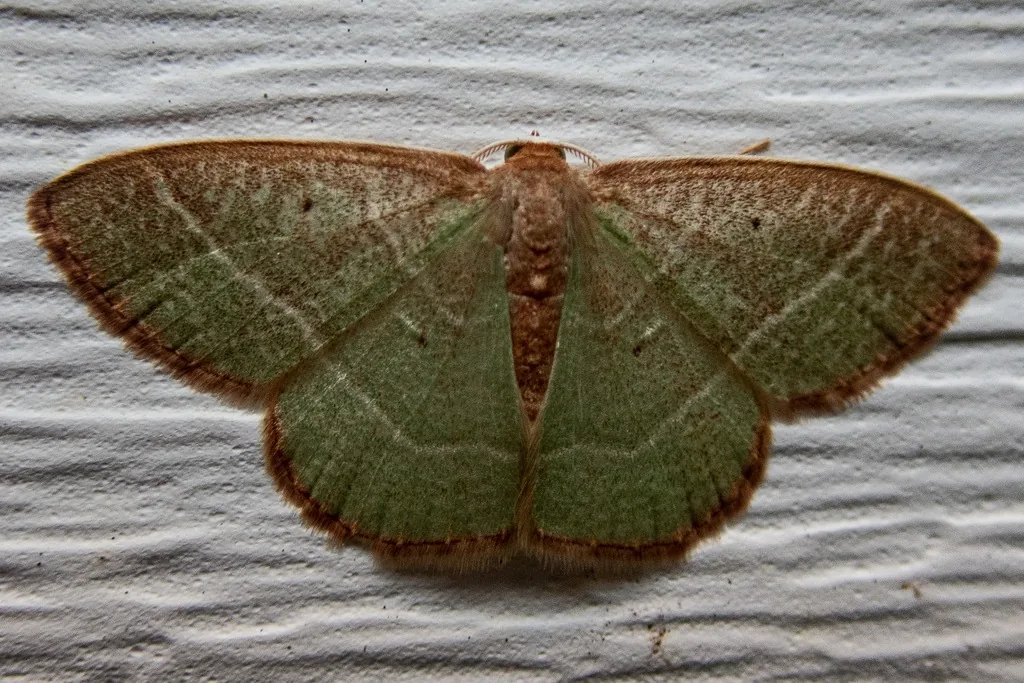
- Both seasonal forms have two thin white lines across the wings, running parallel to the outer edges and flowing unbroken from the forewings onto the hindwings.[1]
- Summer adults are green, and their wing edges can carry a pink or pink-checkered fringe. Spring adults are tan.[1]
- The abdomen has white spots that are usually outlined in red. The wingspan is 3/4 to 1 inch.[1]
- The caterpillar is grayish, brownish or tan, with a pair of finlike projections on each segment. Its slight fuzziness makes it look like a scrap of dead leaf, and resting motionless on the edge of a dying leaf it is perfectly camouflaged.[1]
Look-alikes
| Look-alike | How to tell them apart |
|---|---|
| Wavy-lined emerald | Very similar, but its wing fringe is pale green rather than reddish, and it has an unbroken white stripe along the top of the abdomen instead of red-ringed white spots.[1] |
| Southern emerald | Similar to the wavy-lined emerald, but its wing lines are scalloped instead of wavy. The Missouri Department of Conservation notes the emerald subfamily has some 62 species in 12 genera north of Mexico, and they all look very similar.[1] |
Where it lives
In Missouri it is found in most wooded areas, because white oaks are common there. GBIF holds 4057 U.S. records since 1990 from 43 state-level areas, the most from Vermont (478), Maryland (386) and Ohio (385).[1][3]
Biology and life cycle
The caterpillars eat white oak and possibly other oaks, black walnut and river birch.[1]
Adults fly at night from April into September, with two or more broods a year.[1]
Caterpillars in this genus can change their disguise with the seasons. In the related Nemoria arizonaria, spring caterpillars feeding on oak catkins grew into catkin mimics, while summer caterpillars, hatching after the catkins had fallen, grew into twig mimics. Diet was the switch: caterpillars raised on low-tannin catkins became catkin forms, and those raised on high-tannin leaves became twig forms.[2]
Damage and signs
- The caterpillars graze oak leaves. The Missouri Department of Conservation describes no damage to trees and does not treat the moth as a pest.[1]
Health risk
The Missouri Department of Conservation mentions no bite, sting or other risk to people or pets.[1]
Control
Prevention
No control is recommended. The Missouri Department of Conservation notes that every stage, from egg to adult, is food for predators.[1]
Common questions
- Why are some red-fringed emeralds tan instead of green?
- The species has two seasonal forms. Adults that emerge in spring are tan, and those that emerge in summer are green.[1]
- Why do I find little green moths on my house in the morning?
- They may be red-fringed emeralds. Like most moths they are active at night and attracted to lights, and the Missouri Department of Conservation notes you may find them perched on the side of your house near lights in the morning.[1]
- What do the caterpillars look like?
- Grayish, brownish or tan inchworms with a pair of finlike projections on each segment; they look like bits of dead leaf when they rest on a leaf edge.[1]
- Why do moths gather at my lights?
- The Missouri Department of Conservation says biologists believe night-flying insects steer by a distant bright object like the moon, and bright, close artificial lights confuse that navigation.[1]
Sources
- Missouri Department of Conservation, “Red-Fringed Emerald (Field Guide).” mdc.mo.gov/discover-nature/field-guide/red-fringed-emerald (accessed 2026-11-12)
- Science 1989;243(4891):643-6, via PubMed, “A diet-induced developmental polymorphism in a caterpillar.” pubmed.ncbi.nlm.nih.gov/17834231/ (accessed 2026-11-12)
- Global Biodiversity Information Facility (GBIF), “Nemoria bistriaria: U.S. occurrence records since 1990 by state (GBIF occurrence search).” api.gbif.org/v1/occurrence/search?taxonKey=1981277&country=US&hasGeospatialIssue=false&occurrenceStatus=PRESENT&year=1990%2C2026&facet=stateProvince&facetLimit=400&limit=0 (accessed 2026-11-12)
- iNaturalist, “Nemoria bistriaria taxon page (order and family).” www.inaturalist.org/taxa/203831 (accessed 2026-11-09)