On this page
How to identify it
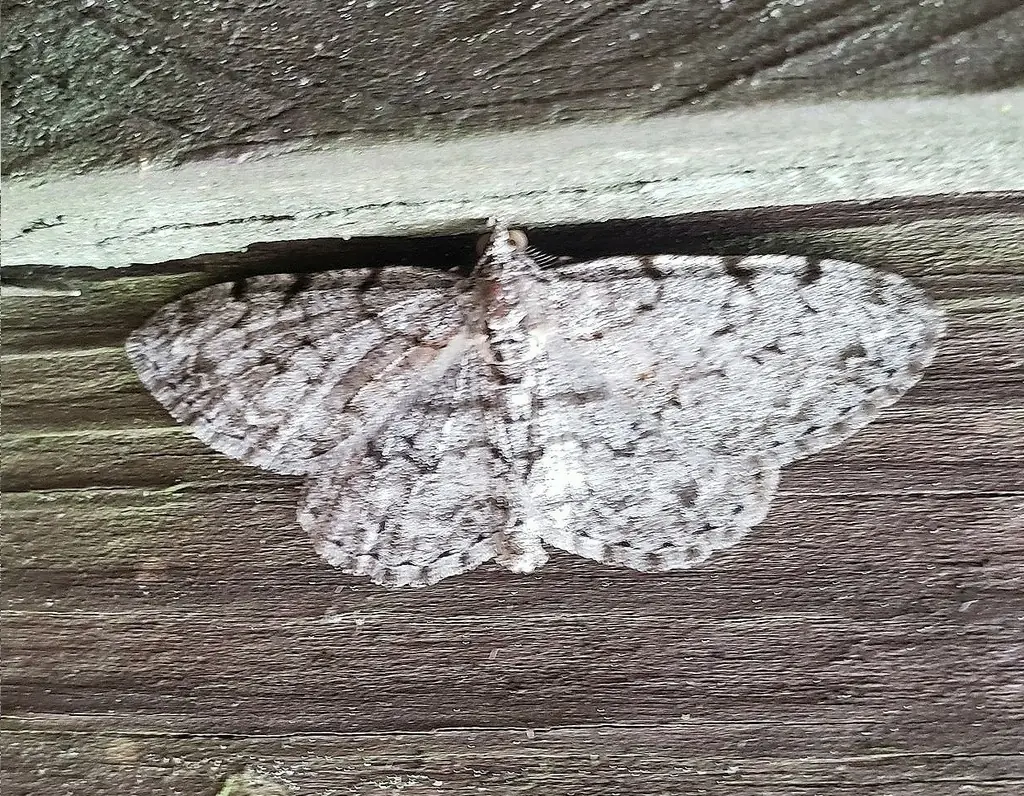
- The wings are usually gray or whitish and sprinkled with tiny brown specks, though some moths are lighter, darker, or more tan or brownish. MDC gives the wingspan as about 1 1/4 inches; Fontenelle Forest naturalists give 1 to 1.5 inches.[1][2]
- Several dark brown and gray lines cross the wings, curving roughly parallel to the outer edge. At least one of them has a toothed edge, with small triangular teeth pointing toward the wing margin.[1]
- Like other geometrids, it rests with its wings held flat out to the sides, and its markings run across all four wings without a break.[1]
- The caterpillar, called the dash-lined looper, is slender and blotched gray, tan and brown, sometimes greenish, with wrinkles, bumps and dots that make it look like a twig. It rests stiff and straight at about a 45-degree angle to a branch and walks like an inchworm.[1]
- Grown caterpillars are a little under 1 inch long (up to 25 mm). Up close, the gray head carries a cream herringbone pattern, the first six abdominal segments show a white plus sign and a dark Y on the back, and a row of conspicuous white rectangles runs along each side.[1][3]
Look-alikes
| Look-alike | How to tell them apart |
|---|---|
| Other gray geometrid moths | Many grayish-brown, mottled geometrids are confusingly similar. Telling them apart takes a close look at details such as the dark spots along the front edge of the forewing and the placement of other spots.[1] |
| Saddleback looper (Ectropis crepuscularia) | The University of Alberta museum says its wing pattern is very similar, but in the porcelain gray the dark patch near the outer part of the forewing is usually fainter or missing, and males have much more strongly feathered (pectinate) antennae.[4] |
Where it lives
Natural Resources Canada reports it throughout British Columbia, north to the Yukon, east to Newfoundland and south to Texas and Florida; the University of Alberta museum gives southern Northwest Territories to Texas and Florida. The Missouri Department of Conservation describes it as widespread in eastern North America and found statewide in Missouri. GBIF holds 8844 U.S. records since 1990, the most from Pennsylvania (851), New York (814) and Massachusetts (806); in Alberta it is generally common in mixedwood forests.[3][4][1][5]
Biology and life cycle
In Missouri its most widespread hosts are eastern red cedar and pines and other conifers, many of them cultivated; it is also reported on sugar maple, soapberry, birches, elms, oaks and poplars. Elsewhere the caterpillars eat firs, spruces, hemlocks, tamarack and larch, and various cedars.[1]
Natural Resources Canada names Douglas-fir as the principal host, with Engelmann, white, Sitka and black spruce, western hemlock, western redcedar, subalpine, grand and amabilis fir, western larch, tamarack and several hardwoods also eaten.[3]
It spends the winter as a partly grown caterpillar in its next-to-last larval stage. The caterpillars start feeding again on tender new growth when spring warms up and finish by about June.[1][3]
In Missouri the caterpillars pupate in May or June. Natural Resources Canada gives pupation from late June into July, with the moths emerging in July.[1][3]
Females lay their eggs on host trees in midsummer; Natural Resources Canada reports up to 150 eggs per female, laid in July. The University of Alberta museum says the eggs are laid in large clusters at the base of conifer needles or on the underside of hardwood leaves and hatch in about one week. The young caterpillars feed in August and September, then shelter for the winter, often fully exposed on the branches.[1][3][4]
The caterpillars feed alone and move about freely on the foliage.[3]
Adults are on the wing from spring into autumn, and Missouri has one or two generations a year. Fontenelle Forest naturalists give a May to September flight in Nebraska, and the University of Alberta museum gives a peak in late June to early July in Alberta.[1][2][4]
Damage and signs
Health risk
None of the sources (Missouri Department of Conservation, Natural Resources Canada, the University of Alberta museum, Fontenelle Forest naturalists) mentions any bite, sting or other risk to people.[1][3][4][2]
Control
Prevention
No source recommends any control. Natural Resources Canada describes the species as innocuous, and the University of Alberta museum lists it as not of conservation concern and generally common.[3][1][4]
Common questions
- What is a dash-lined looper?
- It is the caterpillar of the porcelain gray moth: a slender, twig-colored inchworm that rests stiffly at an angle on red cedar, pines and other trees.[1]
- Will dash-lined loopers hurt my evergreens?
- They eat the needles and leaves of many conifers and hardwoods, but Natural Resources Canada describes the species as a common, innocuous defoliator that feeds singly.[3][1]
- Why do I find these moths by my porch light in the morning?
- Like most moths, porcelain grays are drawn to lights at night, and the Missouri Department of Conservation suggests checking around lights that stayed on overnight to see which moths are resting nearby.[1]
- Is the porcelain gray the same as the saddleback looper moth?
- No, but they look very alike. The University of Alberta museum separates them by the fainter dark patch on the porcelain gray's forewing and the male's more feathery antennae.[4]
Sources
- Missouri Department of Conservation, “Porcelain Gray (Field Guide).” mdc.mo.gov/discover-nature/field-guide/porcelain-gray (accessed 2026-11-12)
- Fontenelle Forest (Nebraska), volunteer naturalists, “Porcelain Gray (NatureSearch).” ffnaturesearch.org/porcelain-gray (accessed 2026-11-12)
- Natural Resources Canada, Canadian Forest Service, “Protoboarmia porcelaria (Trees, insects and diseases of Canada's forests).” tidcf.nrcan.gc.ca/en/insects/factsheet/9021 (accessed 2026-11-12)
- University of Alberta, E.H. Strickland Entomological Museum, “Species Details: Protoboarmia porcelaria.” search.museums.ualberta.ca/g/2-4670 (accessed 2026-11-12)
- Global Biodiversity Information Facility (GBIF), “Protoboarmia porcelaria: U.S. occurrence records since 1990 by state (GBIF occurrence search).” api.gbif.org/v1/occurrence/search?taxonKey=4302230&country=US&hasGeospatialIssue=false&occurrenceStatus=PRESENT&year=1990%2C2026&facet=stateProvince&facetLimit=400&limit=0 (accessed 2026-11-12)
- iNaturalist, “Protoboarmia porcelaria taxon page (order and family).” www.inaturalist.org/taxa/143867 (accessed 2026-11-08)