On this page
How to identify it
- Grown caterpillars are about 1.18 inches long (UMass); Natural Resources Canada gives up to 30 mm for the western form.[1][2]
- Descriptions of the caterpillar differ by source and form. UMass describes a black band with white teardrop-shaped spots along the body; Natural Resources Canada describes the western hemlock looper as light to dark gray with alternating gray to cream lines, four dark spots on the back of each abdominal segment and a brown head with eight black spots.[1][2]
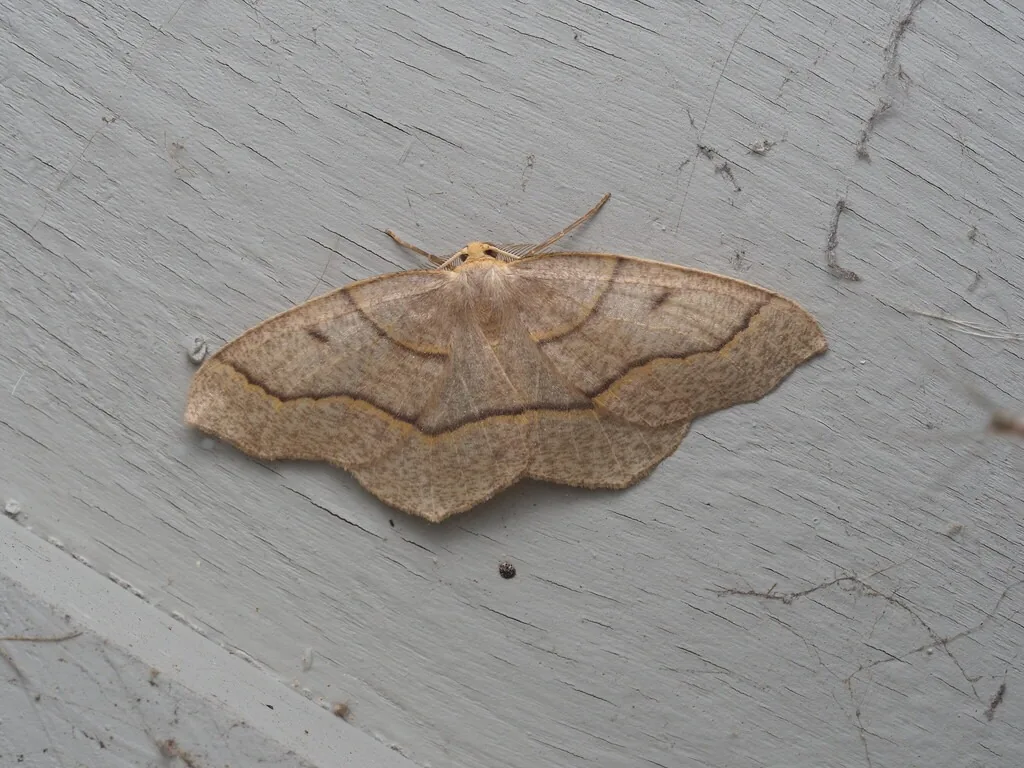
- Moths are small and tan to gray-brown, with a wingspan of about 1.25 inches. When numbers are high, many moths can be found mating and resting at the base of trees and on nearby plants.[1]
- Feeding is wasteful: caterpillars nip needles without eating them whole, the damaged needles turn brown, and a mat of clipped needles can collect under the tree.[1][2]
Look-alikes
| Look-alike | How to tell them apart |
|---|---|
| Phantom hemlock looper | Another hemlock inchworm in western Canada. Its grown caterpillar is yellowish green with white and yellow stripes and a green head with ten black spots; the western hemlock looper is gray with cream lines and four dark spots on each abdominal segment.[3][2] |
Where it lives
A native defoliator found in Canada and the United States, with a western form (L. f. lugubrosa) in British Columbia. GBIF has about 4,300 U.S. records since 1990, the most from Vermont, Massachusetts, Maine, New York, New Hampshire and Washington, and more records from Canada (about 6,300) than from the United States.[1][2][4][5]
Biology and life cycle
Tiny eggs, about 1 mm, are laid singly on the bark of trunks and limbs (on moss, lichens or bark, per Natural Resources Canada) and spend the winter there. They hatch in late May or early June.[1][2]
The eggs are highly cold-hardy: their mean supercooling point stays below -30 C from October through spring and drops as low as -47 C in February.[6]
Young caterpillars feed on new needles, then move to older foliage. There are four or five larval stages depending on the population; a Quebec island population reared on balsam fir had four, a mainland population five.[1][2][7]
From late July they drop to pupate without a cocoon in bark cracks at the base of the tree or in debris on the ground, and the moths emerge in September and October.[1][2]
Damage and signs
- Hemlock and balsam fir are preferred; larch, spruce and arborvitae are also fed on, and deciduous hosts such as sugar maple and white birch have been reported.[1]
- By midsummer the outer shoots can be stripped bare, and heavy populations can defoliate trees completely. Hemlock can die after a single year of defoliation and fir after one or two years.[1]
- Deciduous trees are rarely killed. In western Canada the damage falls mostly on mature stands, where severe defoliation causes growth loss, top-kill and death.[1][2]
- In New England, looper larvae fed foliage infested with the invasive hemlock woolly adelgid pupated earlier and heavier than larvae fed uninfested foliage from susceptible hemlocks, so the two pests may compound each other.[8]
Health risk
None of the sources mentions any effect on people or pets; they treat it only as a defoliator of conifers.[1][2]
Control
Prevention
From June 1 to July 1, tap or shake branches of hemlock and balsam fir weekly over a light-colored sheet or upside-down umbrella and look for fallen caterpillars and notched needles.[1]
Biological control
Many egg, larval and pupal parasites, fungal diseases, a virus and predators attack the hemlock looper. Historically, populations stay heavy for 2 to 3 years and then virtually disappear.[1]
Pesticides
Bacillus thuringiensis subsp. kurstaki is listed for hemlock looper and is toxic to its caterpillars in laboratory tests. UMass advises reduced-risk products that spare the natural enemies.[1][9]
Common questions
- Why are my hemlock's needles browning and piling up under the tree?
- Hemlock looper caterpillars nip needles wastefully, leaving browned foliage and a mat of clipped needles below.[1]
- How do I check my hemlocks for loopers?
- From June 1 to July 1, shake branches weekly over a light-colored sheet or upside-down umbrella and look for small inchworms. Outbreaks rise fast and patchily, which is why foresters rely on surveys of eggs.[1][10]
Sources
- UMass Extension Landscape, Nursery and Urban Forestry Program (Landscape Insect & Mite Guide), “Lambdina fiscellaria and L. athasaria (Hemlock Looper).” www.umass.edu/agriculture-food-environment/landscape/publications-resources/insect-mite-guide/lambdina-fiscellaria-lambdina-athasaria (accessed 2026-11-11)
- Natural Resources Canada, Canadian Forest Service, “Western hemlock looper, Lambdina fiscellaria lugubrosa (Trees, insects and diseases of Canada's forests).” tidcf.nrcan.gc.ca/en/insects/factsheet/1000002 (accessed 2026-11-11)
- Natural Resources Canada, Canadian Forest Service, “Phantom hemlock looper (Trees, insects and diseases of Canada's forests).” tidcf.nrcan.gc.ca/en/insects/factsheet/1000004 (accessed 2026-11-11)
- Global Biodiversity Information Facility (GBIF), “Lambdina fiscellaria: U.S. occurrence records since 1990 by state (GBIF occurrence search).” api.gbif.org/v1/occurrence/search?taxonKey=1962900&country=US&hasGeospatialIssue=false&occurrenceStatus=PRESENT&year=1990%2C2026&facet=stateProvince&facetLimit=400&limit=0 (accessed 2026-11-11). Exact count at access: 4,254 U.S. records since 1990 (Vermont 798; Massachusetts 644; Maine 468; New York 432; New Hampshire 355; Washington 343).
- Global Biodiversity Information Facility (GBIF), “Lambdina fiscellaria: occurrence records since 1990 by country (GBIF occurrence search).” api.gbif.org/v1/occurrence/search?taxonKey=1962900&hasGeospatialIssue=false&occurrenceStatus=PRESENT&year=1990%2C2026&facet=country&limit=0 (accessed 2026-11-11). Exact counts at access: 10,528 records since 1990; Canada 6,269, United States 4,254.
- Journal of Insect Physiology, via PubMed, “Effect of temperature and host tree on cold hardiness of hemlock looper eggs along a latitudinal gradient (Rochefort et al. 2011).” pubmed.ncbi.nlm.nih.gov/21356214/ (accessed 2026-11-11)
- Bulletin of Entomological Research, via PubMed, “Geographic biotype and host-associated local adaptation in a polyphagous species, Lambdina fiscellaria, feeding on balsam fir (Hebert et al. 2006).” pubmed.ncbi.nlm.nih.gov/17201980/ (accessed 2026-11-11)
- Insects, via PubMed, “Impact of an Invasive Insect and Plant Defense on a Native Forest Defoliator (Wilson et al. 2016).” pubmed.ncbi.nlm.nih.gov/27649247/ (accessed 2026-11-11)
- Journal of Invertebrate Pathology, via PubMed, “Comparative toxicity of the HD-1 and NRD-12 strains of Bacillus thuringiensis subsp. kurstaki to defoliating forest Lepidoptera (van Frankenhuyzen et al. 1992).” pubmed.ncbi.nlm.nih.gov/1607666/ (accessed 2026-11-11)
- Journal of Economic Entomology, via PubMed, “Oviposition traps to survey eggs of Lambdina fiscellaria (Delisle et al. 2003).” pubmed.ncbi.nlm.nih.gov/12852615/ (accessed 2026-11-11)
- iNaturalist, “Lambdina fiscellaria taxon page (order and family).” www.inaturalist.org/taxa/154446 (accessed 2026-10-06)