On this page
How to identify it
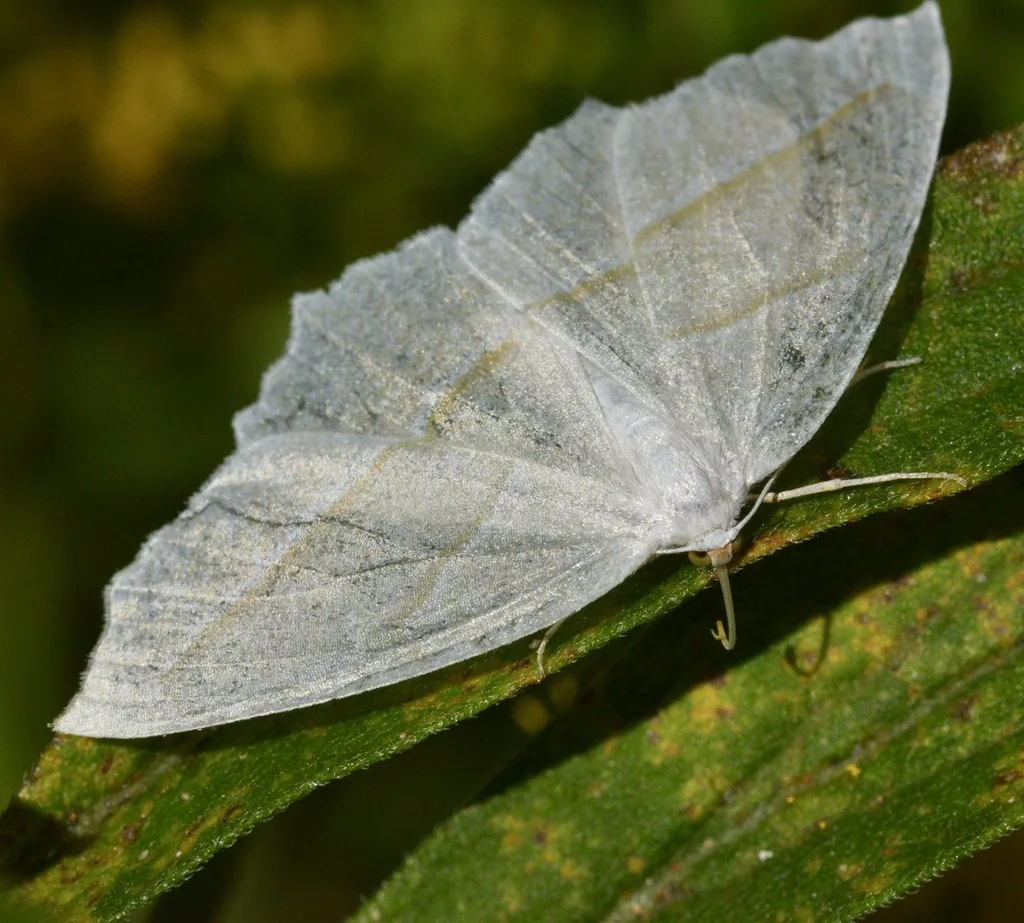
- The adult is a light-colored moth.[1]
- The caterpillar is an inchworm, and two features set it apart from other inchworms: an extra, reduced pair of prolegs on the fifth abdominal segment, and a fringe of short, thick, pale hairs along the lower sides of the abdomen.[4][2][3]
- Its color ranges from gray to brick red or reddish brown, less often smoky green. A dark band runs at a slant across the head from the top down to the eye, and each tan breathing pore (spiracle) is ringed with black.[2][3]
- The underside is noticeably flattened and pale, green down the middle and frosty toward the fringe, and the top of the eighth abdominal segment has small warts. Full-grown caterpillars reach about 4 cm.[2][3]
Look-alikes
| Look-alike | How to tell them apart |
|---|---|
| Other loopers (inchworms) | Almost all geometrid caterpillars in the East have a single pair of prolegs in the middle of the body, on the sixth abdominal segment. The fringed looper has an extra, reduced pair on the fifth segment, plus its fringe of pale hairs.[2][3] |
| Underwing moth caterpillars (Catocala) | Underwing caterpillars also rest on bark and have a similar fringe of pale hairs, thickened at their bases, along the lower sides; this fringe is common among bark-resting caterpillars. Underwings are noctuid caterpillars without the looper's way of walking.[2] |
Where it lives
The National Park Service's species database lists it for Great Smoky Mountains National Park, as the pale beauty moth. GBIF holds 20212 U.S. records since 1990 from 47 state-level areas, the most from New York (2,143), Massachusetts (1,737), Pennsylvania (1,714) and Michigan (1,669). The USDA Forest Service describes it as transcontinental in Canada, reaching south in the East to Georgia (in the mountains) and Arkansas, in forests, woodlands and parks.[5][6][2]
Biology and life cycle
The caterpillars make hyperactive antifreeze proteins. In laboratory measurements they showed a freezing point depression of 6.4 °C, and researchers purified two new antifreeze proteins with no match among known protein sequences.[4]
In a 1968 experiment, pale beauty moths offered black and white backgrounds rested on the background that suited their light color, and painting the scales around their eyes didn't change the choice, which suggests the preference is inborn.[1]
The caterpillars eat many woody shrubs and trees, including alder, aspen, birch, cherry, hazelnut, maple, oak, rose, serviceberry and willow, and conifers such as fir, hemlock and larch. Caterpillars of Eastern Forests singles out maples.[2][3]
There are two generations a year in the North. In Connecticut, caterpillars that spent the winter mature from May into June, and the summer generation matures in July and August; in Maryland the first generation can mature as early as April and the second runs from late June into September.[2][3]
Damage and signs
Health risk
The two research papers, the National Park Service record and the two USDA Forest Service caterpillar guides don't mention any bite, sting or other risk to people or pets.[4][1][5][2][3]
Control
Prevention
None of the sources read for this page recommends any control, including the two USDA Forest Service caterpillar guides.[4][1][5][2][3]
Where the sources disagree
English name: BAMONA calls it the pale beauty and the National Park Service the pale beauty moth; GBIF's English name is fringed looper.[7][5][8]
Year of description: BAMONA gives Guenée, 1857; the National Park Service record gives 1858; GBIF gives no year.[7][5][8]
Caterpillar season: Caterpillars of Eastern Forests gives June to November, with two generations in the North; the geometroid guide has overwintered caterpillars maturing from May into June in Connecticut and first-generation caterpillars maturing as early as April in Maryland.[3][2]
Common questions
- How do pale beauty caterpillars cope with cold?
- They make hyperactive antifreeze proteins: in laboratory measurements the caterpillars showed a freezing point depression of 6.4 °C. In Connecticut, caterpillars that spent the winter finish maturing from May into June.[4][2]
- Is the pale beauty the same as the fringed looper?
- Yes. GBIF lists Campaea perlata under the English name fringed looper; BAMONA and the National Park Service call it the pale beauty.[8][7][5]
- What is the gray inchworm with a fringe along its sides on my maple?
- Probably a fringed looper, the caterpillar of the pale beauty. Check for a fringe of pale hairs along the lower sides and an extra pair of small prolegs in front of the usual ones.[2][3]
- What trees do fringed loopers eat?
- Many: maples especially, plus alder, aspen, birch, cherry, hazelnut, oak, rose, serviceberry and willow, and conifers such as fir, hemlock and larch.[2][3]
Sources
- Science (via NCBI PubMed), “Cryptic moths: effects on background selections of painting the circumocular scales (T. D. Sargent; Science 159(3810): 100-101, 1968; abstract).” pubmed.ncbi.nlm.nih.gov/17737484/ (accessed 2026-11-14). Cited from the abstract, read through NCBI E-utilities.
- USDA Forest Service, Forest Health Technology Enterprise Team, “Geometroid Caterpillars of Northeastern and Appalachian Forests, FHTET-2001-10 (D. L. Wagner, D. C. Ferguson, T. L. McCabe and R. C. Reardon, September 2001; scanned copy).” archive.org/details/geometroidcaterp00wagn (accessed 2026-11-14). Scanned copy at archive.org; read from archive.org's full-text (djvu.txt) version.
- USDA Forest Service, Forest Health Technology Enterprise Team, “Caterpillars of Eastern Forests, FHTET-96-34 (D. L. Wagner, V. Giles, R. C. Reardon and M. L. McManus, 1997; scanned copy).” archive.org/details/caterpillarsofea001997 (accessed 2026-11-14). Scanned copy at archive.org; read from archive.org's full-text (djvu.txt) version.
- Biochemistry (via NCBI PubMed), “The Thr- and Ala-rich hyperactive antifreeze protein from inchworm folds as a flat silk-like beta-helix (F.-H. Lin, P. L. Davies and L. A. Graham; Biochemistry 50(21): 4467-4478, 2011; abstract).” pubmed.ncbi.nlm.nih.gov/21486083/ (accessed 2026-11-14). Cited from the abstract, read through NCBI E-utilities.
- National Park Service, NPSpecies (IRMA), “NPSpecies species profile: Campaea perlata, Great Smoky Mountains National Park (GRSM).” irma.nps.gov/NPSpecies/Species/Profile/211538 (accessed 2026-11-14). Federal (U.S. National Park Service) park species record: Park Accepted, Record Status Approved, park common name Pale Beauty Moth.
- Global Biodiversity Information Facility (GBIF), “Campaea perlata: U.S. occurrence records since 1990 by state (GBIF occurrence API).” api.gbif.org/v1/occurrence/search?taxonKey=1978751&country=US&hasGeospatialIssue=false&occurrenceStatus=PRESENT&year=1990%2C2026&facet=stateProvince&facetLimit=400&limit=0 (accessed 2026-11-14). 20,212 records from 47 state-level areas; New York 2,143, Massachusetts 1,737, Pennsylvania 1,714, Michigan 1,669; fetched 2026-11-13.
- Butterflies and Moths of North America (BAMONA), “Pale Beauty, Campaea perlata (Guenée, 1857).” www.butterfliesandmoths.org/species/Campaea-perlata (accessed 2026-11-14). Cited only for the name shown; the page's text fields are empty.
- Global Biodiversity Information Facility (GBIF), “Campaea perlata (Guenée) (GBIF Backbone Taxonomy).” api.gbif.org/v1/species/1978751 (accessed 2026-11-14). ACCEPTED; order Lepidoptera, family Geometridae; vernacular name Fringed Looper