On this page
How to identify it
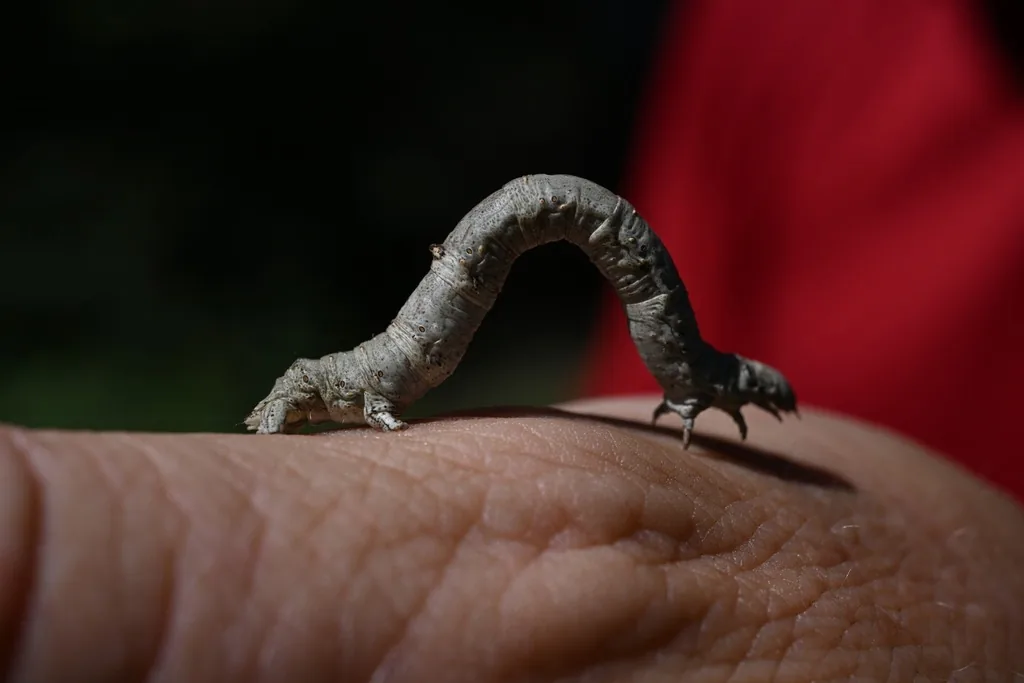
- A large, very smooth looper, almost black when newly hatched and chocolate brown as it grows, about 2.5 inches (64 mm) long when mature; USDA Forest Service guides describe the color as greenish or tan to dark purple-brown, or gray to brown to purplish brown.[1][3][4]
- The second thoracic segment is swollen, with a long thin ridge on top bearing a dark band and usually orange or red spots; UMass describes a noticeable dark ridge with a few low bumps crossing the back. There are large bumps on the fourth abdominal segment and smaller ones on the eighth, often blackened.[3][4][1]
- The small spiracles are tan to orange and rimmed with black, and the paraprocts stick out past the anal shield.[3][4]
- The adult is a light gray moth marked with rusty brown with a wingspan of about 2 inches.[1]
Look-alikes
| Look-alike | How to tell them apart |
|---|---|
| Brown spanworm (cranberry spanworm moth) | The common brown looper of cranberry bogs is much smaller, a little over an inch when full grown, with a 1-inch moth; the curved-toothed geometer reaches 2.5 inches and has the swollen collar and bumpy dorsal ridge.[1] |
| Prochoerodes lineola | A USDA Forest Service guide says the caterpillar is most likely to be confused with Prochoerodes lineola; the curved-toothed geometer has a dark band on the thoracic ridge that Prochoerodes lineola lacks.[4] |
| Cutworms on cranberry | UMass advises counting great cranberry spanworm with the cutworms in sweep-net samples because of its size, but mature cutworms feed at night and hide by day, while spanworms are slender, hairless loopers with only two pairs of hind legs that feed openly.[1] |
Where it lives
A USDA Forest Service guide gives its range as Newfoundland to Minnesota, south to Florida and Texas, and calls it common throughout the eastern US. GBIF holds about 18,400 records, about 14,300 from the US and about 4,000 from Canada; its US records since 1990 (about 13,600) come from 37 states, most from Alabama, North Carolina and Texas. On Massachusetts cranberry bogs it occurs in distinct patches.[4][6][2][1]
Biology and life cycle
Moths emerge in late May on Massachusetts bogs, and egg clusters that may contain hundreds of eggs hatch toward mid-June; the larvae mature and pupate in July. A USDA oak guide records up to 491 eggs and says larvae on cranberry mature in 47 days.[1][4]
Caterpillars pupate between leaves or in a slight cocoon at the soil surface. The number of generations and the caterpillar season differ by source and region (see Where the sources disagree).[4][1][3]
Food plants include many forest trees and shrubs, softwoods among them; the oak guide's host list runs from fir, spruce and hemlock to maple, birch, cherry, oak, poplar, willow, sassafras, viburnum and blueberry.[3][4]
At rest the caterpillar holds its legs tight against the body, or presses its head and legs together so the front end looks like a fist.[4]
Damage and signs
- On cranberry the larvae prefer to sever flower buds and blossoms. The species usually occurs in distinct patches and can be particularly destructive on rare occasions.[1]
- In woodlands it is a general feeder on hardwoods and conifers; the USDA Forest Service guides record its food plants but describe no outbreak damage.[3][4]
Health risk
The sources describe it only as a plant feeder; no cited source describes any risk to people or pets.[1][3]
Control
Prevention
For woodlands and yards the USDA Forest Service guides give no control advice; they treat it as a common caterpillar of eastern forests.[3][4]
Traps and physical control
On cranberry bogs, scout with a sweep net and, because of the larva's large size, count it along with the cutworms, where UMass's threshold is an average of more than 4 to 5 per 25 sweeps.[1]
Pesticides
Spot treating infested patches with a backpack sprayer has been highly effective and saves treating larger acreage that is not heavily infested. Bacillus thuringiensis products work against spanworms while they are small; larger caterpillars are much harder to control with any spray.[1]
Where the sources disagree
Generations: UMass reports one generation a year on cranberry; the Caterpillars of Eastern Forests guide gives two; the Missouri oak guide says two are common from Pennsylvania southward.[1][3][4]
Overwintering: UMass says it overwinters as a pupa; the Missouri oak guide says it overwinters as an adult or a pupa.[1][4]
Caterpillar season: the Caterpillars of Eastern Forests guide gives June to October; the Missouri oak guide gives June to September in Canada, most common in July in Maine, and in Missouri found only on April and May foliage; UMass has eggs hatching toward mid-June and larvae pupating in July.[3][4][1]
Common questions
- Is the curved-toothed geometer the same as the great cranberry spanworm?
- Yes. Eutrapela clemataria is the great or big cranberry spanworm of the UMass sheet and the purplish-brown looper of the USDA Forest Service caterpillar guide.[1][3]
- How big does the caterpillar get?
- UMass gives about 2.5 inches (64 mm) for mature larvae and a USDA oak guide about 60 mm; the moth's wings span about 2 inches.[1][4]
- Why can it be hard to spot on a twig?
- It mimics a twig, and at rest it holds its legs tight against its body or presses head and legs together like a fist.[4]
- Does it need control in a yard or woodlot?
- The USDA Forest Service guides give no control advice for woodlands; only on cranberry bogs does UMass describe patch damage worth treating.[3][4][1]
Sources
- UMass Amherst Cranberry Station, Center for Agriculture, Food, and the Environment, “Confusing Spring Caterpillars in Cranberry (1999) (UMass Cranberry Station fact sheet).” www.umass.edu/agriculture-food-environment/cranberry/fact-sheets/confusing-spring-caterpilars-in-cranberry-1999 (accessed 2026-11-13)
- Global Biodiversity Information Facility (GBIF), “Eutrapela clemataria: U.S. occurrence records since 1990 by state (GBIF occurrence search).” api.gbif.org/v1/occurrence/search?taxonKey=5148520&country=US&hasGeospatialIssue=false&occurrenceStatus=PRESENT&year=1990%2C2026&facet=stateProvince&facetLimit=400&limit=0 (accessed 2026-11-13)
- USDA Forest Service, Forest Health Technology Enterprise Team, “Caterpillars of Eastern Forests, FHTET-96-34 (D. L. Wagner, V. Giles, R. C. Reardon and M. L. McManus, 1997).” www.fs.usda.gov/foresthealth/technology/pdfs/Caterpillars_of_Eastern_Forests.pdf (accessed 2026-11-13)
- USDA Forest Service, Forest Health Assessment and Applied Sciences Team, “Illustrated Guide to the Immature Lepidoptera on Oaks in Missouri, FHAAST-2018-05 (R. J. Marquis and others, 2019).” www.fs.usda.gov/foresthealth/technology/pdfs/FHAAST-2018-05_Immature_Lepidoptera_Oaks.pdf (accessed 2026-11-13)
- Global Biodiversity Information Facility (GBIF), “Eutrapela clemataria (Smith, 1797) (GBIF Backbone Taxonomy).” api.gbif.org/v1/species/5148520 (accessed 2026-11-13)
- Global Biodiversity Information Facility (GBIF), “Eutrapela clemataria: occurrence records by country (GBIF occurrence search).” api.gbif.org/v1/occurrence/search?taxonKey=5148520&facet=country&facetLimit=20&limit=0 (accessed 2026-11-13)