On this page
How to identify it
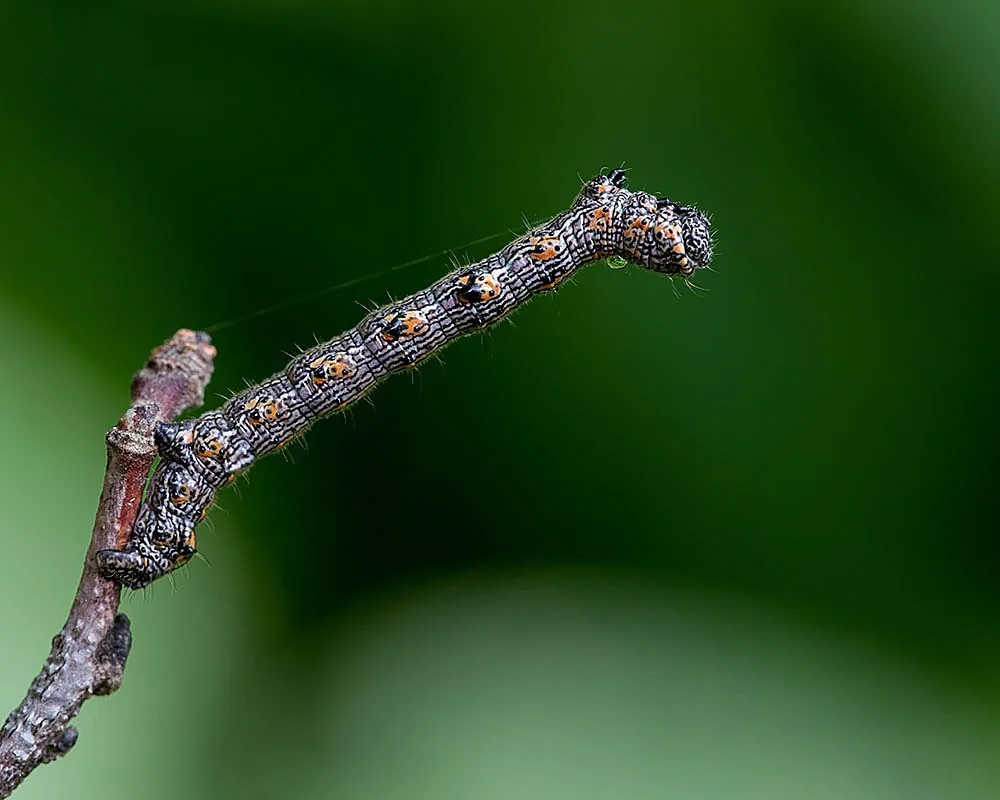
- Full-grown caterpillars are violet, pinkish-gray brown with many blackish longitudinal lines and are about 37 mm (1.5 inches) long.[2]
- The male moth spans about 1.5 inches (37 mm), with a whitish thorax, two rows of black dots down the abdomen, and forewings dotted with dark brown specks, crossed by three blackish lines and edged with a row of black spots; an entirely blackish melanic form also occurs in western Massachusetts. BAMONA describes the wings as pale powdery gray and gives a male wingspan of 3 to 4 cm.[2][1]
- The female is ash gray, unmarked and virtually wingless, with vestigial, functionless wings about 3 mm long; she cannot fly and is seldom seen.[2]
Look-alikes
| Look-alike | How to tell them apart |
|---|---|
| Green and brown cranberry spanworms | The usual cranberry spanworms are green or plain brown; UMass counts the spiny looper in with them in sweep samples but notes its patchy aggregations and warty, striped larva.[2] |
Where it lives
UMass records it from western Massachusetts and from cranberry bogs, where it appears in dense, localized patches, and describes its forest life history from Virginia and West Virginia. GBIF holds about 4,600 U.S. records since 1990 from 42 states, most from New York, Massachusetts, Texas, Connecticut, Wisconsin and Pennsylvania.[2][3]
Biology and life cycle
On forest trees in Virginia and West Virginia there is a single generation a year and winter is spent as a pupa in the soil. The larvae are reported active in May and June; on cranberry they finished feeding and burrowed into the sand to pupate in the first week of June. BAMONA gives a flight period of March and April.[2][1]
Adults emerge in early spring and climb vertical surfaces. Males appear several days to a week before the females and rest on tree trunks, where mating takes place; the flightless females then climb upward to lay their eggs, usually on dead twigs. The light-colored male is cryptic on birch bark.[2]
First-instar larvae actively balloon, hanging on silk lines below the dead twigs where the eggs were laid and riding air currents to new sites. There are five larval instars.[2]
Because the females do not fly, a patch of larvae on a cranberry bog may be the progeny of a single female that ballooned in from the uplands as a first instar, completed development, overwintered as a pupa on the bog, attracted a male and laid her eggs there; UMass found a dense aggregation on a bog edge in May 1998 and concluded the pupa can survive on the bog.[2]
Damage and signs
- BAMONA lists American basswood, American elm, blueberry, hickories, maples, oaks and poplars as caterpillar hosts.[1]
- On cranberry the larvae feed from the leaves of new growth down to the old growth and then move to adjacent new growth; some nip the stems of new shoots, which fall over, and browned tips are obvious in areas of older feeding. Patchy feeding and larval aggregation are highly characteristic.[2]
Health risk
UMass and BAMONA describe it only as a plant-feeding caterpillar and moth; neither mentions bites, stings or any effect on people or pets.[2][1]
Control
Traps and physical control
On cranberry bogs, scout early and visually inspect the vine areas where spanworms have been a problem, since larger larvae hold onto the vines and may be missed by sweeping; UMass counts the other spanworm species in with green and brown spanworms against the 18-larvae-per-25-sweeps threshold and notes that localized circular patches can be quite damaging.[2]
Biological control
Bacillus thuringiensis products are effective against cranberry spanworms when they are small; larger caterpillars are much harder to control by any type of spray.[2]
Where the sources disagree
Hosts: BAMONA's host list is trees and blueberry and does not mention cranberry; UMass records larvae feeding and completing development on cranberry bogs.[1][2]
Name: BAMONA titles its account Spiny Looper; UMass uses both spiny looper and half-wing geometer.[1][2]
Common questions
- Why is it called the half-wing?
- The female's wings are vestigial stubs about 3 mm long and functionless; she cannot fly, is ash gray and unmarked, and is seldom detected. Only the male has full wings.[2]
- How does a flightless moth reach a cranberry bog?
- As a caterpillar: newly hatched first instars balloon on silk lines from the dead twigs where the eggs were laid and ride air currents to new sites, and UMass considers that the likely route onto a bog.[2]
- What trees does the caterpillar feed on?
- BAMONA lists American basswood, American elm, blueberry, hickories, maples, oaks and poplars, and UMass describes the larvae feeding on new cranberry growth. There is a single generation a year.[1][2]
Sources
- Butterflies and Moths of North America (BAMONA), “Spiny Looper, Phigalia titea (species account).” www.butterfliesandmoths.org/species/Phigalia-titea (accessed 2026-11-13)
- UMass Amherst Cranberry Station, Center for Agriculture, Food, and the Environment, “Confusing Spring Caterpillars in Cranberry (1999) (UMass Cranberry Station fact sheet).” www.umass.edu/agriculture-food-environment/cranberry/fact-sheets/confusing-spring-caterpilars-in-cranberry-1999 (accessed 2026-11-13)
- Global Biodiversity Information Facility (GBIF), “Phigalia titea: U.S. occurrence records since 1990 by state (GBIF occurrence search).” api.gbif.org/v1/occurrence/search?taxonKey=5144386&country=US&hasGeospatialIssue=false&occurrenceStatus=PRESENT&year=1990%2C2026&facet=stateProvince&facetLimit=400&limit=0 (accessed 2026-11-13)
- Global Biodiversity Information Facility (GBIF), “Phigalia titea (Cramer, 1780) (GBIF Backbone Taxonomy).” api.gbif.org/v1/species/5144386 (accessed 2026-11-13)
- iNaturalist, “Phigalia titea taxon page (order and family).” www.inaturalist.org/taxa/209713 (accessed 2026-11-10)